Behavioral Weight Loss Therapy: Cognitive Strategies That Actually Work
 Jan, 5 2026
Most people who lose weight gain it back. Not because they lack willpower, but because they never fixed the thoughts that led them to overeat in the first place. If you’ve ever felt guilty after eating a slice of pizza, convinced yourself you’ve "ruined" your diet, or believed you "can’t ever" enjoy food again, you’re not broken-you’re caught in a cycle of distorted thinking that behavioral weight loss therapy can break.
What Behavioral Weight Loss Therapy Really Is
Behavioral weight loss therapy isn’t another diet. It’s a science-backed psychological approach that targets the thoughts behind your eating habits. Rooted in Cognitive Behavioral Therapy (CBT), it was adapted for obesity treatment in the 1980s by researchers at the University of Pennsylvania. Unlike diets that focus only on calories or exercise, CBT for weight loss looks at how your mind talks to you about food, your body, and your progress.
Think of it like this: You don’t eat because you’re hungry. You eat because you’re stressed, bored, sad, or convinced you deserve a reward after a hard day. CBT helps you spot those triggers and change the story you tell yourself about them.
A 2023 meta-analysis in Scientific Reports reviewed nine studies with over 900 participants and found that CBT led to an average BMI reduction of -1.6-while control groups saw almost no change. That’s not magic. It’s restructuring how you think.
The Five Cognitive Strategies That Deliver Results
Not all CBT techniques are created equal. Some work better than others-and the ones that stick are simple, repeatable, and grounded in real behavior.
- Cognitive Restructuring: This is the core. It’s about catching automatic negative thoughts like “I blew it,” “I’ll never be thin,” or “It’s not fair,” and replacing them with realistic ones. For example, instead of “I ate cookies, so my whole day is ruined,” you learn to say, “I had a cookie. That’s one snack. I can still make good choices the rest of the day.” Studies show this cuts emotional eating episodes by 63%.
- Self-Monitoring: Writing down what you eat and how you felt before and after isn’t about guilt-it’s about awareness. People who keep food journals lose 5-10% more weight than those who don’t. Why? Because when you see patterns-like always snacking after 8 p.m. or eating when you’re lonely-you can plan for it.
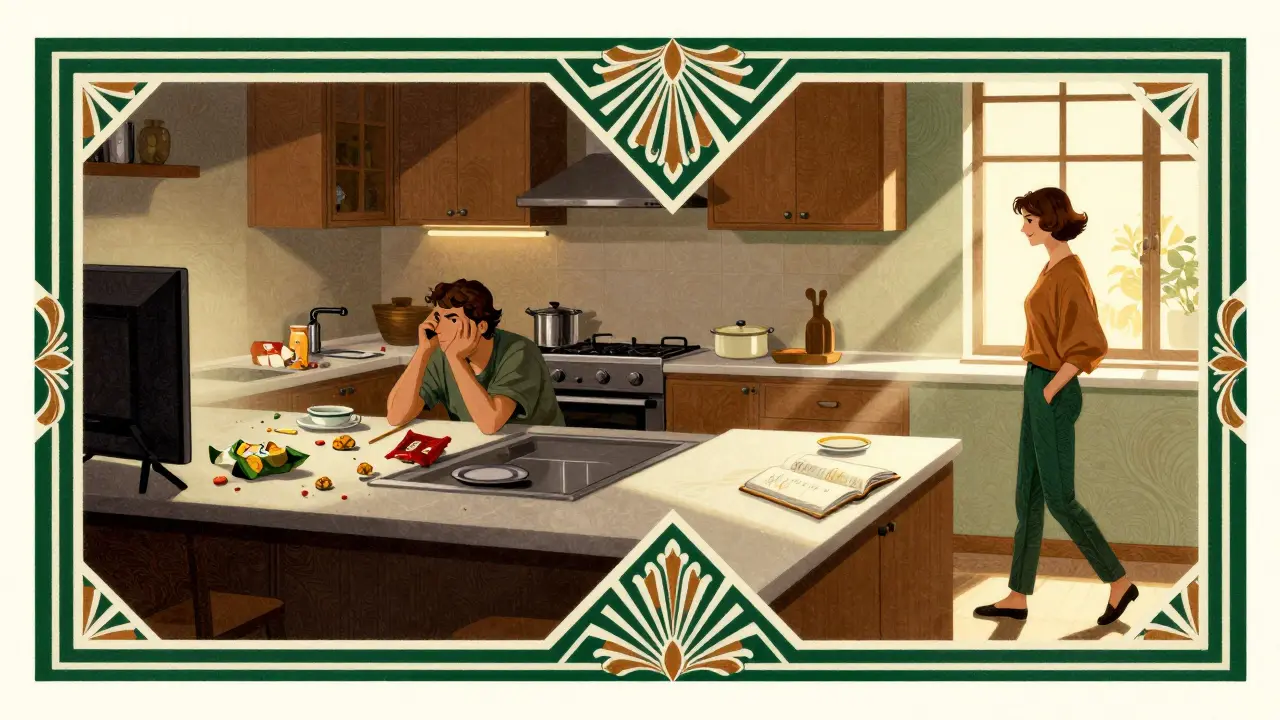
- Stimulus Control: Your environment is wired to push you toward food. Keep chips on the counter? You’ll eat them. Leave dessert on the table? You’ll take it. CBT teaches you to change your surroundings: store snacks out of sight, use smaller plates, avoid eating in front of the TV. Small changes. Big impact.
- Goal Setting (SMART Goals): “Lose weight” is not a goal. “Lose 1 pound a week by walking 30 minutes five days a week and eating protein at every meal” is. Specific, measurable, achievable, relevant, time-bound goals keep you focused. And when you hit them, you build confidence-not just in your body, but in your ability to change.
- Relapse Prevention: Slip-ups aren’t failures-they’re data. CBT prepares you for them. You learn to identify high-risk situations (parties, stress, holidays) and plan ahead. What will you do if you crave sugar after work? Will you call a friend? Go for a walk? Have a healthy snack ready? Planning reduces panic.
Why CBT Beats Dieting Alone
Diets promise quick results. CBT promises lasting change. And the numbers back it up.
A 2018 study by Jacobs and colleagues found that people using CBT lost an average of 8.2% of their body weight in six months. Those on standard diet-and-exercise plans lost 5.1%. The difference? CBT addressed the mental barriers that made sticking to diets impossible.
And it’s not just about weight. People in CBT programs report 40% reductions in depression and anxiety. That’s huge. When your mood improves, you’re less likely to turn to food for comfort. You start eating because you’re hungry-not because you’re trying to numb something.
CBT also works better for people with binge eating disorder. One study found more than half of participants no longer met the clinical criteria for BED five years after treatment. That’s not just weight loss-it’s freedom.
What Doesn’t Work (And Why)
CBT isn’t a magic bullet. And it’s not a solo mission.
Most people regain 30-35% of lost weight within the first year. Why? Because they stop using the tools. CBT isn’t something you learn once and forget. It’s a skill. Like playing guitar or learning a language-you need to practice.
Also, CBT alone doesn’t always lead to clinically significant weight loss. The NIH says it best: CBT works best when combined with other strategies. Nutrition counseling. Movement you enjoy. Even medication like GLP-1 agonists.
And here’s the kicker: online apps like Noom or WeightWatchers Beyond the Scale use CBT principles-but they’re not the same as working with a trained therapist. A 2023 JAMA Internal Medicine review found therapist-led CBT produced 6.8% weight loss. Apps? Only 3.2%. Why? Human connection matters. Trust matters. A therapist notices when you’re avoiding the truth. An app doesn’t.
Who Benefits Most From CBT for Weight Loss
CBT isn’t just for people who’ve tried every diet. It’s for people who’ve tried every diet and still feel stuck.
It’s especially powerful for:
- People with binge eating disorder
- Those who feel guilt or shame after eating
- People who struggle with emotional eating
- Anyone who’s tried to lose weight but keeps gaining it back
- Those with anxiety, depression, or low self-esteem tied to their weight
If you’ve ever thought, “I’ll start again Monday,” or “I’m just bad at this,” CBT can help you rewrite that script.

The Real Barrier: Access
Here’s the problem: there aren’t enough trained therapists.
The American Psychological Association reports only 1 CBT obesity specialist for every 125,000 eligible patients in the U.S. Most insurance plans cover only 12 sessions a year. And in rural areas, only 15% of counties have even one certified provider.
That’s why group CBT is gaining traction. A 2022 study in the Annals of Behavioral Medicine found group sessions produced the same results as individual therapy-at one-third the cost. And dropout rates drop too. People stay because they’re not alone.
Some clinics now combine CBT with nutritionists, movement coaches, and even peer support. That’s the future: integrated care.
How to Get Started
You don’t need a fancy program. Start small.
- Keep a thought journal for three days. Write down what you ate, when, and what you were feeling right before.
- Look for patterns. Do you eat when you’re tired? Alone? Stressed?
- Write down one distorted thought you’ve had about food or your body. Now, rewrite it as a realistic, kinder version.
- Choose one environmental trigger to change-maybe move snacks out of the pantry or don’t keep dessert at home.
- Set one SMART goal: “I will eat breakfast with protein three mornings this week.”
If you can afford it, find a therapist certified in CBT for obesity. The Anxiety and Depression Association of America has a directory. If not, look for group programs through hospitals, community centers, or online platforms that offer live coaching.
The Bottom Line
Weight loss isn’t about willpower. It’s about mindset. You can eat perfectly for a week. But if your inner voice still says, “You’re not good enough,” you’ll find a way back to old habits.
CBT gives you the tools to quiet that voice-not by fighting it, but by understanding it. And that’s the only kind of change that lasts.
The science is clear. The strategies are simple. The only thing standing between you and real progress isn’t your willpower. It’s whether you’re ready to change the way you think about food-and yourself.
Amy Le
January 6, 2026 AT 16:23Okay but let’s be real - if you’re not taking GLP-1s and you’re still talking about ‘cognitive restructuring,’ you’re just doing yoga with a side of kale. 🥗😂 CBT’s nice, but if your body’s screaming for pharmacology and you’re still journaling ‘I deserve this cookie,’ you’re not healing - you’re performing wellness.
Also, ‘SMART goals’? Please. I set a goal to not cry over my third slice of pizza and somehow that’s progress. 🤷♀️
Stuart Shield
January 7, 2026 AT 18:02There’s something profoundly human in how this piece ties hunger to heartache. I’ve spent years thinking I was weak because I ate when I was lonely - but what if I wasn’t broken? What if I was just… hungry for connection?
The part about ‘emotional eating as a language’ hit me like a thunderclap. We don’t need more diets. We need more mirrors that don’t lie - and therapists who don’t flinch when you say, ‘I don’t know how to stop.’
Thank you for naming the silence.
Susan Arlene
January 8, 2026 AT 19:22cbt for weight loss? sounds like therapy for people who cant stop eating but also cant stop thinking about not eating
also why is everyone so obsessed with journaling like its a cult? i ate a bag of chips. i felt sad. now what? do i write a sonnet about it? lol
Mukesh Pareek
January 9, 2026 AT 07:10CBT is merely a surface-layer intervention when metabolic dysregulation remains unaddressed. The neuroendocrine axis - particularly ghrelin-leptin signaling - is the true driver of compulsive eating patterns. Without pharmacological modulation of the hypothalamic-pituitary-adrenal axis, cognitive restructuring is just cognitive distraction.
Furthermore, the meta-analysis cited lacks stratification by insulin resistance status. You cannot treat binge eating disorder in a Type 2 diabetic cohort the same way you treat a metabolically healthy individual. This is pseudoscience dressed in behavioral garb.
Katelyn Slack
January 10, 2026 AT 16:37i tried the thought journal for 2 days and then forgot about it because i was too tired. then i ate a whole pizza and cried. then i wrote ‘i’m a failure’ in my notes app. then i deleted it. i don’t know what to do anymore.
Kiran Plaha
January 11, 2026 AT 23:23man i relate so hard to the part about eating because you’re lonely. i do it all the time. not even hungry, just… empty. like my stomach’s a hole and food’s the only thing that kinda fills it for a sec.
also i never knew stimulus control was a thing. i just thought i was bad at self-control. turns out my kitchen is just a trap.
Kelly Beck
January 13, 2026 AT 18:43YOU ARE NOT BROKEN. YOU ARE NOT BAD. YOU ARE NOT TOO SLOW OR TOO WEAK. YOU ARE A HUMAN WHO WAS TAUGHT TO EAT TO SOOTHE, AND THAT’S NOT YOUR FAULT.
Every time you write down what you felt before you ate - even if it’s just ‘sad’ or ‘bored’ - you’re rewiring your brain. Every time you move the snacks? You’re reclaiming your power. Every time you say ‘I had a cookie. That’s it. I can still choose well’? That’s victory.
Progress isn’t linear. It’s messy. It’s Tuesday pizza and Wednesday walking. It’s crying in the shower and trying again. You’re doing better than you think. I see you. I’m rooting for you. 💪❤️
Beth Templeton
January 14, 2026 AT 01:32CBT works? wow. what a revelation. next you’ll tell me water is wet and gravity exists.
also why is everyone acting like this is new? i learned this in 2008. you’re late to the party.
Tiffany Adjei - Opong
January 15, 2026 AT 19:35Okay but what if the real problem is capitalism? Why are we blaming individuals for eating when the food system is literally engineered to make us addicted? Why are we calling it ‘behavioral’ when it’s structural?
Also, the ‘therapist-led CBT’ thing? Yeah, great for people who can afford $200/hour and have insurance that doesn’t make you beg. Meanwhile, I’m on a waiting list longer than my stretch marks.
So… thanks for the science, but where’s the policy change? 🤔
Ryan Barr
January 16, 2026 AT 17:28CBT is for people who can’t afford real treatment. If you’re serious about weight loss, you get a GLP-1, not a journal.
Also, ‘SMART goals’? How quaint.
Lily Lilyy
January 17, 2026 AT 08:05Thank you for writing this with such compassion. In my community, weight loss is often seen as a moral failure - but you have shown it as a journey of healing. I have shared this with my church group and our wellness circle. We are organizing a free CBT-based support group next month. No cost. No judgment. Just people who understand.
Change begins when we stop shaming and start supporting. You have given us a map. We will walk it together.