Bipolar Disorder: How Mood Stabilizers and Antipsychotics Really Work
 Mar, 5 2026
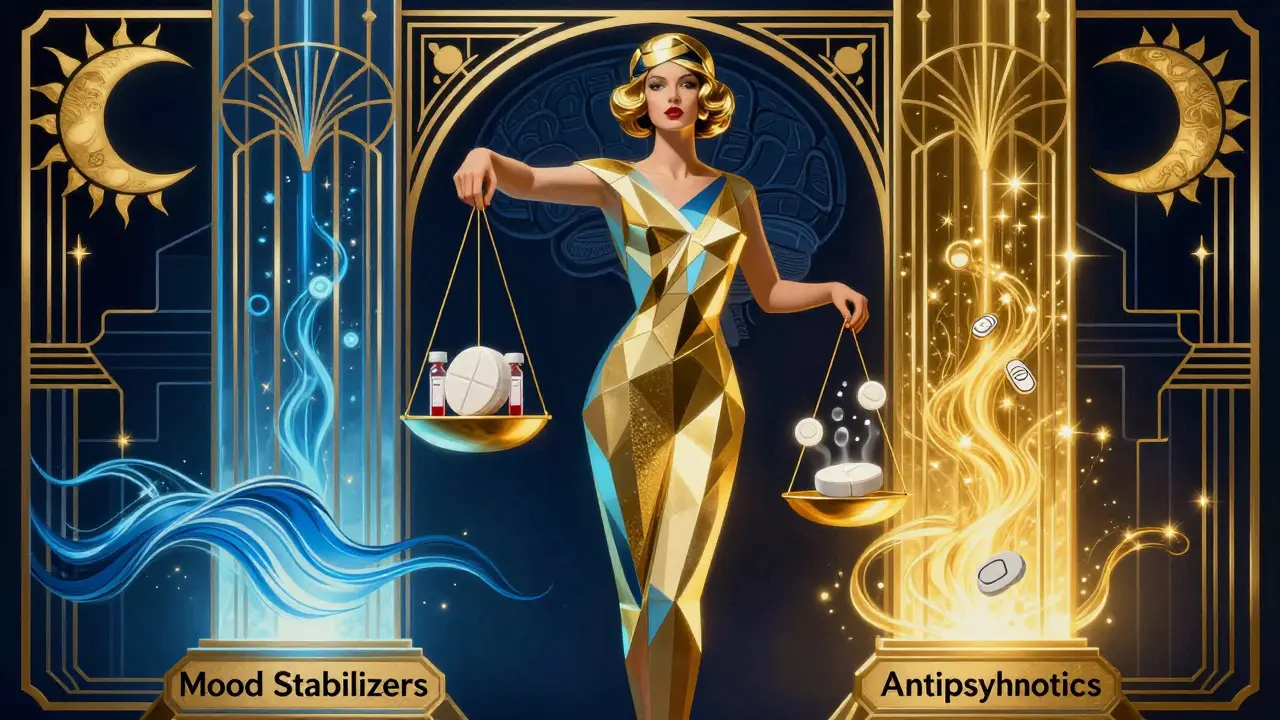
Managing bipolar disorder isn’t about finding one magic pill. It’s about balancing two kinds of medicines-mood stabilizers and antipsychotics-to keep extreme highs and lows from taking over your life. For many, this balance is hard to find. Side effects can be just as disruptive as the mood swings themselves. But with the right approach, treatment can work. Not perfectly, not always easy, but enough to make daily life possible.
What Do Mood Stabilizers Actually Do?
Mood stabilizers are the oldest and still the most trusted tools for bipolar disorder. Lithium, first approved in 1970, isn’t flashy, but it’s the most studied. It doesn’t just calm mania-it lowers suicide risk by 80% compared to no treatment. That’s not a small number. It’s life-saving.
But lithium isn’t simple. You need blood tests. Weekly at first, then every few months. The target range? Between 0.6 and 1.0 mmol/L. Too low, and it doesn’t work. Too high, and you risk toxicity-slurred speech, shaking, even seizures. Most people feel side effects: constant thirst, needing to pee every hour, hand tremors, weight gain of 10 to 15 pounds in the first year. Some quit because of it. Others stick with it because the alternative-weekly suicidal thoughts-is worse.
Other mood stabilizers include valproate, carbamazepine, and lamotrigine. Valproate works fast for mania but carries a black box warning: it can cause serious birth defects. If you’re a woman of childbearing age, this matters. Carbamazepine can interact with over 40 other drugs, including common painkillers like ibuprofen, which can push lithium levels into dangerous territory. Lamotrigine? It’s the go-to for bipolar depression. It helps 47% of people, compared to 28% on placebo. But it comes with a scary risk: a serious skin rash in about 10% of users. That’s why doctors start low and go slow.
How Antipsychotics Fit In
Antipsychotics like quetiapine, olanzapine, and aripiprazole were originally made for schizophrenia. But they turned out to be powerful for bipolar disorder too. Quetiapine got FDA approval for bipolar depression in 2006. It works faster than lithium-some people feel better in just 7 days. But it comes with a cost.
Weight gain is the big one. People on quetiapine average 22 pounds in the first year. Olanzapine? Up to 4.6kg in just 6 weeks. That’s not just about appearance. It’s about diabetes risk. Olanzapine increases type 2 diabetes risk by 20-30%. Sedation is another problem. Sixty to seventy percent of users feel so tired they can’t drive or work. Akathisia-restlessness so intense you can’t sit still-affects 15-20%. It feels like anxiety, but it’s the drug.
Still, for acute mania, antipsychotics win. Risperidone hits 68% response rate in three weeks. That’s why they’re often used early-when someone is in crisis. But long-term? They’re harder to tolerate. That’s why doctors often switch to mood stabilizers once the crisis passes.
Combining Them: When More Is Necessary
Not everyone responds to one drug alone. About 30% of people need a combo: a mood stabilizer plus an antipsychotic. This pushes response rates to 70% in treatment-resistant cases. But side effects pile up. Weight gain, drowsiness, metabolic changes-all doubled. A 2022 NAMI survey found that 45% of people stopped their meds because of side effects. Weight gain? 78% of those who quit said it was a major reason. Cognitive fog? 65%. Sexual dysfunction? 52%.
Some people find workarounds. Reddit users share tips: take lithium with food to cut nausea. Split the dose-two smaller pills instead of one big one. Use metformin, a diabetes drug, to fight weight gain from antipsychotics. One user wrote: "I gained 15 pounds on lithium, but I haven’t had a suicidal episode in 3 years. I’ll take the weight."
What About Antidepressants?
Antidepressants like fluoxetine or sertraline are sometimes used for bipolar depression. But they’re risky. In 10-15% of cases, they trigger mania. Some experts, like Dr. Gary Sachs from Harvard, say the risk is too high-up to 25% switch to mania. Others, like Dr. David Miklowitz at UCLA, say they’re okay if paired with a mood stabilizer. The truth? Most guidelines now say: avoid antidepressants unless depression is severe and other options failed. And even then, never alone.
Monitoring: The Hidden Part of Treatment
Medication management isn’t just about taking pills. It’s about regular checks. Blood tests for lithium. Quarterly labs for glucose, cholesterol, and waist measurement. A waist over 40 inches in men or 35 in women signals metabolic syndrome. That’s a red flag. If you’re on quetiapine or olanzapine, you need these tests every three months. Your psychiatrist can’t do it all. Your primary care doctor needs to be in the loop.
And timing matters. Lithium takes weeks to build up. You can’t judge it after a few days. Quetiapine starts fast, but you still need to adjust slowly. Starting at 50mg at night, then increasing by 50-100mg every few days. Too fast? You’ll be too drowsy. Too slow? You won’t get relief.

The Changing Landscape
New drugs are coming. Lumateperone (Caplyta), approved in 2023, treats bipolar depression with almost no weight gain. Long-acting injectables like Abilify Maintena mean you only need a shot once a month. No daily pills. That helps people who struggle with consistency.
Genetic testing is also becoming part of treatment. About 40% of bipolar medications are processed by liver enzymes CYP2D6 and CYP2C19. If your genes make you a slow metabolizer, you’ll need lower doses. Companies like Genomind offer tests that improve medication selection by 30%. By 2027, experts predict this will be standard.
But the big picture hasn’t changed. Only 35% of people with bipolar disorder reach full remission. Sixty percent still struggle with side effects that make them want to quit. The goal isn’t perfection. It’s stability. Enough calm to work. Enough focus to care for your kids. Enough peace to sleep through the night.
What Works for Real People
There’s no one-size-fits-all. One person finds lithium unbearable but thrives on lamotrigine. Another hates the drowsiness of quetiapine but can’t function without it. One Reddit user said: "I tried five drugs. Four made me feel like a zombie. The fifth? Lithium. I gained weight. I’m thirsty all the time. But I haven’t cried for two years. That’s worth it."
Success isn’t about being symptom-free. It’s about being in control. It’s about knowing that when you wake up, you won’t be paralyzed by despair-or reckless with your money, your relationships, your safety. That’s what these drugs do. Not perfectly. Not without cost. But often, enough.
Can mood stabilizers cure bipolar disorder?
No. Mood stabilizers don’t cure bipolar disorder. They manage symptoms by reducing the frequency and intensity of manic and depressive episodes. They help prevent relapses and lower suicide risk, but they don’t eliminate the condition. Long-term use is usually needed to maintain stability.
Why do some people stop taking their bipolar meds?
Side effects are the main reason. Weight gain, drowsiness, cognitive fog, and sexual dysfunction are common. A 2022 NAMI survey found 45% of people stopped their meds because of these effects. Lithium causes constant thirst and tremors. Quetiapine leads to weight gain and fatigue. When the side effects feel worse than the illness, many choose to quit-even if they know it’s risky.
Is lithium still the best option for bipolar disorder?
For long-term protection, yes-especially if suicide risk is high. Lithium reduces suicide attempts by 8.6 times compared to other mood stabilizers. It’s the most effective at preventing both mania and depression over time. But it’s not the easiest. It requires blood monitoring, causes side effects, and can affect thyroid and kidney function. Still, for many, it’s the most reliable.
Can you take antipsychotics without mood stabilizers?
Yes, but it’s not ideal. Antipsychotics work well for acute mania and depression, but they’re not as effective as mood stabilizers for long-term prevention. Many doctors use antipsychotics short-term to control a crisis, then switch to a mood stabilizer like lithium or lamotrigine for ongoing care. Using antipsychotics alone long-term increases the risk of metabolic problems and tolerance.
How long does it take for bipolar meds to start working?
It varies. Quetiapine can help in as little as 7 days. Lithium takes 1-3 weeks to build up in your system. Lamotrigine is slow-up to 6-8 weeks to reach full effect. That’s why doctors start low and go slow. Rushing increases side effects. Patience is part of the treatment.
Do generic mood stabilizers work as well as brand names?
For lithium and valproate, yes. Generic versions are identical in effectiveness and are much cheaper-$4 to $40 a month versus $1,200 for brand-name antipsychotics like Vraylar. The issue isn’t quality-it’s consistency. Some people report feeling different switching between generic brands. If that happens, stick with one manufacturer or ask your pharmacist to help you stay consistent.
Can lifestyle changes reduce the need for medication?
Lifestyle changes help, but they don’t replace medication. Regular sleep, avoiding alcohol, stress management, and exercise can reduce episode triggers. But bipolar disorder is a biological condition. Without medication, most people still experience severe mood episodes. Think of lifestyle changes as support-not substitution.
There’s no easy path with bipolar disorder. But there is a path. It’s not about finding the perfect drug. It’s about finding the right combination-enough to keep you safe, not so much that it steals your life. And for many, that balance is possible.
William Minks
March 5, 2026 AT 20:00Man, I’ve been on lithium for 5 years now. Thirsty all the time? Yeah. Tremors? Still there. But I haven’t had a single depressive episode in 2 years. I’ll take the dry mouth over the dark holes any day. 🙏
Jeff Mirisola
March 5, 2026 AT 21:24Lithium’s not perfect, but it’s the closest thing we got to a miracle drug for bipolar. I’ve seen people go from suicidal to stable on it. The side effects suck, sure-but so does losing time to mania. This post nailed it. No magic pill, just hard choices. 💪
Susan Purney Mark
March 7, 2026 AT 20:23I’m a nurse who works in psych, and I can’t tell you how many patients I’ve seen who quit meds because of weight gain. It’s heartbreaking. But I also see the ones who stick with it-some on metformin, some splitting doses, some just learning to live with the side effects. You’re not alone. And yes, the weight sucks-but so does losing yourself. 💛
Ian Kiplagat
March 9, 2026 AT 07:11Lithium’s still gold standard. Blood tests? Annoying. Tremors? Annoying. But suicide risk down 80%? Worth it. 🇬🇧
Amina Aminkhuslen
March 9, 2026 AT 21:20Let’s be real-antipsychotics turn people into walking zombies with a side of diabetes. I’ve seen guys on olanzapine who look like they’ve been hit by a truck. And don’t even get me started on the akathisia. That’s not treatment, that’s chemical restraint with a fancy label. 🤢
amber carrillo
March 10, 2026 AT 13:37Thank you for sharing this. It’s important to know that stability doesn’t mean perfection. It means showing up. Even with thirst. Even with weight gain. Even with tremors. You’re still you. And that matters.
Aaron Pace
March 10, 2026 AT 18:58Bro I took lamotrigine for 8 months and got that rash. I thought I was gonna die. ER. Hospital. Scared the hell out of me. Never again. But I’m on lithium now and honestly? Better than the rash. 🙃
Joey Pearson
March 12, 2026 AT 07:42You’re not weak for struggling with side effects. You’re human. And you’re brave for sticking with it. One pill at a time. You’ve got this. 💪❤️