FDA Listing for Biosimilars: How They Are Evaluated and Approved
 Feb, 1 2026
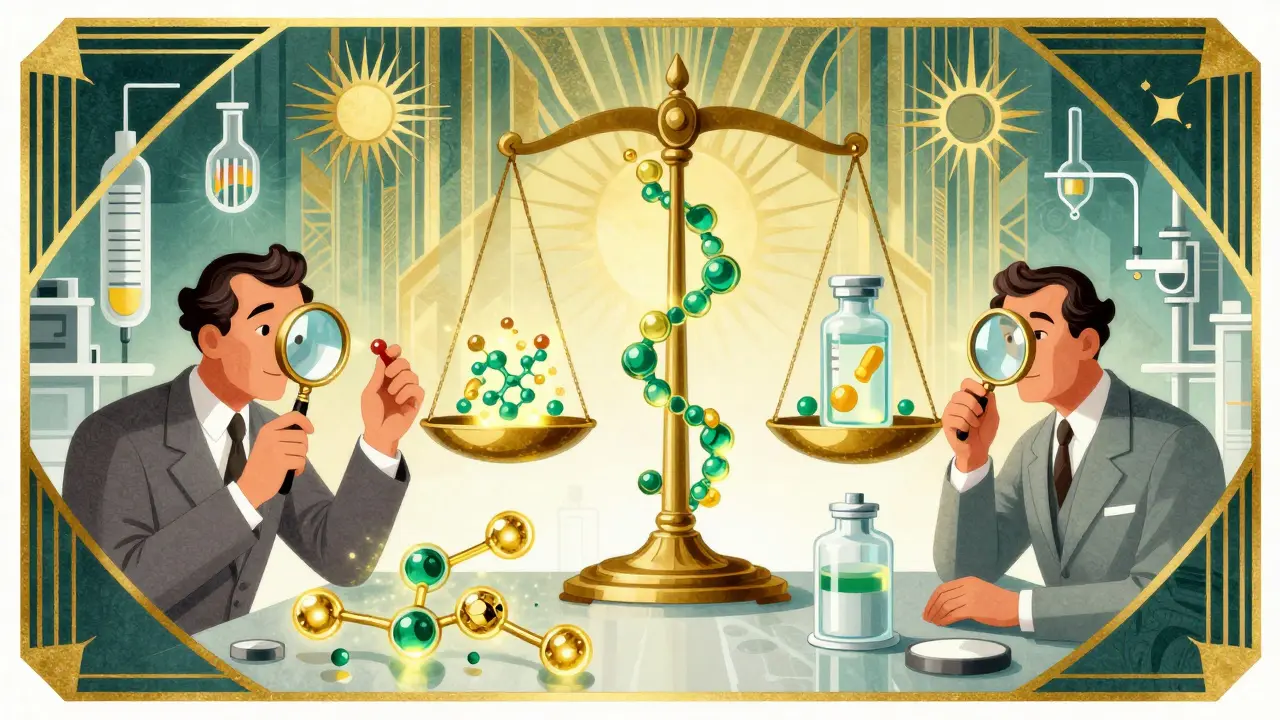
When you hear the word biosimilar, you might think it’s just another name for a generic drug. But that’s not true. Biosimilars aren’t copies like generics-they’re highly similar versions of complex biologic medicines, made from living cells. The FDA doesn’t rate them like you’d rate a movie or a restaurant. Instead, they go through a rigorous scientific review to prove they’re as safe and effective as the original biologic. This process is unlike anything used for traditional generics, and understanding it can help patients and doctors make better choices.
Why Biosimilars Aren’t Generics
Generics are simple chemical copies of small-molecule drugs. Think of them as identical twins made from the same recipe. A generic version of aspirin or metformin has the exact same active ingredient, in the same form, at the same dose. The FDA can approve them quickly because the chemistry is straightforward. Biosimilars are different. They’re made from living organisms-cells, proteins, antibodies. Even tiny changes in how they’re grown, purified, or stored can change how they work in the body. That’s why a biosimilar isn’t an exact copy. It’s a very close match. The FDA requires proof that any differences are minor and don’t affect safety or effectiveness. This is why a biosimilar for a drug like Humira (adalimumab) can’t be approved the same way as a generic version of ibuprofen.The FDA’s Approval Pathway: Step by Step
The FDA doesn’t just look at one thing. They build a complete picture using four key steps, called the "totality of evidence" approach.- Analytical Studies: This is where the process starts. Scientists use advanced tools like mass spectrometry and chromatography to compare the biosimilar and the original biologic molecule by molecule. They check over 200 characteristics-things like protein shape, sugar attachments (glycosylation), and purity. The goal? At least 95% similarity across most attributes. If the data doesn’t show this level of closeness, the application stops right there.
- Animal Studies: These aren’t always required. If the analytical data is strong enough, the FDA may skip this step. But if there’s uncertainty, they’ll test for toxicity in animals to make sure there are no hidden risks.
- Human Studies: This usually means pharmacokinetic (PK) and pharmacodynamic (PD) studies. In simple terms, they check how the body absorbs, uses, and clears the drug. These studies are done in healthy volunteers or patients, typically with 50-100 people. They compare how fast the drug enters the bloodstream and how long it stays active. Immunogenicity-whether the body reacts with unwanted antibodies-is also tested over 6 to 12 months.
- Clinical Studies: These used to be mandatory. Now, thanks to updated guidance in September 2024, the FDA may waive them if analytical data is extremely strong. This is a big shift. In the past, companies had to run full clinical trials comparing outcomes like tumor shrinkage or joint pain relief. Now, for well-understood proteins, they can rely on advanced analytics alone.
This entire process takes about 3.2 years on average-longer than in Europe, where approval takes around 2.1 years. The FDA’s stricter analytical standards mean fewer biosimilars get approved in the U.S., but those that do have a very solid track record.
The Purple Book: The Official FDA Listing
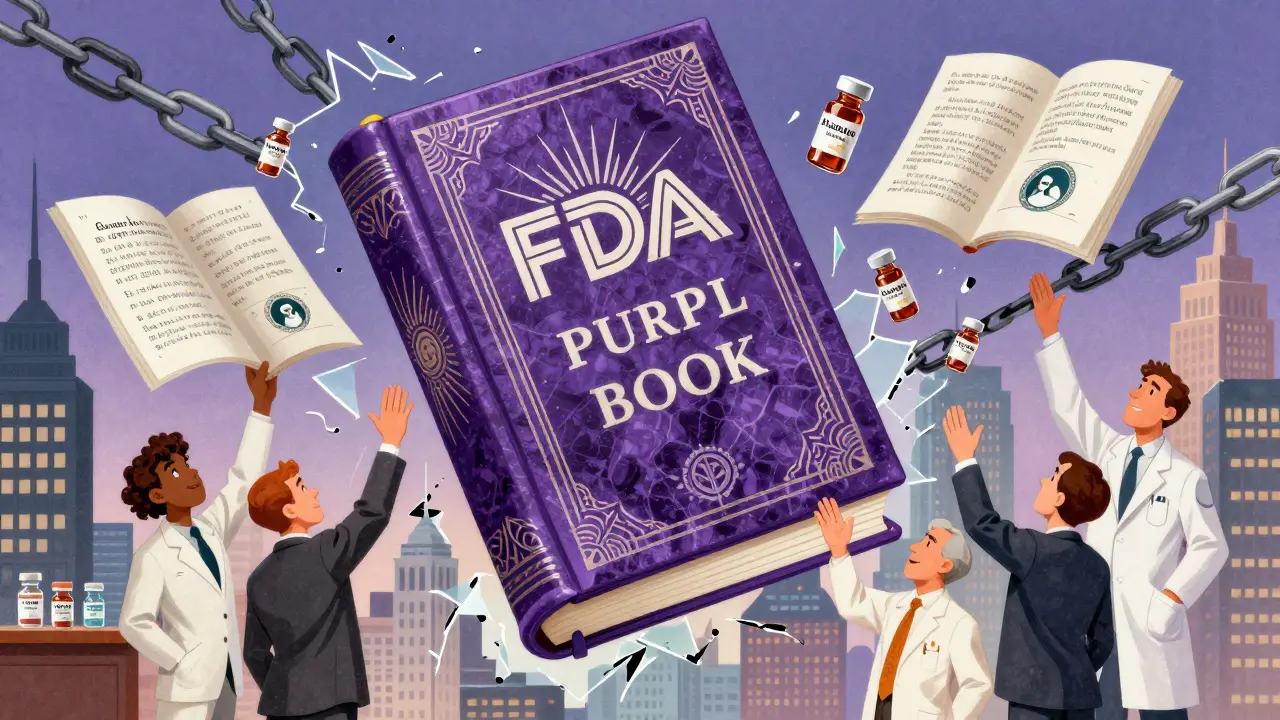
You won’t find biosimilars listed on the same database as generics. The FDA uses something called the Purple Book-an official, searchable public list of all approved biologics and their biosimilars. Updated daily since early 2025, it’s the only place to see which products are approved, when they were approved, and whether they’re designated as “interchangeable.”As of October 2025, the Purple Book lists 387 reference biologics and 43 approved biosimilars. Only 17 of those 43 are labeled “interchangeable.” That’s a special status. To earn it, a biosimilar must prove it can be switched with the original product without increasing risk or reducing effectiveness. This is critical for pharmacists who may substitute a biosimilar without needing a doctor’s new prescription.
Each entry includes patent information, exclusivity dates, and the reference product it matches. It’s not just a list-it’s a legal and clinical roadmap for prescribers, pharmacies, and insurers.
Interchangeable vs. Non-Interchangeable: What’s the Difference?
Not all biosimilars are created equal when it comes to substitution. Here’s the key distinction:- Non-interchangeable biosimilars: These are approved as highly similar, but pharmacists can’t automatically switch them for the original drug. A doctor must specifically prescribe the biosimilar. Most approved biosimilars fall into this category.
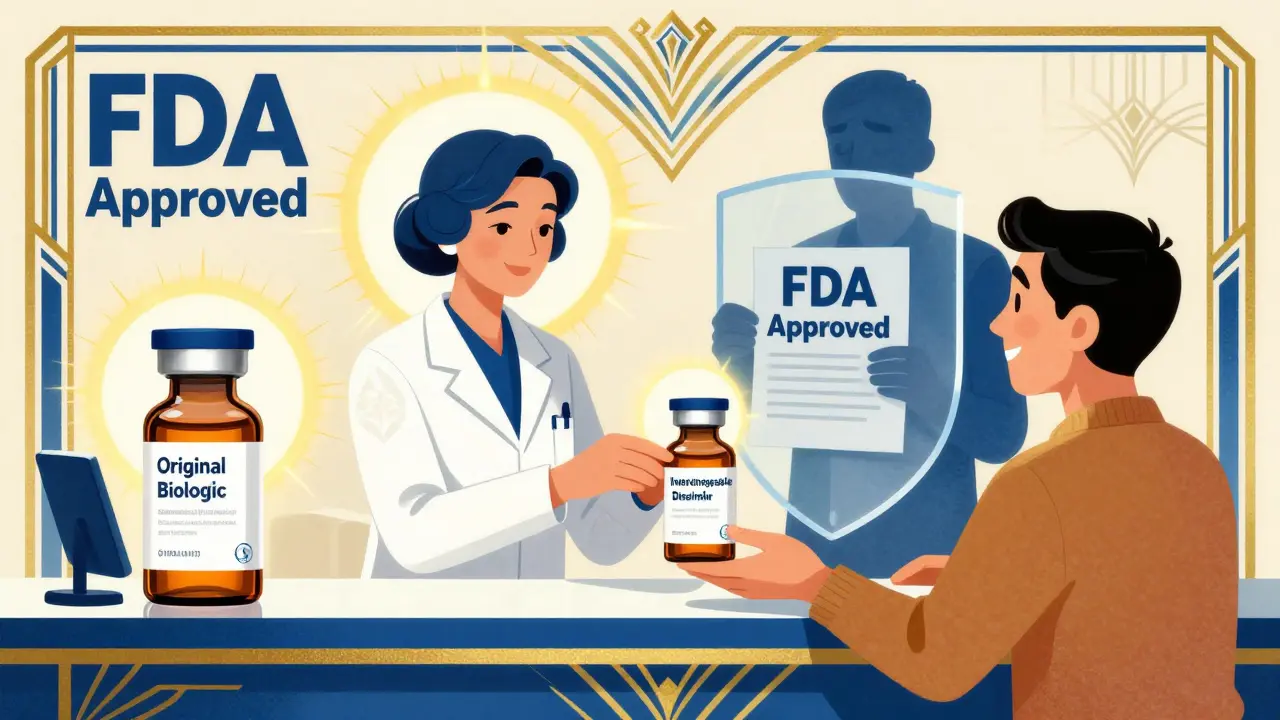
- Interchangeable biosimilars: These meet a higher bar. The FDA requires data showing that switching between the biosimilar and the original product multiple times doesn’t change safety or effectiveness. Only 17 products have reached this status as of late 2025. These are the ones that can be substituted at the pharmacy level, just like generics.
For patients, this means if your doctor prescribes a non-interchangeable biosimilar, you’ll get exactly that product. But if you’re prescribed an interchangeable one, your pharmacist can swap it for the original-or another interchangeable version-without asking your doctor again.
Why So Few Biosimilars Are Actually on the Market
You might think that with 43 approved biosimilars, prices should be falling fast. But here’s the catch: only 29 have actually launched. Why? Patent lawsuits.Biologic drugmakers often hold dozens of patents on their products-covering everything from manufacturing methods to specific uses. These patent thickets delay market entry. On average, it takes 11.3 months from FDA approval to a biosimilar hitting pharmacy shelves. In some cases, delays stretch to years.
Another issue? Payers and doctors are cautious. Oncology biosimilars-like those for rituximab and trastuzumab-have seen strong adoption, with 65-75% market share within 18 months. But for autoimmune drugs like adalimumab, uptake is slow. By mid-2025, only 28% of prescriptions were for biosimilars, even though they cost 15-30% less. Many doctors still prefer the original, fearing unknown long-term effects.
Real-World Safety: No Red Flags After 9 Years
One of the biggest concerns patients have is safety. Are biosimilars riskier? The data says no.The FDA’s Sentinel Initiative tracks adverse events in real time. As of Q3 2025, biosimilars reported 0.8 adverse events per 10,000 patients. The original biologics? 0.7 per 10,000. No statistically significant difference. In nine years of post-market surveillance, no biosimilar has shown a new or unexpected safety signal.
Patient advocacy groups like the Cancer Support Community have praised this record. They point out that every single approved biosimilar has matched the original in safety outcomes. That’s not luck-it’s the result of the FDA’s strict, science-based process.
What’s Changing in 2025 and Beyond
The FDA isn’t standing still. New tools and rules are coming:- Extrapolation of indications: If a biosimilar is proven similar for one condition, it can now be approved for others without additional clinical trials-provided the science supports it. This saves time and money.
- AI for data review: Starting in early 2026, the FDA will pilot AI tools to analyze analytical data faster and more accurately. This could cut review times by months.
- Guidance for complex molecules: Antibody-drug conjugates and gene therapies are next on the list. Only three applications for these have been submitted so far. None have been approved. New guidance is expected by late 2026.
- Interchangeability for combo products: Some biologics are paired with delivery devices or other drugs. The FDA is working on a framework to assess interchangeability for these complex products by mid-2027.
These changes could double the number of biosimilars approved each year-from 3-5 to 7-9 by 2027. That means more choices, lower prices, and better access.
What Patients Should Know
If you’re prescribed a biologic, ask your doctor:- Is there a biosimilar available for my drug?
- Is it interchangeable? That affects whether your pharmacist can switch it.
- Has it been on the market long enough for real-world data to support its use?
Don’t assume a biosimilar is less effective. The science says otherwise. And if cost is a concern, biosimilars are already saving patients and insurers billions. The FDA’s process may be complex, but it’s designed to protect you-without holding back progress.
Are biosimilars the same as generic drugs?
No. Generics are exact chemical copies of small-molecule drugs. Biosimilars are highly similar versions of complex biologic drugs made from living cells. They’re not identical, but they’re proven to have no clinically meaningful differences in safety or effectiveness.
How does the FDA decide if a biosimilar is approved?
The FDA uses a step-by-step process called the "totality of evidence." It starts with detailed lab tests comparing the biosimilar to the original biologic molecule by molecule. Then, it may include animal and human studies to check how the body responds. The goal is to prove there are no clinically meaningful differences in safety, purity, or potency.
What is the FDA Purple Book?
The Purple Book is the FDA’s official public database listing all approved biologics and their biosimilars. It includes licensure dates, interchangeability status, patent information, and which reference product each biosimilar matches. It’s updated daily and is the only authoritative source for this information.
What does "interchangeable" mean for a biosimilar?
An interchangeable biosimilar has met a higher standard than a regular biosimilar. It must prove that switching between it and the original biologic multiple times won’t increase risk or reduce effectiveness. Pharmacists can substitute it without a doctor’s permission, just like with generics.
Why are so few biosimilars actually available in pharmacies?
Even though the FDA has approved 43 biosimilars, only 29 have launched. Delays are mostly due to patent lawsuits from the original drugmakers, which can block market entry for years. Payer restrictions and prescriber hesitation also slow adoption, especially in autoimmune diseases.
Are biosimilars safe?
Yes. Since the first biosimilar was approved in 2015, over 9 years of real-world data show no increased safety risks compared to the original biologics. The FDA’s surveillance system tracks adverse events and has found no unique safety signals linked to any approved biosimilar.
Solomon Ahonsi
February 2, 2026 AT 07:55This whole biosimilar thing is just Big Pharma’s way of keeping prices high under a fancy label. They call it 'rigorous science'-yeah, right. If it’s 'highly similar,' why not just call it a copy? The FDA’s playing god with paperwork while patients pay through the nose.
George Firican
February 2, 2026 AT 22:18The distinction between generics and biosimilars isn’t just technical-it’s philosophical. A generic is a blueprint reproduced; a biosimilar is a living echo of a complex biological symphony. You can’t replicate a cell’s whisper in a petri dish the same way you replicate aspirin’s molecular structure. The FDA’s 'totality of evidence' approach respects that complexity, even if it’s slower. Slowness isn’t bureaucracy-it’s humility before biology.
Matt W
February 3, 2026 AT 23:19I’ve been on Humira for years and switched to a biosimilar last year. No difference. My joints still hurt the same-but now I’m paying half. The fear around biosimilars is totally irrational. If your doctor says it’s approved, trust the science, not the marketing hype.
Anthony Massirman
February 4, 2026 AT 12:0643 approved, 29 launched. Patent lawsuits are the real villain here. Pharma’s playing chess while patients lose pawns.
phara don
February 4, 2026 AT 21:10Does the Purple Book include biosimilars that were withdrawn or had their approval revoked? I couldn’t find that info anywhere.
larry keenan
February 6, 2026 AT 03:31While the analytical comparability metrics are robust, the clinical waiver provisions introduced in September 2024 represent a significant regulatory evolution. The reduction in required in vivo studies for well-characterized proteins introduces a non-negligible risk profile that may not be adequately mitigated by in silico modeling alone. Long-term immunogenicity data remains insufficiently captured in post-marketing surveillance systems.
Nick Flake
February 6, 2026 AT 14:06Imagine this: a living molecule, grown in a lab like a tiny miracle, and then we say, 'Hey, this one’s close enough!' 🌱✨ The FDA isn’t just approving drugs-they’re approving hope. And when a patient gets a biosimilar that saves them $10k a year? That’s not just science-that’s justice. The Purple Book? It’s the Bible for anyone who cares about truth in medicine.
Chinmoy Kumar
February 7, 2026 AT 19:42so biosimilars are not generics but still approved with less testing? i thought the whole point was to be exact? also i heard some indian companies make them cheaper but not sure if they meet usa standards? anyone know?
Vatsal Srivastava
February 9, 2026 AT 08:55Who cares about the Purple Book? It’s just a glorified spreadsheet. Real innovation is in gene therapies. Biosimilars are just pharma’s way of milking patents longer. The whole system is rigged.
Brittany Marioni
February 9, 2026 AT 23:10Important note: The FDA’s 'interchangeable' designation does NOT mean the biosimilar is identical-it means that, based on the totality of evidence, switching back and forth between the reference product and the biosimilar does not increase the risk of adverse events or diminish efficacy. This is critical for pharmacists, insurers, and patients who rely on automatic substitution. Please do not confuse 'highly similar' with 'identical.' The distinction saves lives.
Monica Slypig
February 11, 2026 AT 12:28US has the strictest standards in the world. Europe lets anything through. Why should we lower our bar just to catch up? Biosimilars from India? Maybe. But I won’t trust my life to a drug made in a lab with no FDA oversight. America first-safety first.