Hepatic Encephalopathy: Understanding Confusion, Lactulose, and How to Prevent It
 Dec, 17 2025
What Is Hepatic Encephalopathy?
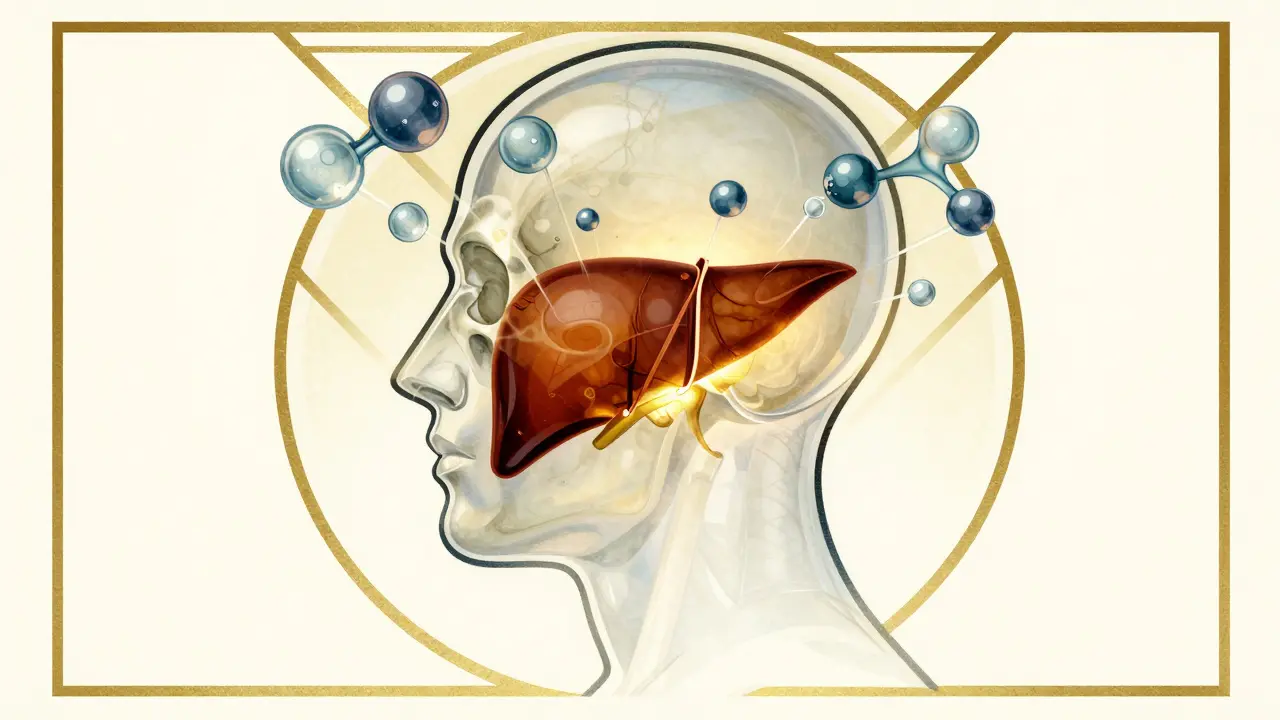
When your liver can’t clean your blood properly, toxins like ammonia start building up. Instead of being filtered out, they travel to your brain. That’s hepatic encephalopathy (HE) - a brain disorder caused by advanced liver disease. It doesn’t happen suddenly in everyone, but if you have cirrhosis, your risk is high: about 1 in 3 people with cirrhosis will develop noticeable symptoms at some point.
HE doesn’t look like a stroke or a seizure. It creeps in quietly. At first, you might just feel a little off - forgetful, sleepy, or easily distracted. Family members notice it first: "You’re not yourself today." That’s minimal hepatic encephalopathy, the hidden form. It shows up on special cognitive tests but not on a regular doctor’s exam. Left unchecked, it can turn into full-blown confusion, slurred speech, even coma.
The main culprit? Ammonia. Your gut makes it when bacteria break down protein. A healthy liver turns it into urea and flushes it out. But a damaged liver? It can’t keep up. And if there are shunts - abnormal blood vessels bypassing the liver - ammonia slips straight into your brain. That’s why HE isn’t just about liver damage. It’s about how your body handles waste.
How Does HE Progress? From Subtle to Severe
HE doesn’t jump from normal to coma. It climbs in stages, and each level has clear signs.
Grade 1 is mild: trouble sleeping, slight trouble concentrating, irritability. You might think it’s stress or aging. But if you have liver disease, this is your body’s first warning.
Grade 2 is clearer: personality changes, slurred speech, poor handwriting, confusion about time or place. You might forget why you walked into a room. Or you suddenly can’t balance your checkbook like you used to.
Grade 3 is serious: you’re deeply confused, can’t follow conversations, may be drowsy or unresponsive. You’re not fully awake, but not fully asleep either.
Grade 4 is coma. At this point, you need emergency care. About 1 in 5 people with severe HE end up in intensive care.
Doctors use tools like the Clinical Hepatic Encephalopathy Staging Scale (CHESS) to track this. But here’s the catch: family members often spot these changes before the doctor does. In 65% of cases, caregivers notice the shift 48 to 72 hours before a clinic visit. That’s why learning the early signs matters.
Why Lactulose Is the First Line of Defense
Since the 1960s, lactulose has been the go-to treatment for HE. It’s not a cure, but it works. And it’s cheap - $15 to $30 a month as a generic.
Lactulose is a synthetic sugar your body can’t digest. When it reaches your colon, gut bacteria break it down. That process lowers the pH in your intestines, turning ammonia (NH3) into ammonium (NH4+). Ammonium can’t cross into your bloodstream. It stays trapped and gets flushed out with your stool.
The goal? Two to three soft bowel movements a day. That’s the sweet spot. Too few, and ammonia builds up. Too many, and you’re dehydrated and miserable.
Most people start with 30-45 mL (about 2-3 tablespoons) three or four times a day. Some need more. Some need less. The dose isn’t one-size-fits-all. And here’s the big problem: 65% of people who don’t respond to lactulose are actually taking too little. They’re scared of diarrhea, so they cut the dose - and the treatment fails.
One patient on Reddit shared: "Lactulose saved me from hospitalization, but the constant bathroom trips ruined my job interviews." That’s real. It’s messy. It’s inconvenient. But it works. And if you skip it, you’re at risk.

What Else Works? Rifaximin and Other Options
If lactulose alone isn’t enough, doctors add rifaximin. It’s an antibiotic that doesn’t get absorbed into your blood. It stays in your gut and kills the ammonia-making bacteria - like Klebsiella and Proteus.
Studies show rifaximin cuts recurrent HE episodes by 58% compared to placebo. It’s taken as two 550 mg pills daily. But it’s expensive - around $1,200 a month. Insurance often covers it, but only if you’ve already tried lactulose.
There are other options too. L-ornithine-L-aspartate (LOLA) helps your liver process ammonia better. It’s given as an IV in hospitals or as pills. Studies show it improves mental clarity in about 35% of patients.
Newer treatments are on the horizon. SYN-004, a gut-protecting enzyme, reduced HE episodes by 35% in early trials. Fecal transplants - swapping bad gut bacteria for healthy ones - worked for 70% of patients who didn’t respond to anything else. And in Japan, AST-120, a charcoal-like pill that absorbs toxins, has been used for nearly 20 years.
But for now, lactulose + rifaximin is the gold standard. And it’s not just for treatment. It’s for prevention too.
How to Prevent HE Before It Starts
Preventing HE is smarter - and cheaper - than treating it. Hospital stays for acute HE cost about $28,500. Outpatient care with lactulose? Around $1,200 a year. That’s a massive difference.
If you’ve had HE before, your doctor should put you on daily lactulose - even when you feel fine. One study showed this cuts recurrence by half within six months.
But prevention isn’t just pills. It’s habits.
- Watch your protein. Don’t cut it out. Your body needs it. But during an HE flare, reduce it to 0.5 grams per kilogram of body weight. Once you’re stable, go back to 1.2-1.5 grams per kg. That’s about 70-90 grams a day for most people - a palm-sized portion of meat at each meal.
- Avoid sedatives. Benzodiazepines (like Xanax or Valium) can make HE worse by 3.2 times. Even over-the-counter sleep aids can trigger it.
- Check for infections. A simple UTI or pneumonia can spark an HE episode. One caregiver tracked her husband’s flares for months and found every single one followed a urinary infection. Now, she tests monthly. It’s cut his episodes by 80%.
- Don’t skip your diuretics. If you’re on water pills for fluid buildup, taking them wrong can throw off your electrolytes. Low potassium is a known trigger.
- Keep your bowels moving. Constipation lets ammonia sit in your gut longer. That’s why lactulose isn’t just a drug - it’s a lifestyle tool.

What to Do If Treatment Isn’t Working
If you’re taking lactulose and rifaximin and still getting confused, something’s missing.
First, check your dose. Are you really getting two to three soft stools a day? If not, you’re underdosed. Many people stop at one bowel movement and think it’s enough. It’s not.
Second, look for hidden triggers. Did you recently start a new medicine? Have you had a fever, diarrhea, or bleeding? Even a small GI bleed can dump protein into your gut and spike ammonia.
Third, ask for a gut microbiome test. If your HE keeps coming back, your gut bacteria might be resistant. That’s becoming more common - 8.7% of HE patients now have rifaximin-resistant strains.
And if you’re still stuck, consider newer options. Fecal transplants are no longer just experimental. They’re being used in liver centers for refractory cases. And a new blood test, still in trials, might soon predict your HE risk before symptoms even start.
Living With HE: Real Stories, Real Challenges
HE doesn’t just mess with your brain - it messes with your life.
One woman in her 50s stopped working after her first episode. She was diagnosed with dementia for two years before someone noticed her liver disease. "I felt like I was losing my mind," she said. "No one believed me until I showed them my blood work."
Another man, 68, uses a free app called EncephalApp Stroop to test his memory every morning. It takes five minutes. He logs his scores. His doctor uses them to adjust his lactulose dose. "I didn’t know I could monitor this myself," he said. "Now I feel in control."
And then there’s the loneliness. Over 40% of HE patients say they’ve withdrawn from friends because they’re embarrassed by their confusion. They stop calling, stop going out. The stigma is real.
But recovery is possible. One patient on Hep Forums shared: "After six months of sticking with lactulose and rifaximin, my cognitive scores improved. I went from MELD 22 to 15. I’m back to part-time work. I’m not cured - but I’m living."
That’s the message. HE isn’t a death sentence. It’s a manageable condition - if you know how to fight it.
What’s Next for Hepatic Encephalopathy?
The future of HE is personal. Researchers are building a "Gut-Liver-Brain Axis" profile for each patient - tracking gut bacteria, ammonia levels, and brain changes together. The goal? To predict who’s about to crash before they even feel it.
A smartphone app study in Virginia is already showing results. Patients using daily cognitive tests had 62% fewer hospital visits. Early detection saves lives.
And new drugs are coming. Non-antibiotic alternatives to rifaximin are in Phase 3 trials. One, L-norvaline, blocks ammonia production without killing gut bacteria. That could be a game-changer.
For now, the tools we have work - if you use them right. Lactulose isn’t glamorous. Rifaximin isn’t cheap. But they’re the difference between confusion and clarity, between hospital and home.
Can hepatic encephalopathy be reversed?
Yes, in most cases. Hepatic encephalopathy is often reversible, especially if caught early. When ammonia levels drop and triggers like infections or constipation are treated, brain function can return to normal. Many patients recover fully after an acute episode. However, if HE keeps coming back, the brain can sustain lasting damage. That’s why prevention and consistent treatment are so important.
Does lactulose cause diarrhea?
Yes, it often does - and that’s the point. Lactulose works by drawing water into the colon and stimulating bowel movements. The goal is two to three soft stools per day. If you’re having watery diarrhea or cramping constantly, you’re taking too much. Talk to your doctor to adjust the dose. Don’t stop it - just lower it.
Is hepatic encephalopathy the same as dementia?
No. While both cause confusion and memory problems, HE is caused by liver failure and ammonia buildup, not brain degeneration. Unlike Alzheimer’s or vascular dementia, HE symptoms can improve or disappear with treatment. Many patients are misdiagnosed with dementia before their liver disease is recognized. Blood tests and a history of liver damage help tell them apart.
Can I still eat meat if I have hepatic encephalopathy?
Yes - but not too much. Protein is essential for muscle and healing. During an active HE flare, your doctor may ask you to limit protein to 0.5 grams per kg of body weight for a few days. Once you’re stable, go back to 1.2-1.5 grams per kg. That’s about 70-90 grams daily - roughly two palm-sized portions of meat or fish. Avoid huge protein meals all at once. Spread it out across meals.
Why do I need to take lactulose every day if I feel fine?
Because HE can return without warning. Even when you feel okay, ammonia can still be building up slowly. Daily lactulose keeps your gut acidic and your bowels moving, preventing toxins from reaching your brain. Stopping it, even for a few days, can trigger a flare. Studies show people who take it daily cut their risk of hospitalization by half. Feeling fine is a sign it’s working - not that you can stop.
Can I drink alcohol with hepatic encephalopathy?
Absolutely not. Alcohol damages your liver and increases ammonia production. Even small amounts can trigger a sudden, dangerous episode of HE. If you have cirrhosis or a history of HE, alcohol is not safe at any level. Complete abstinence is required for any chance of recovery or stability.
How do I know if my lactulose dose is right?
The right dose gives you two to three soft, non-watery bowel movements every day. If you’re having less than one, you need more. If you’re having watery diarrhea or cramps all day, you need less. Keep a log: note your dose, stool frequency, and how you feel. Bring it to your next appointment. Most treatment failures come from wrong dosing - not the drug not working.
Are there natural alternatives to lactulose?
There’s no proven natural replacement. Some people try probiotics or fiber supplements, but they don’t lower ammonia like lactulose does. Lactulose works by chemically changing ammonia in the gut - something natural products can’t replicate. Don’t replace it with herbs or supplements unless your doctor approves it. The stakes are too high.
Jedidiah Massey
December 17, 2025 AT 21:48Gloria Parraz
December 19, 2025 AT 14:05Sahil jassy
December 21, 2025 AT 01:16Kathryn Featherstone
December 21, 2025 AT 23:06Nicole Rutherford
December 22, 2025 AT 01:02Mark Able
December 23, 2025 AT 20:33Chris Clark
December 25, 2025 AT 04:56Dorine Anthony
December 25, 2025 AT 08:09