Hepatorenal Syndrome: How Advanced Liver Disease Causes Sudden Kidney Failure
 Dec, 19 2025
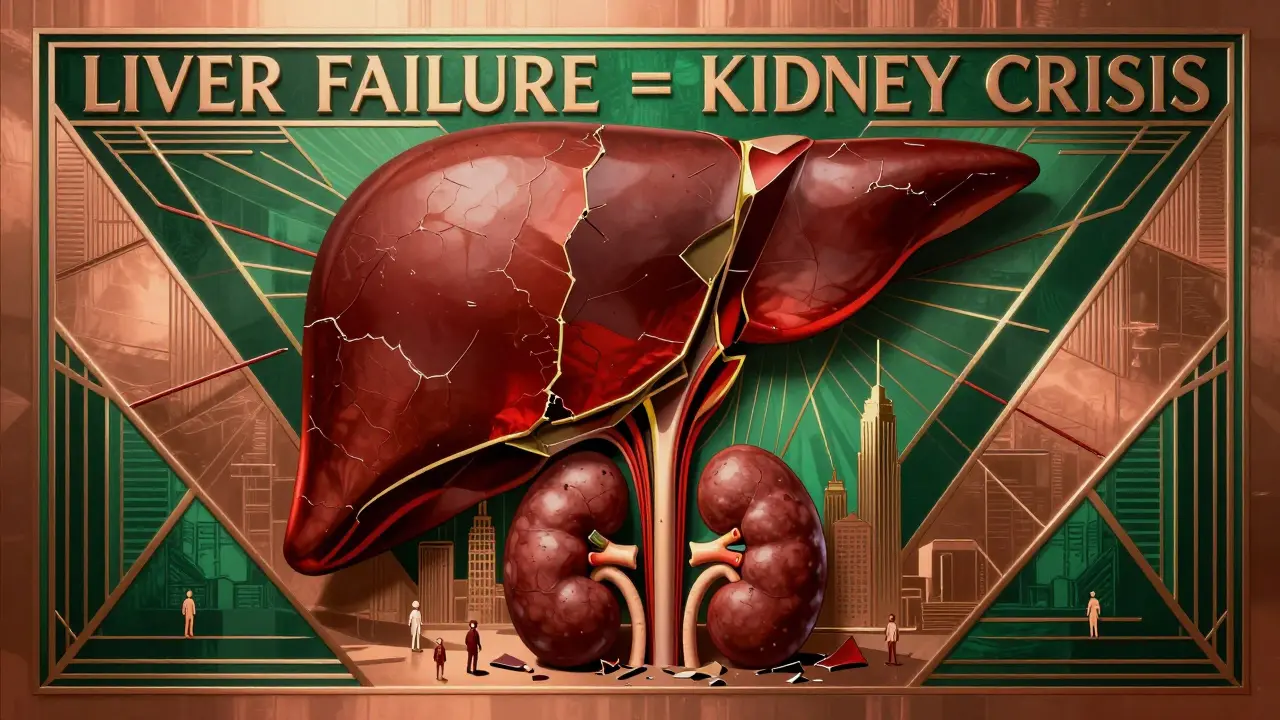
When your liver fails, it doesn’t just stop processing toxins-it starts pulling your whole body apart. One of the most dangerous, yet often missed, consequences is hepatorenal syndrome, a sudden, life-threatening drop in kidney function that happens without any direct damage to the kidneys themselves. This isn’t just a side effect. It’s a full-body crisis triggered by advanced liver disease, especially cirrhosis. And if you don’t recognize it fast, it can kill you in days.
What Hepatorenal Syndrome Really Is
Hepatorenal syndrome (HRS) isn’t kidney disease. It’s liver disease attacking your kidneys from the inside out. The kidneys look normal under a microscope. No scarring, no inflammation, no blockage. But they stop working-fast. That’s because the problem isn’t in the kidneys. It’s in the blood flow. In cirrhosis, scar tissue builds up in the liver. This blocks blood flow through the organ, creating high pressure in the portal vein. That pressure forces blood to find new paths, dilating arteries in the intestines and spleen. This sounds like a fix, but it backfires. Your body thinks it’s losing blood. So it tightens every artery it can, especially the ones leading to the kidneys. Blood flow to the kidneys drops by 40-50%. Glomerular filtration rate (GFR)-the measure of how well kidneys filter waste-plummets by 60-70%. That’s why creatinine rises, urine output drops, and toxins build up. This isn’t dehydration. It’s not caused by drugs or infection. It’s a system-wide collapse triggered by liver failure. And it’s happening in about 10% of hospitalized liver patients, and up to 40% of those with end-stage disease.The Two Types: Fast Killers and Slow Burners
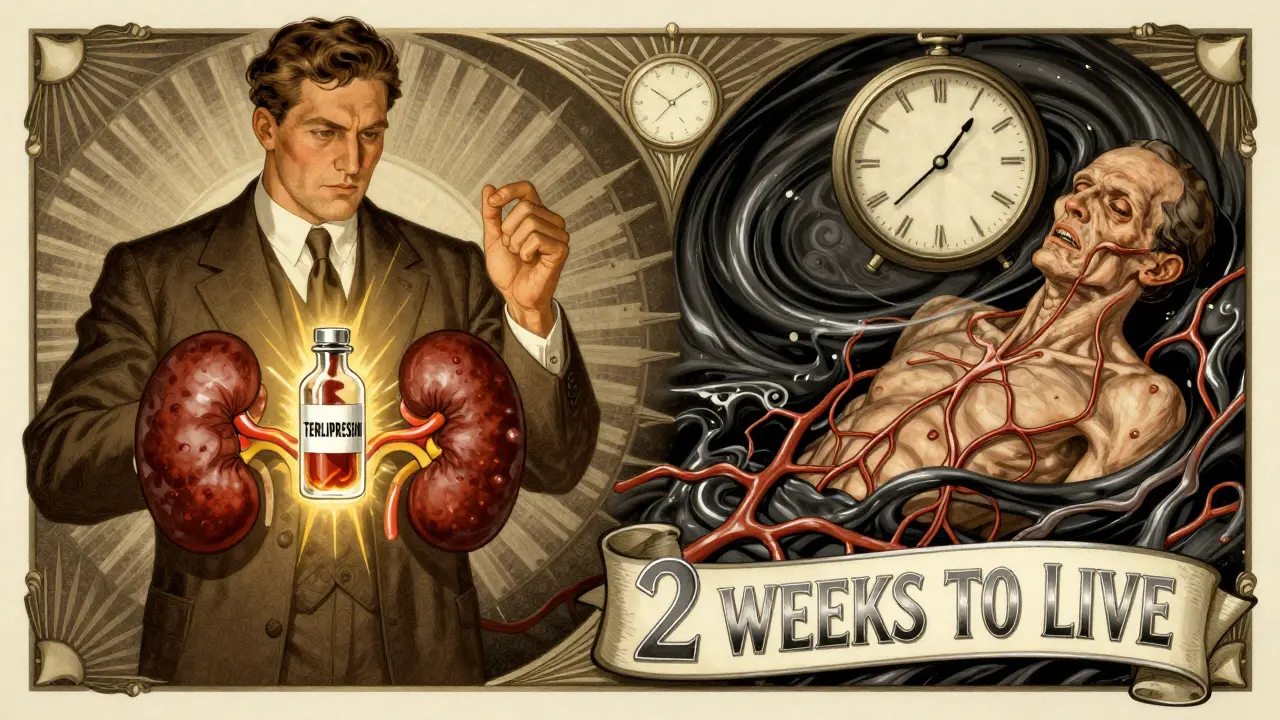
HRS doesn’t come in one flavor. There are two distinct types, each with different timelines and risks. Type 1 HRS is a medical emergency. Creatinine levels double in under two weeks and jump above 2.5 mg/dL. Patients can go from stable to needing dialysis in days. Median survival without treatment? Just two weeks. This type often shows up after a trigger like an infection, bleeding, or sudden alcohol binge. It’s the kind that lands people in ICU. Type 2 HRS creeps in slower. Creatinine stays between 1.5 and 2.5 mg/dL. It’s tied to stubborn ascites-fluid that won’t go away no matter how many diuretics you give. Patients may live months, but their quality of life is terrible. They’re swollen, tired, and constantly drained by fluid removal. This type is a warning sign: the liver is failing, and the kidneys are next. The difference matters because treatment changes completely. Type 1 needs urgent drugs. Type 2 might need a shunt or transplant.How Doctors Diagnose It (And Why So Many Get It Wrong)
There’s no single test for HRS. Diagnosis is a process of elimination. That’s why 25-30% of cases are misdiagnosed. To confirm HRS, doctors must rule out everything else:- No structural kidney damage (no protein in urine, no blood in urine)
- No recent use of kidney-toxic drugs (NSAIDs, antibiotics like vancomycin)
- No shock, sepsis, or dehydration
- No improvement after stopping diuretics and giving 1 gram of albumin per kilogram of body weight (up to 100g) over 48 hours
What Triggers It? The Hidden Causes
HRS doesn’t appear out of nowhere. In 68% of cases, there’s a clear trigger:- Spontaneous bacterial peritonitis (SBP) - 35% of cases. A silent infection in the belly fluid. Often no fever, no pain. Just a rising creatinine.
- Upper GI bleeding - 22%. Blood in the gut gets absorbed, triggering inflammation and blood vessel changes.
- Acute alcoholic hepatitis - 11%. A sudden liver crash from heavy drinking.
- Large-volume paracentesis - Removing too much fluid without replacing albumin can cause a sudden drop in blood pressure, triggering HRS.
What Treatments Work? And What Doesn’t
There’s no magic pill. But there are proven steps. For Type 1 HRS: The gold standard is terlipressin (a vasoconstrictor) plus albumin. Terlipressin tightens blood vessels, redirecting flow back to the kidneys. Albumin holds fluid in the bloodstream, improving pressure. In clinical trials, this combo works in 44% of cases-creatinine drops below 1.5 mg/dL in 14 days. But it’s not safe for everyone. It can cause heart attacks, strokes, or intestinal ischemia. Dosing has to be tight. One patient shared online: “Terlipressin brought my creatinine down from 3.8 to 1.9-but I had severe stomach cramps. They had to cut the dose.” In the U.S., terlipressin was only FDA-approved in December 2022 as Terlivaz™. It costs about $1,100 per vial. A 14-day course runs $13,200. Many insurers still fight coverage. In countries without access, doctors use midodrine and octreotide-less effective, but cheaper. One patient on Reddit wrote: “My husband didn’t respond to midodrine for six weeks. We’re on the transplant list now.” For Type 2 HRS: Vasoconstrictors help less. The better option is a TIPS procedure-a shunt placed inside the liver to bypass the high-pressure portal vein. It works in 60-70% of cases. But it has a 30% risk of causing hepatic encephalopathy-brain fog, confusion, even coma. So it’s not for everyone.
The Only Real Cure: Transplant
No drug fixes the liver. No pill rebuilds it. The only cure for HRS is a liver transplant. Data from the UNOS database shows:- Without transplant, 1-year survival for Type 1 HRS is under 20%
- With vasoconstrictors and albumin, it jumps to 38.7%
- With transplant? 71.3%
Why So Many Patients Are Left Behind
The problem isn’t just medicine. It’s access. A 2022 survey of 312 HRS patients and caregivers found:- 78% waited over a week for diagnosis
- 63% were misdiagnosed at least once
- 41% had insurance deny terlipressin despite meeting criteria
Nancy Kou
December 19, 2025 AT 17:18This is one of those posts that makes you realize how much we take basic organ function for granted. The liver doesn't just 'process stuff'-it's the silent conductor of your entire internal economy. When it fails, the dominoes fall so fast, you don't even see the first one tip. I've seen patients in the ER with ascites and rising creatinine, and the first question from the intern was 'Did they drink too much?' Not 'Did their kidneys shut down because their liver collapsed?' That gap is terrifying.
Hussien SLeiman
December 20, 2025 AT 00:33Let’s be honest, this whole hepatorenal syndrome narrative is just another way for pharma to sell expensive vasoconstrictors. The kidneys aren’t 'failing'-they’re conserving. It’s a survival mechanism, not a disease. The real problem is the medical system’s obsession with 'fixing' things with drugs instead of recognizing the body’s innate wisdom. Terlipressin? It’s just a bandaid on a ruptured aorta. And transplant? That’s just a luxury for those who can afford the $500k bill. The system is rigged, and this post is just another cog in the machine.
William Storrs
December 20, 2025 AT 17:40Man, this is the kind of clarity we need more of. So many people think kidney failure means 'bad kidneys'-but no, it’s the liver screaming for help. I work in a community hospital and we had a guy last month with cirrhosis and a creatinine of 3.2. We almost missed it because the nurse thought he was just dehydrated. Thank you for spelling out the diagnostic steps so clearly. FeNa under 0.01%? That’s the golden clue. I’m printing this out for our team tomorrow.
James Stearns
December 22, 2025 AT 12:04It is imperative to underscore the fact that the pathophysiological underpinnings of hepatorenal syndrome are not merely clinical curiosities, but rather, systemic manifestations of end-stage organ dysfunction requiring a multidisciplinary, evidence-based approach. The absence of structural renal pathology, coupled with profound vasoconstriction of the renal vasculature, necessitates a paradigm shift in diagnostic prioritization. Furthermore, the economic disparities in therapeutic access-particularly with regard to terlipressin-are not merely logistical concerns, but ethical imperatives demanding institutional reform.
Nina Stacey
December 22, 2025 AT 14:45I just lost my dad to this and no one ever told us this was even a thing until it was too late. He was in the hospital for 'fluid buildup' and they kept giving him diuretics but his creatinine kept climbing and no one said 'hey maybe its your liver killing your kidneys'... we thought he was just getting sicker from the alcohol. I wish someone had told us about albumin or FeNa or even just to ask about transplant earlier. I’m so angry at how much time we lost. Please if you have cirrhosis or know someone who does-ask the doctor about HRS. Don’t wait. I wish I had.
Frank Drewery
December 23, 2025 AT 04:58Reading this felt like someone finally put into words what I’ve been seeing in clinic for years. The quiet, slow creep of Type 2 HRS is so easy to miss. Patients come in with bloated bellies, tired eyes, and they say 'I’m just getting older.' But it’s not aging-it’s the liver slowly strangling the kidneys. I’ve had patients live 18 months with Type 2 before we got them on TIPS. That’s not 'stable'-that’s a countdown. We need better screening protocols in primary care. This isn’t hepatology-only stuff.
Danielle Stewart
December 25, 2025 AT 04:17So many people think if your kidneys are failing, you need dialysis. But if the liver doesn’t get fixed, dialysis is just buying time for a body that’s already shutting down. I’m a nurse and I’ve seen patients get dialysis for months only to die because their liver kept getting worse. Transplant isn’t a 'last resort'-it’s the only real answer. If you’re in HRS, get on the list. No excuses. Your kidneys can’t save you. Only the liver can.
mary lizardo
December 25, 2025 AT 21:10While the clinical description of hepatorenal syndrome is accurate, the author’s casual tone and reliance on anecdotal Reddit quotes undermine the scientific rigor expected in medical discourse. The reference to 'one patient on Reddit' as a data point is not merely unprofessional-it is methodologically indefensible. Furthermore, the casual use of terms like 'fast killers' and 'slow burners' trivializes a lethal pathophysiological process. This is not an article for public consumption; it is a dangerous oversimplification.
jessica .
December 27, 2025 AT 06:39They don’t want you to know this but the whole HRS thing is a scam. Big Pharma and transplant centers make billions off this. The real cause? Toxins in the water. Glyphosate. GMOs. The liver gets overwhelmed and the kidneys pay the price. They don’t want you to know you can reverse it with bentonite clay and lemon water. They need you dependent on terlipressin. Ask yourself: why is this drug only approved in 2022? Coincidence? Or control?
Ryan van Leent
December 28, 2025 AT 23:17Why are we even talking about terlipressin? We’re spending thousands on drugs that barely work while people die waiting for transplants. The real issue is we don’t have enough livers. Why aren’t we pushing harder for artificial livers or xenotransplants? Why are we still stuck in the 1990s with vasoconstrictors? This whole system is broken. We’re treating symptoms like they’re the disease. We need radical change not more band-aids.
Sajith Shams
December 29, 2025 AT 21:49Indian doctors don’t even know what HRS is. I’ve seen three cases in my hospital. All misdiagnosed as acute kidney injury. No one checked urine sodium. No one gave albumin. One patient died in 72 hours. We don’t have terlipressin here. We have nothing. The WHO doesn’t even list it as a priority. The global health system is failing the poor. This isn’t just medicine-it’s injustice.
Adrienne Dagg
December 31, 2025 AT 12:46My uncle had this. They told him he needed a transplant but he didn’t have insurance. He died waiting. 😔 We need to fix this. No one should die because they can’t afford a drug that costs $13k. This isn’t fair. 🙏
Chris Davidson
January 1, 2026 AT 20:21Terlipressin is the only real treatment for Type 1. The rest is noise. If you’re not using it, you’re not doing your job. The data is clear. The guidelines are clear. If you’re not listing for transplant immediately, you’re killing them with kindness. Stop waiting. Start acting.
Mike Rengifo
January 2, 2026 AT 18:36Just read this while waiting for my liver consult. Feels like someone finally explained why I’ve been so tired and swollen for months. I didn’t know my kidneys were just along for the ride. I’m getting my FeNa test tomorrow. Thanks for the clarity.
Ashley Bliss
January 3, 2026 AT 18:55It’s not just about organs failing-it’s about how society treats the broken. We don’t heal people. We manage decline. We label them ‘high risk’ and move on. HRS is a mirror. It shows us how little we value life when it’s messy, when it’s tied to addiction, when it’s not ‘perfect’ enough to deserve a new liver. The real disease isn’t cirrhosis. It’s indifference.