How Insurance Benefit Design Uses Generics to Cut Costs
 May, 16 2026
Did you know that generic drugs make up over 91% of prescriptions filled in the United States, yet they account for only about 22% of total drug spending? That massive gap is not an accident. It is the result of deliberate insurance benefit design, which uses strategic financial structures and rules to steer patients toward lower-cost medications. For years, health insurers and Pharmacy Benefit Managers (PBMs), intermediaries that negotiate drug prices between insurers, pharmacies, and manufacturers have built systems specifically designed to maximize the use of generics. But how exactly do these plans work, and who really benefits from them?
The foundation of this strategy lies in the Hatch-Waxman Act, a 1984 U.S. law that streamlined the approval process for generic drugs by allowing them to prove bioequivalence rather than repeating clinical trials. This legislation allowed cheaper alternatives to enter the market once brand-name patents expired. Since then, insurance companies have refined their tools to ensure you pick up the generic bottle instead of the brand-name one. The result? According to the IQVIA Institute, generic drugs saved the U.S. healthcare system approximately $3.7 trillion between 2013 and 2022. However, the system is complex, and while it saves billions, some argue that opaque pricing practices prevent patients from seeing the full savings at the pharmacy counter.
The Mechanics of Tiered Formularies
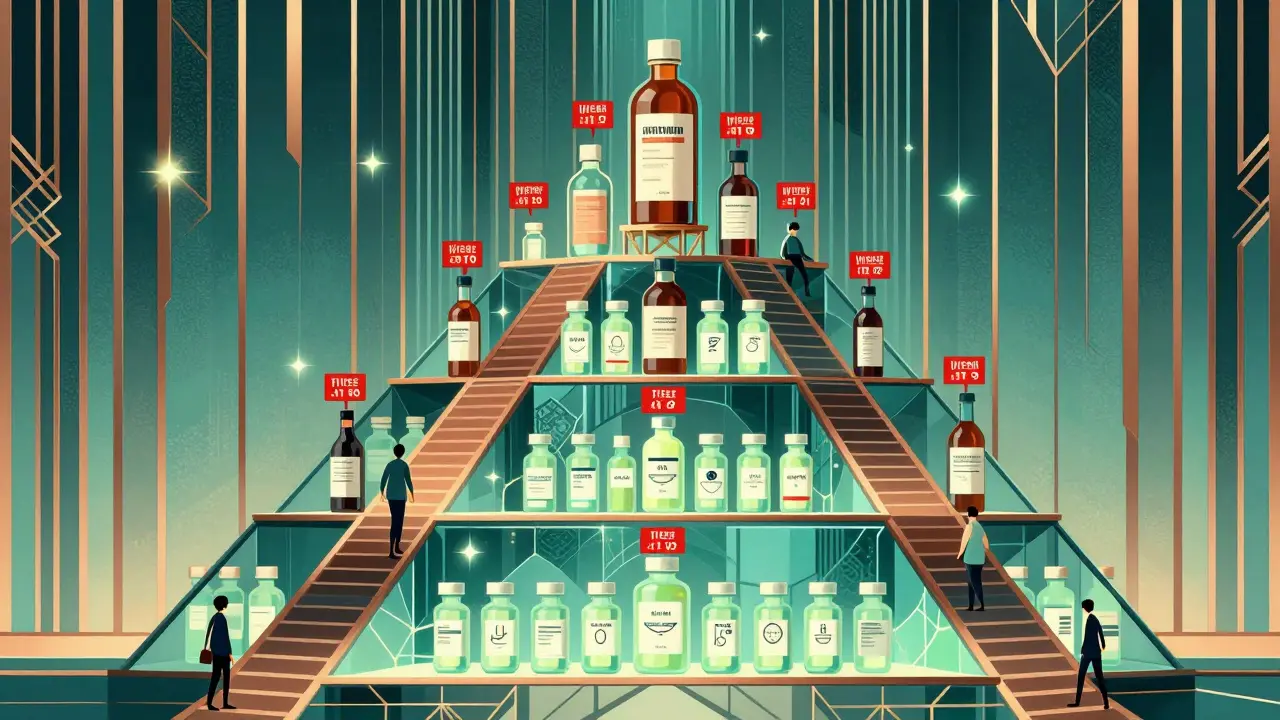
The most visible tool in an insurer’s arsenal is the formulary. Think of a formulary as a ranked list of approved drugs. Insurers group these drugs into tiers based on cost and preferred status. You likely see this when you fill a prescription or check your plan details online.
- Tier 1 (Preferred Generics): These are the cheapest options. Copayments often range from $0 to $10 for a 30-day supply. This tier includes almost all FDA-approved generic equivalents.
- Tier 2 (Preferred Brands): Brand-name drugs that the insurer has negotiated good rates for. Copays here might jump to $25-$50.
- Tier 3 (Non-Preferred Brands): Expensive brand names with little competition. Copays can exceed $60 or even $100.
This structure creates a powerful financial incentive. If your brand-name medication costs $50 out-of-pocket but the generic version costs $5, the math is simple for most people. Data from the Kaiser Family Foundation shows that commercial plans consistently use this tiered approach to drive utilization toward Tier 1. In fact, 98.7% of commercial health plans used tiered formularies prioritizing generics as of 2024. By making the generic option significantly cheaper at the point of sale, insurers reduce their overall liability without necessarily denying coverage for the brand-name drug entirely.
Mandatory Substitution and Step Therapy
Price differences alone aren’t always enough to change behavior, especially when patients feel strongly attached to a specific brand. To bridge this gap, benefit designs employ more rigid controls. One of the most common is mandatory generic substitution. In 49 states, pharmacists are legally permitted-and often required-to substitute a generic drug for a brand-name one unless the prescriber explicitly writes “Dispense as Written” on the prescription. This automatic switch happens millions of times daily, ensuring that the lowest-cost option is dispensed by default.
Another mechanism is step therapy, also known as “fail-first” protocols. Under this rule, an insurer will only cover a more expensive brand-name drug if you first try and fail on a cheaper generic alternative. As of 2023, 92% of Medicare Part D plans utilized step therapy protocols. For example, if you need a new statin for cholesterol, your plan might require you to take generic atorvastatin first. Only if you experience side effects or insufficient results would they approve coverage for a newer, branded statin. While this can delay access to preferred treatments, it forces a trial of the cost-effective option first, significantly lowering aggregate spending for the insurer.
| Factor | Generic Drugs | Brand-Name Drugs |
|---|---|---|
| Average Cost Reduction | 80-85% less than brand | Baseline price |
| Typical Copay (Commercial) | $0 - $10 | $25 - $100+ |
| Market Share (Prescriptions) | 91.5% | 8.5% |
| Share of Total Spending | 22% | 78% |
| Patient Satisfaction (Medicare) | 68% satisfied | 42% satisfied |
The PBM Profit Paradox
While insurers save money, the journey of those savings is not always straightforward. Enter the Pharmacy Benefit Manager (PBM). Companies like CVS Caremark, OptumRx, and Express Scripts process the vast majority of prescription claims. They negotiate rebates from drug manufacturers and pass some of those savings back to health plans. However, critics argue that the system is opaque.
A 2022 white paper from the USC Schaeffer Center highlighted a troubling trend: spread pricing. This occurs when a PBM charges an insurer more for a generic drug than it pays the pharmacy. The difference stays in the PBM’s pocket. Consequently, while the insurer sees lower aggregate costs due to high generic volume, the individual patient might still face higher-than-expected copays. Some research suggests patients could be overpaying by $10 to $15 per prescription due to these hidden margins. This disconnect explains why some consumers feel frustrated despite being steered toward “cheaper” generics.

Impact on Different Insurance Models
Not all insurance programs handle generics the same way. Medicare Part D, which covers over 50 million beneficiaries, uses standardized benefit designs with mandatory generic tiers. However, out-of-pocket costs vary wildly depending on the specific plan chosen. In contrast, Medicaid programs operate under federal Upper Payment Limits (UPL), capping reimbursement for generics at 250% of the average manufacturer price. This strict cap helps Medicaid achieve slightly higher generic dispensing rates (89.3% in 2022) compared to the commercial market (87.1%).
Self-insured employers are also aggressive in their cost-cutting. A study from Johns Hopkins University found that large self-insured employers achieved savings of 9% to 15% by substituting prescription drugs with therapeutically equivalent lower-cost options. Meanwhile, new direct-to-consumer models like the Mark Cuban Cost Plus Drug Company challenge traditional PBMs by offering transparent cost-plus pricing. An economic evaluation showed that uninsured patients could save a median of $4.96 per prescription by bypassing insurance for certain generics, highlighting the potential inefficiencies in the current insured model.
Navigating Your Benefits as a Patient
Understanding these mechanisms empowers you to manage your healthcare costs better. Here is what you should look for in your plan:
- Check the Formulary Tier: Before starting a new medication, ask your doctor if a generic equivalent exists and which tier it falls under in your plan.
- Understand Step Therapy: If your claim is denied due to step therapy, ask your provider if they can submit a “peer-to-peer” review to justify the brand name, or be prepared to try the generic first.
- Watch for Copay Cliffs: With the introduction of coinsurance (paying a percentage rather than a flat fee) for some plans, calculate whether the generic’s lower base price actually results in a lower out-of-pocket cost for you.
- Leverage Transparency Tools: Use apps and websites that show cash prices versus insured prices. Sometimes, paying cash for a generic at a discount pharmacy can be cheaper than your copay, especially if your deductible hasn’t been met.
The shift toward generic-focused benefit design is irreversible. With the Inflation Reduction Act’s new drug price negotiations launching in 2026 and the CMS GENEROUS Model aiming to cut Medicaid drug spending by $40 billion over ten years, the pressure to utilize low-cost generics will only intensify. For patients, the key is staying informed about how these rules apply to your specific plan, ensuring you get the clinical care you need without falling victim to hidden costs or unnecessary delays.
What is a formulary in health insurance?
A formulary is a list of prescription drugs covered by a health insurance plan. Drugs are grouped into tiers based on cost and preference, with generic drugs usually placed in the lowest-cost tier to encourage their use.
Why do insurers prefer generic drugs over brand-name ones?
Insurers prefer generic drugs because they cost 80-85% less than brand-name counterparts while providing the same therapeutic effect. This significantly reduces overall prescription drug spending for both the insurer and the patient.
What is step therapy in insurance benefit design?
Step therapy is a protocol where an insurer requires patients to try a lower-cost medication (usually a generic) before approving coverage for a more expensive brand-name drug. It is used to control costs and ensure cheaper options are tried first.
Can I refuse a generic substitution?
Yes, but it may come at a higher cost. In most states, pharmacists can substitute generics automatically unless your prescriber specifies “Dispense as Written.” If you request the brand name, your insurance may charge you the higher brand-name copay instead of the lower generic copay.
How do PBMs affect the price of generic drugs?
PBMs negotiate discounts and rebates from manufacturers. However, practices like spread pricing can mean PBMs keep a portion of the savings, potentially leading to higher out-of-pocket costs for patients than expected, despite the drug being labeled as a low-cost generic.
Are generic drugs just as effective as brand-name drugs?
Yes. To be approved by the FDA, generic drugs must demonstrate bioequivalence, meaning they contain the same active ingredients and perform similarly in the body as the brand-name drug. Differences are usually limited to inactive ingredients like dyes or fillers.
What is the Hatch-Waxman Act?
The Hatch-Waxman Act of 1984 created the modern pathway for generic drug approval. It allowed generics to enter the market after patent expiration by proving bioequivalence rather than conducting new clinical trials, drastically reducing development costs and increasing availability.
How does the Inflation Reduction Act impact generic drug costs?
The Inflation Reduction Act introduces Medicare drug price negotiations and caps out-of-pocket costs for Medicare Part D beneficiaries at $2,000 annually starting in 2025. This changes the financial landscape, potentially altering incentives for both insurers and patients regarding generic utilization.
Lori Wildrick
May 17, 2026 AT 21:15It is so refreshing to see an article that actually breaks down the mechanics behind our insurance plans instead of just complaining about high costs. I always feel like there is a hidden layer to these benefit designs that we are not told about until we are stuck at the pharmacy counter. The part about mandatory substitution really clicked for me because I have experienced that automatic switch so many times without realizing why it happened. It makes sense from a cost-saving perspective, but it can be frustrating when you have a specific brand you trust. I appreciate how this post explains the Hatch-Waxman Act context too. It helps to understand that this system has been in place for decades and is deeply entrenched in our healthcare infrastructure. We need more transparency in how PBMs operate if we want real change.
Emma Olliff
May 18, 2026 AT 17:42You people are absolutely deluded if you think generic drugs are equivalent to their brand-name counterparts. The fact that they save money is irrelevant if your health suffers as a result of inferior fillers and binders. I refuse to take cheap knock-offs when my life depends on precise medication delivery. This entire system is designed to bleed patients dry while pretending to help them. It is disgusting.
Diana Wiechecka
May 19, 2026 AT 14:14I never knew about spread pricing 😲 That sounds wild! Is it legal?
Kathryn Byrd
May 21, 2026 AT 06:32The section on step therapy is particularly interesting. It seems like a logical approach to ensure that cheaper options are utilized before moving to expensive brands, but the implementation often feels rigid and impersonal. I wonder if there are ways to streamline the peer-to-peer review process for patients who genuinely cannot tolerate generics. The data presented here is quite comprehensive.
Tanya KLIMCHUK Klimchuk
May 23, 2026 AT 02:45Listen up folks, you need to stop letting these PBMs walk all over you! They are stealing millions from your pockets through spread pricing and you are just sitting there accepting it. You have to fight back by demanding transparency and choosing plans that do not hide these fees. Do not let them tell you what drug you must take without understanding the full financial picture. Educate yourselves and hold your insurers accountable!
Anthony Red
May 23, 2026 AT 10:01Hey everyone, great discussion here. I work in pharmacy benefits management, so I can shed some light on the PBM side of things. While spread pricing exists, it is not as widespread as conspiracy theorists claim. Most savings are passed back to insurers, which keeps premiums lower for everyone. The tiered formulary system is essential for keeping healthcare affordable. Without it, we would see skyrocketing costs for brand-name drugs. It is a complex ecosystem, but it works for the majority of patients.
Javier Arauz
May 23, 2026 AT 12:27This is another example of how foreign ideas and inefficient regulations are ruining American healthcare. We should focus on domestic production and stop relying on global supply chains for our medications. The government needs to step in and ban these predatory practices immediately. Americans deserve better than this corporate greed.
Kris Wong
May 24, 2026 AT 04:31They want you to believe generics are safe 🧐 But have you looked into the FDA approval process? It is a joke. Big Pharma owns the regulators. Spread pricing is just the tip of the iceberg. Wake up sheeple! 👁️
Danny S
May 25, 2026 AT 21:55The notion that bioequivalence ensures therapeutic equivalence is a dangerous fallacy promoted by industry lobbyists. The inactive ingredients in generic drugs can alter absorption rates significantly, leading to suboptimal treatment outcomes. This is a classic case of regulatory capture where profit motives override patient safety. One must question the integrity of the entire pharmaceutical approval pipeline.
Jeremiah Cassandra
May 27, 2026 AT 02:59Oh, look at us, shocked that corporations prioritize profit over everything else. Groundbreaking revelation right there 🙄 I suppose we should all just start buying drugs on the black market next. At least then we would know exactly what we are paying for. Thanks for the eye-opening article, truly.
charles robert
May 27, 2026 AT 20:29The illusion of choice is the most potent drug of all 💊 We are fed narratives of savings while our autonomy erodes. The formulary is not a list; it is a cage. Step therapy is not care; it is control. Who benefits when we are trapped in a cycle of dependency and deception? The architects of this system sleep soundly while we suffer in silence. 🌑
Warren Brewer
May 29, 2026 AT 15:45Here is the simple truth: generics are cheaper because they do not have to pay for research and development. If you want the best medicine, you pay for the innovation. But for most people, the generic works fine. Just check with your doctor before switching. Keep it simple.
Mikey Mann
May 31, 2026 AT 06:20It is fascinating to consider the ethical implications of step therapy. On one hand, it promotes economic efficiency and accessibility. On the other, it introduces delays that could potentially harm vulnerable patients. We must find a balance between cost containment and compassionate care. The Inflation Reduction Act may provide some relief, but we need deeper systemic changes to ensure equity in healthcare access.
Mollie Louise
June 1, 2026 AT 12:36I completely agree with the points raised about the importance of understanding your plan details! It is so empowering to know that you can ask your doctor about generic equivalents and check the formulary tiers before starting a new medication. I have found that using transparency tools like GoodRx can sometimes reveal even better cash prices than my insured copay, especially when I am still working towards meeting my deductible. It is amazing how much difference a little bit of research can make in managing our healthcare costs effectively. Let us continue to support each other in navigating these complex systems and advocating for greater transparency and fairness in our healthcare journey together! ✨💪