How to Safely Use Short-Term Medications After Surgery
 Feb, 26 2026
After surgery, your body is healing-and that’s when short-term medications can make a real difference. Painkillers, antibiotics, anti-nausea drugs, and muscle relaxants help you recover faster and avoid complications. But using them safely? That’s where most people slip up. A single mistake-wrong dose, mislabeled syringe, skipped verification-can lead to serious harm. In fact, medication errors account for 20% of all adverse events in surgical settings, according to the World Health Organization. And the worst part? Most of these errors happen right after surgery, when you’re groggy, tired, and trusting everyone around you to get it right.
Why Post-Surgery Medication Safety Matters More Than You Think
It’s not just about taking pills correctly. The real danger lies in how medications are handled in the first hours and days after surgery. Think about it: a nurse draws up morphine from a vial. A surgical tech passes a syringe to the anesthesiologist. A pharmacist labels a bag of antibiotics. Each step has to be flawless. One misstep, and you could get a dose meant for someone else-or worse, a drug you’re allergic to.
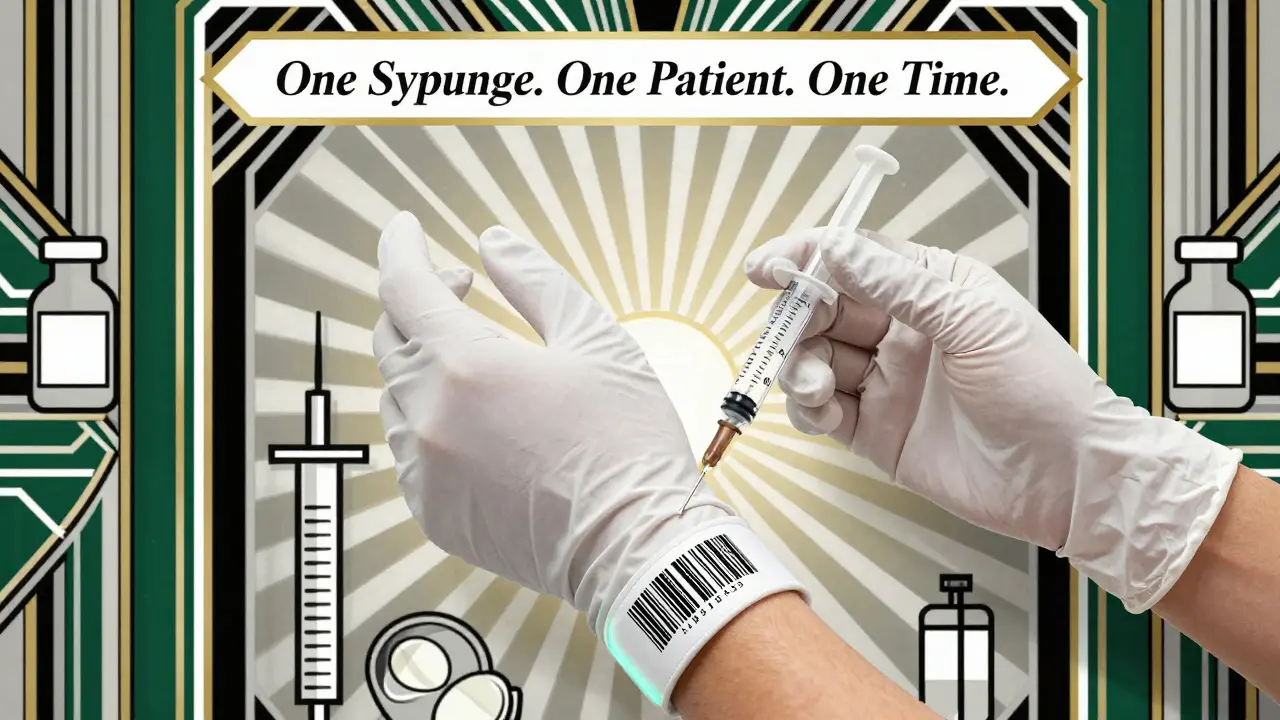
The CDC reports that unsafe injection practices caused 44 outbreaks between 2001 and 2011, affecting over 14,000 patients. That’s not ancient history. In 2023, they updated their guidelines to make it crystal clear: one syringe, one patient, one time. No exceptions. Reusing a syringe-even for the same person-after it’s been left unattended? That’s a violation. And it’s not just about infections. Wrong concentrations of drugs like heparin or insulin can cause strokes, heart attacks, or even death.
The Five Non-Negotiable Rules for Safe Medication Use After Surgery
If you’re recovering at home, you’re not the one handling syringes. But if you’re in a hospital or surgery center, you need to know what to expect-and what to demand. Here are the five rules that every surgical team should follow, based on the 2022 guidelines from the Institute for Safe Medication Practices (ISMP):
- Label everything, immediately. Any syringe, cup, or bowl with medication on the sterile field must be labeled with the drug name, concentration, and expiration time-before it’s even used. Unlabeled containers? Discarded. No second chances.
- Verify every dose. The person giving the medication and the person receiving it must say the drug name, dose, and route out loud. This is called a “read back.” Studies show it cuts verbal order errors by 55%. If someone says, “Give 5 mg of morphine,” and you reply, “You want 5 mg of morphine IV,” you’ve just prevented a mistake.
- Never pre-label empty containers. Writing “morphine 10 mg” on a syringe before you draw it up? That’s a recipe for disaster. You might grab the wrong vial. Always label after filling.
- Double-check high-alert drugs. Opioids, insulin, heparin, vasopressors, and neuromuscular blockers are called “high-alert” for a reason. A small mistake here can kill. These drugs must be stored separately, labeled with clear concentration, and confirmed by two staff members before use.
- Discard after use. If a syringe was used for incremental dosing during surgery-even if it still has medicine left-it must be thrown away immediately after the procedure ends. No saving it for later. No putting it in a drawer. No “I’ll use it next time.”
What You Can Do as a Patient or Family Member
You don’t need to be a nurse to protect yourself. Here’s how to stay safe:
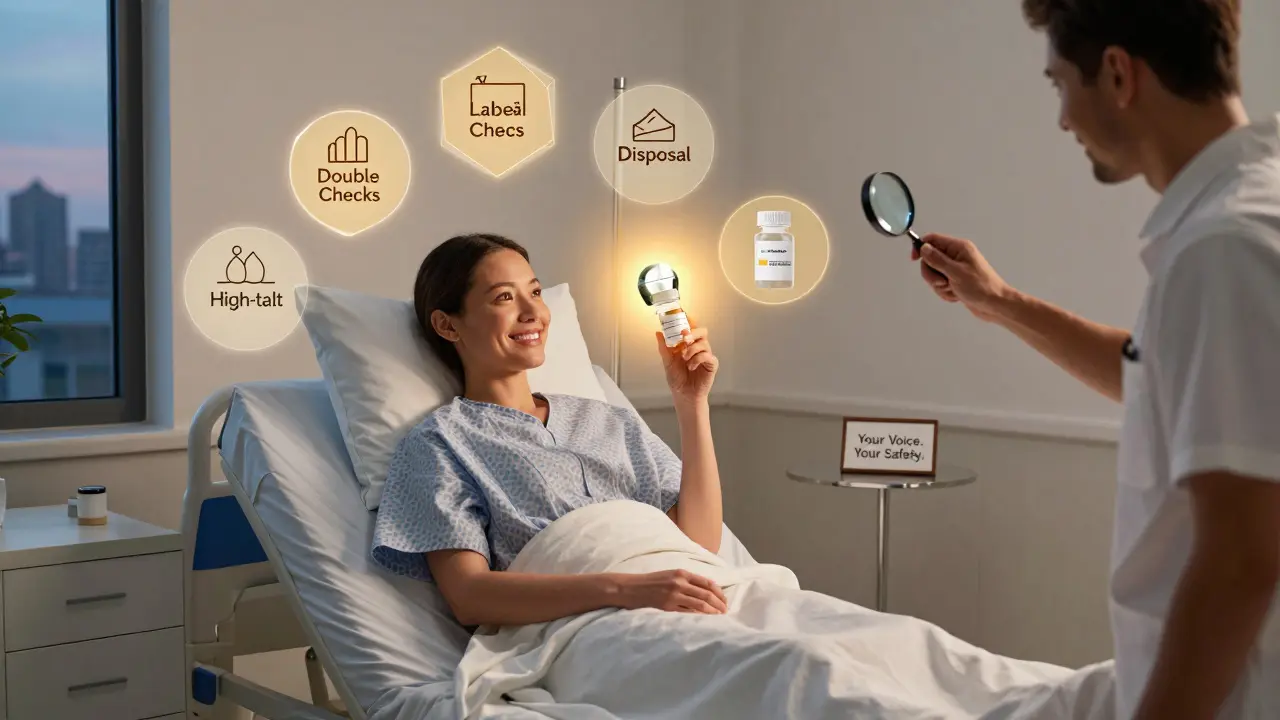
- Ask questions. “What drug is this?” “Why am I getting it?” “How much am I getting?” Don’t be shy. Staff expect this.
- Check labels. If you’re given pills at discharge, read the bottle. Does the name match what your surgeon said? Is the dose right? If you’re unsure, call your pharmacy.
- Speak up about confusion. If a nurse seems rushed, if the label is smudged, if you’re given a drug you’ve never taken before-say something. You’re not being difficult. You’re preventing a mistake.
- Know your meds. Keep a list of everything you’re taking, even over-the-counter stuff. That includes supplements, vitamins, or herbal teas. Some can interfere with pain meds or blood thinners.
Common Mistakes-And How to Avoid Them
Based on data from the ECRI Institute and AORN Journal, here are the top errors-and how to stop them:
- Wrong drug (32% of errors): Often happens when similar-looking vials are side by side-like epinephrine 1:1,000 vs. 1:10,000. Solution: Use color-coded labels and keep similar drugs apart.
- Wrong dose (28%): A nurse thinks “0.5 mg” is “5 mg.” Solution: Always use leading zeros (0.5, not .5) and avoid trailing zeros (5.0, not 5).
- Wrong labeling (19%): A syringe labeled “Lidocaine” turns out to be saline. Solution: Label before leaving the prep area. No exceptions.
- Missed reconciliation at discharge: You’re sent home with three new meds, but your old list wasn’t updated. Solution: Ask for a written list. Compare it to what you were taking before surgery.
The Hidden Cost of Cutting Corners
Some staff skip labeling because it takes 27 seconds. Others skip read backs because they’re “in a hurry.” But here’s the truth: skipping safety steps doesn’t save time-it costs more.
A 2022 study in the AORN Journal found hospitals that fully implemented labeling and verification protocols saw a 63% drop in medication errors. Facilities with partial rules? Only a 12% improvement. And the financial cost? A single preventable error can trigger a $14,500 fine under CMS rules. But beyond fines, there’s human cost: longer hospital stays, permanent injury, even death.
One Reddit thread from anesthesiologists in March 2023 revealed that 15-20% of emergency drug doses were given without full verification. That’s not negligence-it’s burnout. But it’s still dangerous. The pressure to move fast doesn’t justify cutting corners.
What’s Changing in 2026?
Things are getting better. The CDC updated its injection guidelines in November 2023, requiring facemasks during spinal injections to prevent vial contamination. Hospitals are starting to use barcode systems that scan your wristband and the medication before giving it. Smart syringes that auto-detect the drug and dose? Pilot programs are showing a 39% drop in errors.
By 2027, the global market for surgical medication safety tools is expected to hit $8.2 billion. That’s because facilities are realizing: you can’t afford not to invest in safety. Academic hospitals have 87% adoption of full protocols. Ambulatory centers? Only 63%. The gap is closing-but slowly.
Final Thought: Safety Is a Team Sport
Safe medication use after surgery isn’t just about rules on paper. It’s about culture. It’s about a nurse who pauses to double-check. A surgeon who asks, “Did we confirm the dose?” A patient who isn’t afraid to say, “I don’t recognize this pill.”
The tools exist. The guidelines are clear. The data is undeniable. What’s missing is consistency. Whether you’re a patient, a family member, or part of the care team-your voice matters. Don’t assume someone else is watching. Ask. Confirm. Verify. Because after surgery, your safety isn’t a luxury. It’s the minimum.
Eimear Gilroy
February 27, 2026 AT 01:17Just read this after my mom's knee surgery last year. I didn't realize how many little things could go wrong. We thought the nurses were just being efficient, but now I know they were cutting corners. That part about unlabeled syringes? My mom got a dose of something she was allergic to because the label was smudged. She ended up in the ICU. This post should be mandatory reading for every family member.
Martin Halpin
February 28, 2026 AT 12:04Oh please. You’re acting like this is some groundbreaking revelation. Every hospital has protocols. The real problem is staffing shortages. You can’t expect a nurse working 14-hour shifts with 12 patients to pause for a 27-second label check. This is performative safety-like putting seatbelts on a tractor. The system’s broken, not the people. And yes, I’ve worked in ORs. I know how it goes. You don’t need a 12-point checklist when you’ve got 30 seconds before the next patient rolls in.
Vanessa Drummond
March 1, 2026 AT 23:36Ugh. I hate when people turn medical care into a horror story. My cousin had back surgery and everything went perfect. Nurses were chill, meds were clear, no drama. You’re scaring people for no reason. Just trust the system. If you’re that anxious, don’t get surgery. Or stay home and eat turmeric tea. 🤷♀️
Nick Hamby
March 3, 2026 AT 11:39This is one of the most important pieces on post-op care I’ve read in years. The emphasis on culture over compliance is spot-on. Safety isn’t about checkboxes-it’s about psychological safety. When a nurse feels empowered to say, ‘Wait, that doesn’t feel right,’ without fear of being labeled ‘slow’ or ‘difficult,’ that’s when real change happens. The data shows it. The human cost shows it. And yet, too many institutions still treat safety as an inconvenience. Thank you for writing this with such clarity and urgency.
John Smith
March 5, 2026 AT 09:24So let me get this straight. You want us to spend 27 seconds labeling a syringe instead of saving lives? Brilliant. Next you’ll tell us to wash our hands before surgery. I’m sure the guy with the bullet wound in his chest really cares about sterile technique. Priorities, people. Priorities.
Alfred Noble
March 6, 2026 AT 21:16Y’all are overthinking this. I work in a rural clinic. We don’t have barcode scanners or smart syringes. We do what we can. Label after filling? Check. Read-back? If the doc’s not yelling, we do it. Double-check high-alert drugs? Always. We’re not perfect, but we’re not reckless either. Also, typo on purpose. 😅
Matthew Brooker
March 7, 2026 AT 18:34Let’s get real. Every single person reading this has the power to be part of the solution. You don’t need a degree. You just need to speak up. Ask the question. Check the label. Say ‘I don’t recognize this.’ That one thing? It saves lives. You think you’re being annoying? Nah. You’re being the hero in someone’s story. Keep going. You’re doing better than you know.
Emily Wolff
March 8, 2026 AT 05:28Typical. Another post full of fluff and zero accountability. The real issue? Patients who don’t know their own meds. If you can’t tell the difference between aspirin and ibuprofen, maybe you shouldn’t be managing your own care. Stop blaming the nurses. Fix the patient.
Anil bhardwaj
March 8, 2026 AT 08:10Very good points. In India, we often use same syringe for multiple patients due to cost. But after reading this, I will talk to my hospital admin. Maybe we can start with color-coded labels. Small steps. Thank you for sharing.
lela izzani
March 8, 2026 AT 12:33As a nurse for 12 years, I can confirm: the five rules work. We implemented them in our unit three years ago. Errors dropped by 70%. The staff resisted at first-said it was ‘too slow.’ Now? They won’t go back. The real win? Patients started trusting us more. It’s not about bureaucracy. It’s about respect. And yes, I still label syringes before leaving the prep area. Always.
Joanna Reyes
March 10, 2026 AT 01:07I’ve been thinking about this a lot since my dad’s bypass surgery. He was on so many meds, and the discharge paperwork was a mess. I had to call three different pharmacies just to confirm what was supposed to be in the bottle. The system is designed to fail. I spent three days cross-referencing labels, dosages, and timelines. No one helped. No one asked if I needed support. This isn’t just about hospitals-it’s about how we treat people when they’re vulnerable. I’m not mad. I’m just… tired. And I’m not alone.
Stephen Archbold
March 10, 2026 AT 07:57Man I wish I read this before my surgery. My nurse was amazing but she forgot to label the pain med bag. I didn’t know what was in it. I just trusted her. I didn’t want to seem like a pain. But now I know: it’s not a pain to ask. It’s a lifesaver. Also typo on purpose. 😅
kirti juneja
March 10, 2026 AT 20:10Bro this is fire 🔥. I’m a nurse in Mumbai and we’re fighting tooth and nail just to get labels printed. No one cares until someone dies. But I’m telling my team: we’re doing read-backs. We’re labeling before we move. We’re not waiting for the system to fix itself. We’re the change. And yeah, I’m gonna start using ‘high-alert’ as a meme. Heparin = danger zone. 💥