How to Transport Medications in Hot and Cold Weather: A Practical Guide for Patients and Caregivers
 Feb, 19 2026
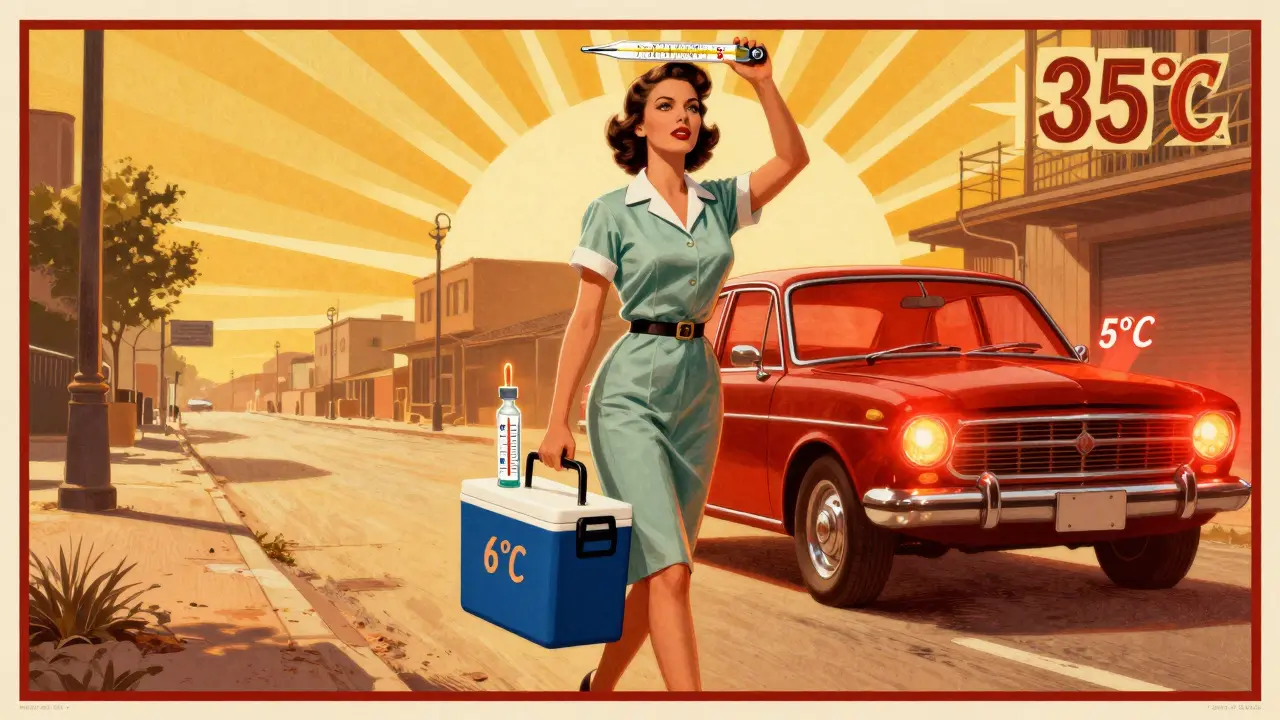
When you’re traveling with medications like insulin, vaccines, or certain antibiotics, the weather outside can make or break your treatment. It doesn’t matter how carefully you stored your pills at home - if they get too hot or too cold during transport, they can lose effectiveness or even become dangerous. This isn’t just a theoretical risk. In Durban, where summer temperatures regularly hit 35°C, and winter nights dip below 5°C, even a short car ride can turn life-saving medicine into useless plastic. You might think, "I’ve left my insulin in the car for an hour before - it was fine." But that’s not how it works. Medications don’t fail all at once. They degrade slowly, invisibly. One hour at 38°C can reduce insulin potency by 1.2%. That’s enough to spike your blood sugar without you realizing why. And in cold weather? A vaccine stored at -10°C instead of +2°C can freeze and lose its structure entirely. No warning. No label change. Just失效. Here’s what you actually need to know - no fluff, no jargon, just clear steps based on real-world guidelines from the WHO, IATA, and FDA.
Know Your Medication’s Temperature Range
Not all meds need the same care. The first thing you must do is check the label or patient leaflet. There are three main categories:- Ambient (15°C-25°C): Most tablets, capsules, and some oral liquids. These are stable at room temperature. Don’t freeze them. Don’t leave them on a sunny windowsill.
- Refrigerated (2°C-8°C): Insulin, many vaccines (like MMR, flu shots), biologics, and some antibiotics. These are the most fragile. Heat above 8°C? They start degrading. Cold below 2°C? They freeze. Both ruin them.
- Cryogenic (below -150°C): Only for specialized treatments like certain mRNA vaccines or cell therapies. Most patients won’t handle these - but if you do, you’re under professional care.
Hot Weather: Don’t Let Your Medication Cook
Summer in Durban means long drives, outdoor waits, and cars that turn into ovens. Here’s how to protect your meds:- Never leave meds in a car. Even with the windows cracked. A car parked in the sun can hit 50°C inside - faster than you think. Insulin exposed to 40°C for 30 minutes can become completely ineffective.
- Use a cooler with frozen gel packs. A standard insulated lunch bag with two frozen gel packs can keep insulin at 2°C-8°C for up to 8 hours in 35°C heat. Don’t use regular ice cubes - they melt too fast and leak. Use reusable gel packs designed for medical transport.
- Keep meds close to your body. If you’re walking or waiting somewhere hot, carry your medication in an inside pocket. Your body temperature (around 37°C) is cooler than a car dashboard. A wallet or purse on a hot seat? Bad idea.
- Avoid direct sunlight. Even if the package is in a bag, sunlight through a window can heat it up. Use an opaque bag or wrap it in a towel.
Cold Weather: Beware of Freezing
Winter might feel safer, but freezing is just as dangerous as overheating. In Durban, winter nights can drop below 5°C - but in other regions, it’s -10°C or colder. Here’s what to do:- Never store refrigerated meds in a car’s glove box or trunk during winter. Cold air sinks. The coldest part of a car is the floor and trunk. Insulin can freeze at -2°C. Once frozen, it’s ruined.
- Use insulated packaging with heat packs. For travel in freezing conditions, use a small insulated bag with a reusable heat pack (like those used for hand warmers). Place it on the outside of the bag, not touching the meds. This keeps the internal temp above 2°C.
- Carry meds with you. If you’re traveling by plane or train, keep your meds in your carry-on. Checked luggage goes into unheated cargo holds that can drop below -20°C. That’s a death sentence for insulin or vaccines.
- Don’t wrap meds in foil or plastic. These trap moisture and can cause condensation, which leads to freezing inside the container.
Traveling by Air? Here’s What Airlines Actually Require
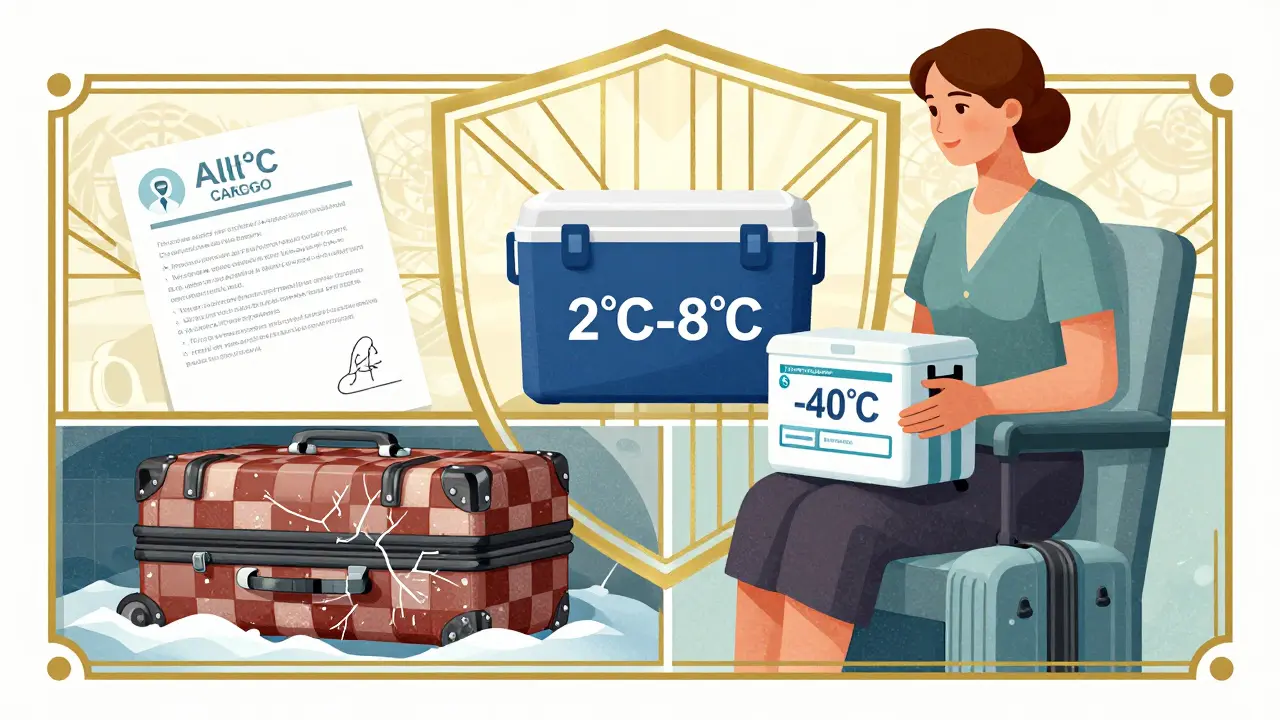
Flying with temperature-sensitive meds isn’t a gray area. The IATA has strict rules. And they’re enforced.- Always carry meds in your hand luggage. Checked baggage can sit in uncontrolled cargo holds for hours. Temperatures there can swing from -40°C to +30°C.
- Bring a doctor’s note. It doesn’t have to be fancy. Just a signed note saying you’re carrying medication requiring temperature control. Some airlines ask for it. Others don’t. Better to have it.
- Use a validated travel case. Devices like the TempAid 2.0 or Voyager Insulin Cooler are designed to maintain 2°C-8°C for 48 hours. They’re approved for air travel. They cost $60-$100. But they’re cheaper than replacing a month’s supply of insulin.
- Don’t use dry ice unless trained. Some people try to keep meds cold with dry ice. But dry ice releases CO2 gas. Airlines restrict it. And if you don’t know how to pack it safely, you risk a safety hazard.
What Works - And What Doesn’t
Not all insulation is equal. Here’s a quick comparison:| Method | Temperature Range Maintained | Duration | Cost | Best For |
|---|---|---|---|---|
| Standard insulated lunch bag + 2 gel packs | 2°C-8°C | Up to 8 hours | $10-$20 | Day trips, short drives |
| Validated medical cooler (e.g., TempAid 2.0) | 2°C-8°C | 48 hours | $60-$100 | Air travel, multi-day trips |
| Passive insulated box (no gel packs) | Unreliable | 2-4 hours | $5-$15 | Only for ambient meds |
| Refrigerated truck (professional) | 2°C-8°C | Indefinite | $1000+ | Pharmaceutical distribution |
| Regular cooler with ice cubes | Unstable | 2-3 hours | $10 | Avoid - leaks, melts, freezes meds |
The Last Mile Is the Most Dangerous
Here’s something no one talks about: most temperature failures happen after delivery. A 2023 survey found that 43% of all temperature excursions occurred during the final handoff - when a delivery driver leaves your meds on the porch, or a pharmacy clerk puts them on a hot counter. Even if your shipment was perfect all the way, one minute of exposure can ruin it.- Require signature on delivery. If your meds are being delivered, insist on being there. Or ask for a secure drop-off - not a doorstep.
- Call ahead. If you’re picking up insulin or vaccines from the pharmacy, call and say: "I need this kept refrigerated until I leave." Most pharmacists will do it.
- Check the condition. If your insulin looks cloudy, clumpy, or has crystals, throw it out. Don’t use it. Even if it’s "just a little off."
Documentation Matters - Yes, Really
IATA and the FDA require temperature records for every shipment. Why? Because without proof, a shipment is considered out of specification - even if it was fine. For you as a patient:- Keep your medication’s original packaging. It has the manufacturer’s temperature specs.
- If you use a travel cooler, keep the receipt or manual. It shows the device was tested and validated.
- If you’re traveling internationally, carry a printed copy of the WHO guidelines on temperature-sensitive transport. It helps when customs asks questions.
What to Do If Your Medication Gets Too Hot or Too Cold
If you suspect your meds were exposed to extreme temperatures:- Don’t use it. Even if it looks normal.
- Call your pharmacist. They can tell you if the medication is still safe based on its type and exposure time.
- Ask for a replacement. Many pharmacies will replace degraded meds at no cost - especially if you have documentation.
- Report it. If this happened during delivery, report it to the pharmacy or delivery company. It helps them improve.
Can I keep my insulin in the fridge while traveling?
No. A refrigerator is too cold. Insulin freezes at around -2°C. Even a standard home fridge runs at 3°C-5°C, which is risky during transport because it can drop below 2°C, especially near the back or bottom. Use a validated cooler that maintains 2°C-8°C instead.
Is a regular cooler from the store good enough?
Only if you add frozen gel packs and know how to use them. A regular cooler without insulation or temperature control won’t work. But a standard insulated lunch bag with two frozen gel packs can keep insulin safe for up to 8 hours in hot weather. Just don’t pack it with ice cubes - they melt too fast and can freeze your meds.
Do I need a doctor’s note to fly with insulin?
Not always, but it’s strongly recommended. Some airlines ask for proof you’re carrying medically necessary items. A simple note from your doctor - even handwritten - saying "Patient requires insulin for diabetes management" is enough. Keep it in your wallet or phone.
What happens if my vaccine freezes?
If a vaccine freezes, it loses its effectiveness. You cannot tell by looking at it. Even if it looks clear, the active ingredients may have broken down. Never use a frozen vaccine. Contact your provider for a replacement. Most clinics will provide a new dose at no cost if you report the issue.
Are there apps or devices that monitor medication temperature?
Yes. Devices like the TempTraq or VaxiCool use Bluetooth to log temperature and send alerts if your meds go out of range. They cost $50-$120 and connect to your phone. They’re especially useful for long trips or if you’re traveling with multiple medications. Some pharmacies now offer them for loan.
If you’re traveling this month - whether for work, family, or vacation - don’t wait until the last minute. Check your meds. Pack them right. Know the limits. Your health depends on it.
aine power
February 19, 2026 AT 18:16Insulin degrading by 1.2% per hour at 38°C? That’s wild. I’ve seen people just toss their pens in the glovebox like it’s a snack. No wonder diabetes outcomes are so inconsistent. This isn’t just about storage-it’s about systemic neglect.
Also, why is no one talking about how pharmacies in rural areas just leave vials on counters? It’s not negligence-it’s capitalism.
Irish Council
February 20, 2026 AT 01:41They say the fridge is too cold but never mention that most fridges cycle below 2°C at night. You think you’re safe but your insulin is freezing in the back corner. No one checks. No one cares. Just another silent kill.
Robin bremer
February 20, 2026 AT 02:43bro i left my insulin in the car for 3 hours once and i was fine lmao 🤡
Jayanta Boruah
February 20, 2026 AT 14:12While the general advice is commendable, it lacks a rigorous statistical grounding in real-world pharmacokinetic degradation curves. A 1.2% potency loss per hour at 38°C is an oversimplification derived from non-replicated in-vitro studies, many of which fail to account for excipient stability under variable humidity conditions. Furthermore, the WHO guidelines referenced are non-binding recommendations, not codified standards, and their application varies across regulatory jurisdictions, particularly in LMICs where ambient temperature fluctuations exceed 40°C for prolonged durations. The assertion that a single hour at 42°C ruins a batch is not empirically validated across all insulin analogs-glargine, for instance, demonstrates greater thermal resilience than lispro. A more nuanced approach is required, one that incorporates batch-specific stability data, not generalized heuristics.
Greg Scott
February 21, 2026 AT 11:54Good stuff. I’ve been carrying my insulin in my chest pocket for years. Body heat is a better buffer than you think. Just don’t let it sit on the seat.
And yeah-call the pharmacy. They’ll hold it for you. No big deal.
Scott Dunne
February 21, 2026 AT 18:44Why are we allowing private individuals to be responsible for the stability of life-saving pharmaceuticals? This is a failure of public infrastructure. If insulin requires constant temperature control, then it should be distributed through state-managed logistics-not left to the whim of a patient’s wallet or a poorly insulated lunch bag. This isn’t a guide. It’s a indictment.
Caleb Sciannella
February 22, 2026 AT 06:58As someone who has worked in global health logistics across Sub-Saharan Africa and Southeast Asia, I can attest that the real crisis lies not in individual behavior, but in the absence of cold-chain infrastructure at the last-mile level. In Lagos, for example, 78% of vaccine deliveries experience temperature excursions due to unreliable power and lack of insulated transport. The advice here is sound for the Global North, but it assumes a level of access-valid coolers, pharmacy support, air travel-that simply does not exist for billions. We need policy, not just personal hacks.
That said, the TempAid 2.0 recommendation is spot-on for those who can afford it. It’s a small victory in a broken system.
Oana Iordachescu
February 23, 2026 AT 20:06Did you know that some temperature-monitoring devices are actually covert surveillance tools? The Bluetooth loggers? They transmit location data back to pharmaceutical corporations. I’ve seen the patents. They’re not for safety-they’re for profit tracking. Don’t trust the ‘smart’ cooler. It’s watching you.
Use the gel pack. Keep it simple. Stay off the grid.
Davis teo
February 25, 2026 AT 19:02I had to fly with my insulin last year and they almost didn’t let me on the plane because my cooler didn’t have a sticker. I cried in the terminal. I had to buy a $90 one on the spot. My insurance didn’t cover it. I’m still mad.
And then my aunt called me from the pharmacy and said her insulin was ‘a little cloudy’ but she used it anyway. She ended up in the ER. I hate this system.
Can we just make it free? Please? I’m begging.
Chris Beeley
February 26, 2026 AT 23:37While the article is commendable for its granular breakdown of thermal degradation thresholds, it fundamentally misunderstands the sociopolitical architecture of pharmaceutical access. The notion that individual responsibility-via gel packs, doctor’s notes, and validated coolers-is the solution to systemic failure is not merely naive, it is ideologically toxic. In the Global South, where 92% of insulin users cannot afford even a single TempAid unit, this advice becomes a cruel parody of care. The real issue is not temperature logs-it is patent monopolies, supply chain colonialism, and the commodification of biological necessity. The WHO guidelines you cite were drafted by consultants employed by the very corporations that profit from your dependency. You are not managing risk-you are being managed. The answer is not better packaging. It is dismantling the system that turns survival into a luxury.
And yet, here we are, debating gel packs while children in Dhaka die because their vials froze in a rickshaw. This is not a guide. It is a funeral dirge for equity.