Labeling Effect: Does 'Generic' Change Drug Response?
 Aug, 5 2026
You take a pill for your headache. It’s just a white tablet, unmarked and plain. You feel better in twenty minutes. Now imagine that same pill, but it comes in a fancy box with a familiar logo you’ve seen on TV ads for years. You take it, and the pain vanishes even faster. Is the second pill actually stronger? No. Chemically, they are identical. But your brain thinks otherwise.
This phenomenon is known as the labeling effect, which is a psychological response where the perception of a medication's label influences its therapeutic outcome, regardless of chemical composition. It’s not just about feeling good; it affects whether you stick to your treatment plan at all. When we talk about generic drugs, which are medications equivalent to brand-name drugs in dosage, safety, strength, and quality but sold under different names, this effect becomes a major hurdle for healthcare providers. The question isn't just whether generics work-they do-but whether the label itself changes how your body responds.
The Psychology Behind the Pill
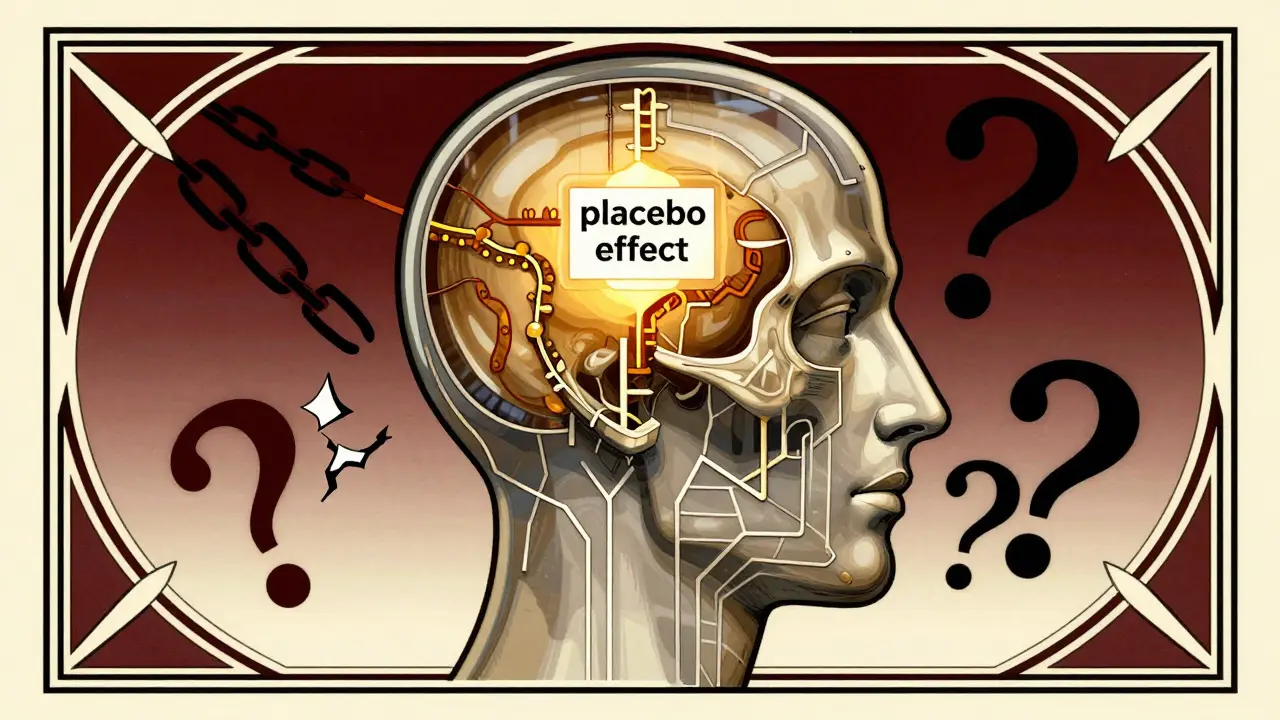
Your brain is wired to associate packaging with power. For decades, pharmaceutical companies have spent billions marketing brand-name medications, creating a strong mental link between those logos and relief. This creates a powerful placebo effect, which is a beneficial health outcome resulting from a patient's belief in the efficacy of a treatment, rather than the treatment itself.
Research backs this up hard. In a 2016 study published in *Psychology & Health*, researchers gave participants either real ibuprofen or a placebo (sugar pill). Here’s the twist: some pills were labeled as "brand-name," and others as "generic." The results were striking. Participants who took the brand-labeled placebo reported significant pain reduction-almost as much as those taking the actual drug. But those who took the generic-labeled placebo saw much less relief. Their brains essentially told their bodies, "This isn’t the good stuff," so the healing response was muted.
Then there’s the flip side: the nocebo effect, which is a harmful health outcome caused by negative expectations about a treatment. If you believe a generic drug is "weaker" or "less pure," you might actually experience more side effects or less efficacy, even if the chemistry is perfect. A 2019 study in the *European Journal of Public Health* found that patients given generic-labeled placebos were more likely to stop taking them early compared to those given brand-labeled ones. They simply didn’t trust the medicine enough to finish the course.
Why Generic Labels Trigger Doubt
It’s easy to dismiss these findings as mere superstition, but the psychology is rooted in real cognitive biases. We judge books by their covers, and pills by their labels. Brand-name drugs often come with distinct colors, shapes, and high-quality packaging. Generics, by contrast, are often plain white or beige tablets in simple blister packs. This visual difference signals "budget" or "lesser" to our subconscious.
Consider the cost factor. Generic drugs typically cost 80-85% less than their brand-name counterparts. While this is great for your wallet, it can trigger a "you get what you pay for" mentality. Patients often equate price with quality. If a drug costs $5 instead of $50, the assumption is that something must be missing. This bias is particularly strong among people with lower health literacy. The same 2019 study noted that patients with less medical knowledge had a discontinuation rate of 67% for generic-labeled meds, compared to 41% for those who understood pharmacology better.
Furthermore, the language used on prescriptions matters. When a doctor writes "Take Lisinopril" (generic) versus "Take Zestril" (brand), the latter sounds like a specific, engineered solution. The former sounds like a commodity. This subtle linguistic cue reinforces the idea that the brand is the "original" and the generic is just a copy, potentially inferior.
Real-World Consequences for Adherence
The labeling effect isn’t just a lab curiosity; it has serious implications for public health. Medication adherence-the act of taking drugs exactly as prescribed-is already a massive problem. According to the World Health Organization, only about 50% of patients with chronic conditions take their medications correctly. When you add the stigma of generic labeling into the mix, that number drops further.
Imagine you’re managing hypertension. You need to take a pill every single day for the rest of your life. If you start with a brand-name drug and feel great, then your insurance switches you to a generic, you might notice nothing changed physically. But psychologically, you feel a loss of control. You might skip doses, thinking, "It’s probably not working anyway." Over time, this leads to uncontrolled blood pressure, increased risk of stroke, and higher healthcare costs.
A survey by the American Pharmacists Association found that 63% of pharmacists encounter patient concerns about generic efficacy directly tied to labeling perceptions. These aren’t irrational fears; they’re deeply ingrained beliefs. When patients doubt their medication, they don’t just suffer from untreated symptoms; they erode the trust relationship with their healthcare providers. Doctors spend valuable appointment time reassuring patients rather than focusing on care plans.
Are Generics Actually Different?
Let’s clear up the science first. Regulatory agencies like the FDA require generic drugs to demonstrate bioequivalence. This means they must deliver the same amount of active ingredient into your bloodstream within the same timeframe as the brand-name drug. The allowable range is tight: 80-125% of the reference drug’s performance. For most medications, this difference is clinically insignificant.
| Attribute | Brand-Name Drug | Generic Drug |
|---|---|---|
| Active Ingredient | Original formulation | Identical chemical structure |
| Cost | High (often hundreds of dollars) | Low (typically 80-85% cheaper) |
| Packaging | Distinctive branding, colors, logos | Plain, standardized labeling |
| Inactive Ingredients | Proprietary binders/fillers | May differ (can affect allergies/taste) |
| Perceived Efficacy | Higher due to labeling effect | Lower due to nocebo/placebo dynamics |
However, there is one area where differences exist: inactive ingredients. These are the fillers, dyes, and binders that hold the pill together. While they don’t treat the disease, they can matter. Some patients are allergic to certain dyes or gluten found in generic binders. Also, extended-release mechanisms can vary slightly between manufacturers, though regulatory standards keep this minimal. For narrow-therapeutic-index drugs (like warfarin or levothyroxine), where tiny dose changes matter greatly, doctors sometimes prefer sticking to one manufacturer to avoid variability. But for the vast majority of medications, the active ingredient does the heavy lifting, and generics perform identically.

Bridging the Gap: Solutions for Patients and Providers
If the labeling effect is real, how do we fix it? We can’t change human psychology overnight, but we can mitigate its impact through education and transparent communication.
First, healthcare providers need to normalize generics. Instead of saying, "Here’s your generic," try framing it positively: "This is the exact same medicine as the brand name, just without the marketing markup." Studies show that adding phrases like "therapeutically equivalent to [Brand Name]" on prescription labels reduces discontinuation rates significantly. One 2023 trial found this simple tweak dropped dropout rates from 52% to 37%.
Second, patients should be empowered with facts. Understanding that generics undergo rigorous testing helps dismantle the "cheap equals bad" myth. Organizations like the FDA’s "It’s the Same Medicine" campaign have successfully reduced patient concerns by 28% in pilot programs. Knowledge is the antidote to fear.
Finally, consistency matters. If a patient is stable on a specific generic manufacturer, switching back and forth between different generic brands can cause anxiety and perceived instability. Asking your pharmacist to source from the same manufacturer whenever possible can help maintain psychological comfort, even if the clinical difference is negligible.
The Bottom Line
Does the word "generic" change your drug response? Scientifically, no. Psychologically, absolutely. The labeling effect proves that our minds play a crucial role in healing. By recognizing this bias, we can make smarter choices. Don’t let a plain white pill fool you into thinking it’s weak. Trust the science, talk to your doctor, and remember: the best drug is the one you actually take consistently, regardless of what the box says.
Are generic drugs really as effective as brand-name drugs?
Yes. Regulatory agencies like the FDA require generic drugs to be bioequivalent to brand-name drugs, meaning they contain the same active ingredient in the same strength and dosage form. Clinical studies consistently show that generics perform identically to brand-name medications in treating diseases. Any perceived difference in effectiveness is usually due to the placebo or nocebo effect influenced by labeling and packaging.
What causes the labeling effect in medication?
The labeling effect is driven by psychological factors such as brand association, price perception, and packaging aesthetics. Patients often associate expensive, well-branded products with higher quality and efficacy. Conversely, plain, low-cost generic labels can trigger doubts about potency, leading to weaker placebo responses or stronger nocebo reactions (negative expectations causing poor outcomes).
Can generic drugs cause more side effects than brand-name drugs?
Generally, no. Since the active ingredient is identical, side effect profiles should be similar. However, generic drugs may use different inactive ingredients (fillers, dyes, binders). Rarely, a patient might be sensitive or allergic to a specific filler used in a generic version. Additionally, the nocebo effect can lead patients to report more side effects simply because they expect the generic to be "worse" or "impure."
Should I stay on the same brand or switch to generic?
For most medications, switching to generic is safe and recommended to save money. However, for narrow-therapeutic-index drugs (like thyroid medication or blood thinners), consistency is key. If you are stable on a specific generic manufacturer, ask your pharmacist to keep using that same brand to avoid minor variations in inactive ingredients or release mechanisms that could theoretically affect absorption.
How can doctors help reduce the labeling effect?
Doctors can explicitly state that generic drugs are therapeutically equivalent to brand-name versions. Using positive language, such as "this is the same medicine, just without the brand tax," helps build trust. Educating patients about the rigorous testing generics undergo and addressing concerns proactively can significantly improve adherence and reduce the psychological barrier to taking generic medications.