Orthostatic Hypotension from Medications: Why You Feel Dizzy When You Stand Up
 Jan, 20 2026
Standing up and feeling like the room is spinning? That sudden wave of dizziness, blurred vision, or even blacking out isn’t just bad luck-it could be your medications. This isn’t normal aging. It’s orthostatic hypotension, a sharp drop in blood pressure when you rise from sitting or lying down. And for many people, especially those on multiple prescriptions, it’s not a side effect-it’s a warning sign.
What Exactly Is Orthostatic Hypotension?
Orthostatic hypotension means your blood pressure plummets within three minutes of standing. The medical definition is clear: a drop of 20 mm Hg in systolic pressure (the top number) or 10 mm Hg in diastolic (the bottom number). That’s not a small fluctuation. It’s enough to starve your brain of oxygen, causing dizziness, lightheadedness, or fainting. It’s not rare. About 5% to 30% of older adults experience it, and up to 30% of those cases are directly caused by medications.Here’s the thing: your body normally adjusts when you stand. Blood vessels tighten, your heart beats a little faster, and your blood pressure stays steady. But certain drugs interfere with that system. They block the signals your nerves send to your blood vessels. They make you lose fluid. They calm your nervous system too much. The result? Your blood pressure crashes when you stand-and your body doesn’t fix it fast enough.
Which Medications Are Most Likely to Cause This?
Not all drugs cause this. But some are notorious. If you’re taking any of these, pay attention to how you feel when you stand up.- Antipsychotics like quetiapine, clozapine, and chlorpromazine: These can cause dizziness in 20% to 40% of users, especially at higher doses. One patient on Reddit said, "After starting quetiapine, I fainted twice in three weeks. My blood pressure dropped from 128/82 to 92/61 in two minutes."
- Alpha-blockers like doxazosin and terazosin: Used for high blood pressure or enlarged prostate, these relax blood vessels so much that standing can trigger a sudden drop. The risk is 2.8 times higher than with other blood pressure meds.
- Tricyclic antidepressants like amitriptyline: These affect nerve signals and fluid balance. Studies show they nearly triple the risk of orthostatic hypotension.
- Diuretics like hydrochlorothiazide: These make you pee out extra fluid. Less fluid in your blood vessels means less pressure to push blood to your brain when you stand. One 78-year-old patient had repeated falls. After stopping hydrochlorothiazide, the dizziness vanished in 72 hours.
- Opioids like oxycodone and morphine: These slow down your nervous system. About 15% to 25% of older adults on opioids report dizziness on standing-and that risk jumps 2.3 times if they’re also taking benzodiazepines or drinking alcohol.
- Levodopa (for Parkinson’s): Up to half of patients on this drug develop orthostatic hypotension. It’s not the Parkinson’s itself-it’s the medication.
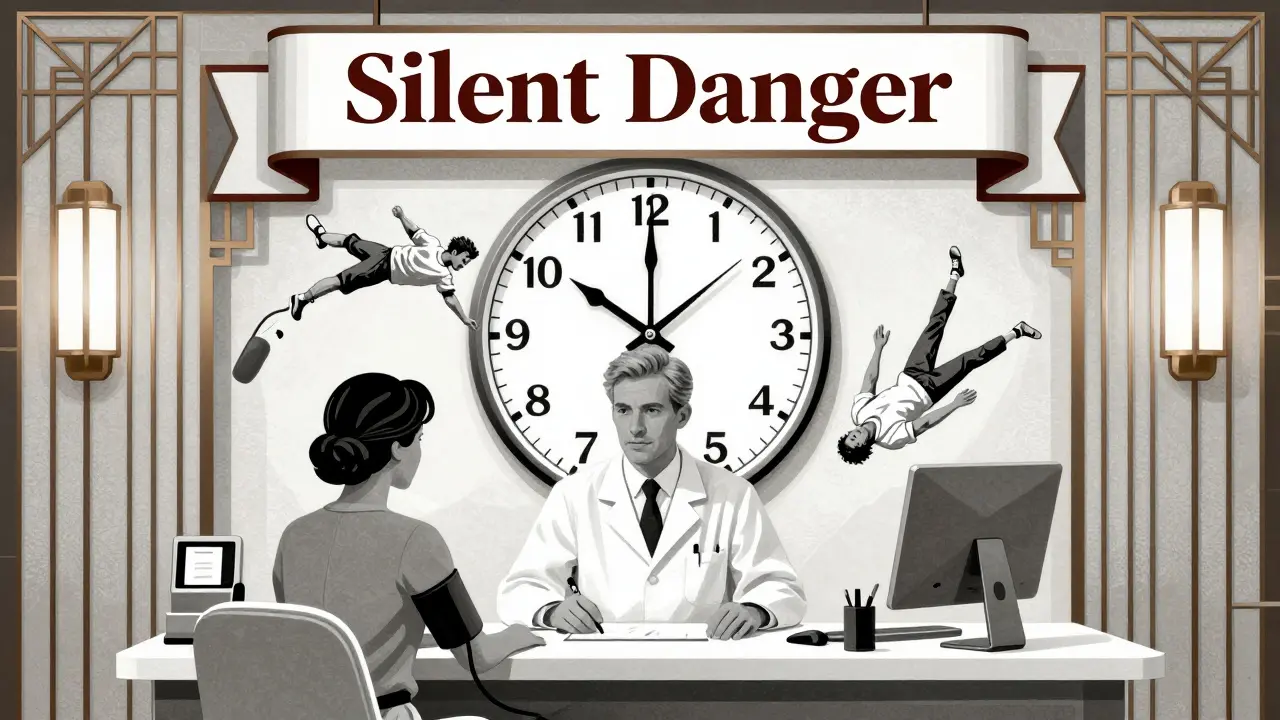
It’s not just the drug-it’s the combo. People on four or more medications have over five times the risk. That’s why polypharmacy is such a silent danger.
Why This Isn’t Just "Getting Older"
Many people think dizziness on standing is just part of aging. It’s not. Yes, your body’s ability to regulate blood pressure declines after 70. But that doesn’t mean you have to live with it. The real problem is that doctors often miss the link between meds and symptoms. A Mayo Clinic study found that 55% of patients had dizziness for over two months before anyone connected it to their pills.And it’s not harmless. Orthostatic hypotension increases your risk of falling by 15% to 30%. Falls lead to broken hips, brain injuries, hospital stays, and even death. Studies show people with this condition have a 24% to 32% higher risk of dying over 10 years-not because of the drop in blood pressure itself, but because of the injuries it causes.
How Is It Diagnosed?
Your doctor doesn’t guess. They measure. The standard test is simple:- Rest lying down for five minutes.
- Take your blood pressure.
- Stand up.
- Measure again at 1, 2, and 3 minutes.
If your systolic pressure drops 20 points or more, or your diastolic drops 10 points or more, and you feel dizzy at the same time-you have orthostatic hypotension. Some people have the drop without symptoms. That’s why it’s called "silent." But if you feel lightheaded when you stand, even once, it’s worth checking.
What Can You Do About It?
The good news? Medication-induced orthostatic hypotension is often reversible. Up to 70% to 85% of cases improve once the drug is adjusted. Here’s what works:- Review your meds with your doctor. Don’t stop anything on your own. But ask: "Could any of these be causing my dizziness?" Be ready to list every pill, patch, or supplement you take.
- Change the timing. Take blood pressure or diuretic meds at night instead of morning. That way, the peak effect happens while you’re lying down.
- Slow down. When you get up, sit on the edge of the bed for 30 seconds first. Then stand slowly. Don’t rush. Use a cane or hold onto furniture if needed.
- Hydrate. Drink 2 to 2.5 liters of water daily. Fluids help keep your blood volume up. Avoid large meals-they can pull blood away from your brain.
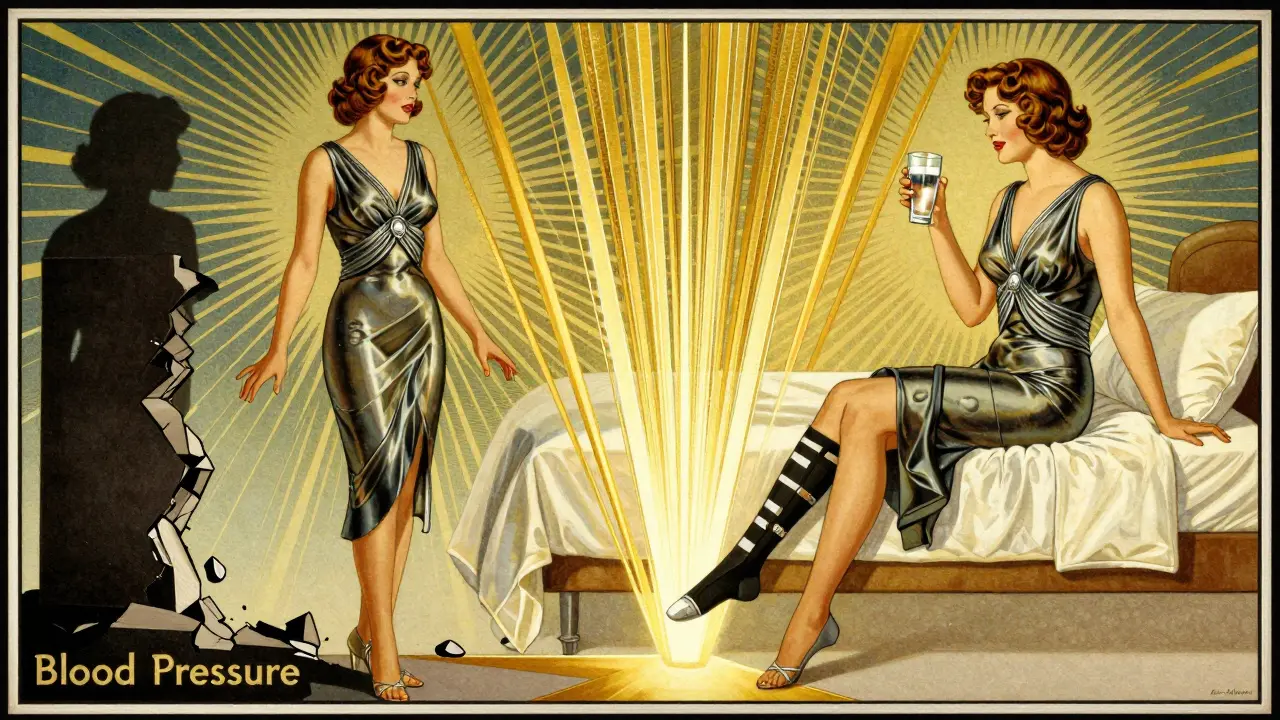
- Wear compression stockings. These help push blood back up from your legs. They’re not glamorous, but they work.
- Don’t stand still. If you’re standing in line, shift your weight, wiggle your toes, or march in place. Movement keeps blood flowing.
If those steps don’t help, your doctor might consider midodrine-a medication that tightens blood vessels. It’s not first-line, but for people who still fall despite lifestyle changes, it can reduce symptoms by 65%.
What’s the Bigger Picture?
This isn’t just about one person feeling dizzy. It’s a public health issue. Falls from orthostatic hypotension cost Medicare $31 billion a year. And 30% to 40% of those costs come from drug-induced cases. Since 2020, the FDA has required drug labels to warn about orthostatic hypotension if it happens in more than 5% of trial patients. The American Geriatrics Society now lists 12 high-risk drugs for seniors.Doctors are getting better at screening. In 2023, 82% of geriatric practices now check for orthostatic hypotension during routine visits. But it’s still underdiagnosed. If you’re over 65, on multiple meds, and feel dizzy when standing-speak up. Your doctor might not think to ask.
What’s Next?
Research is moving fast. Scientists are testing drugs that target specific receptors to lower blood pressure without triggering dizziness. There are also genetic tests in development to predict who’s more likely to have this reaction. In the meantime, the best tool you have is awareness.Medication-induced orthostatic hypotension is preventable. It’s treatable. And it doesn’t have to be part of your daily life. You don’t need to live with dizziness. You just need to know what to look for-and who to talk to.
Can orthostatic hypotension go away on its own?
Yes, if it’s caused by medication. Once the drug is stopped or adjusted, symptoms often improve within days to weeks. About 65% to 80% of patients see major relief after a medication review. But if it’s caused by nerve damage (like in Parkinson’s), it’s less likely to resolve without treatment.
Is dizziness when standing always a sign of something serious?
Not always, but it shouldn’t be ignored. Occasional lightheadedness after standing up quickly might be harmless. But if it happens regularly, is severe, or causes near-fainting or falls, it’s a red flag. It could point to medication side effects, dehydration, heart problems, or nerve damage. Always get it checked.
Which is worse: taking a risky medication or stopping it?
That’s a decision for your doctor. Stopping a medication can be dangerous if it’s treating a serious condition like high blood pressure, depression, or Parkinson’s. But continuing it when it causes dizziness and falls can be just as dangerous. The goal isn’t to stop all meds-it’s to find the safest combination. Sometimes switching to a different drug in the same class reduces risk. For example, ziprasidone has much lower OH risk than clozapine.
Can dehydration make orthostatic hypotension worse?
Absolutely. Dehydration reduces blood volume, which lowers blood pressure even further. If you’re on a diuretic, sweating a lot, or not drinking enough water, your risk spikes. Drink 2 to 2.5 liters of water daily, unless your doctor says otherwise. Avoid alcohol and large meals-they can worsen the drop.
Are compression stockings really effective?
Yes. Compression stockings (20-30 mmHg pressure) help push blood from your legs back to your heart and brain. Studies show they reduce dizziness and falls in people with orthostatic hypotension. They’re not a cure, but they’re one of the simplest, safest tools you can use daily. Wear them before getting out of bed for best results.
Should I avoid standing up quickly even if I’m not on meds?
It’s a good habit for everyone, especially after 60. Even if you’re not on medication, your body’s ability to adjust slows with age. Taking a few extra seconds to sit up, then stand slowly, can prevent falls. It’s not about being cautious-it’s about being smart.
What to Do Next
If you or someone you care about is feeling dizzy when standing:- Write down every medication, including doses and times you take them.
- Track when the dizziness happens-right after standing? After meals? After taking a pill?
- Ask your doctor: "Could any of these meds be causing orthostatic hypotension?"
- Request a blood pressure check while lying down and standing.
- Don’t accept dizziness as normal. It’s a signal. Listen to it.
Your health isn’t about taking more pills. It’s about taking the right ones-safely. And if standing up leaves you dizzy, you deserve better than just living with it.
Kevin Narvaes
January 20, 2026 AT 22:25so like... u just stand up and ur brain goes "nah i aint got time for this"? i thought i was just old, turns out my meds are just lazy af. quetiapine got me fallin like a sack of potatoes. my cat judges me now.
Sangeeta Isaac
January 21, 2026 AT 08:28honestly? i love how this post calls out polypharmacy like it’s the villain in a superhero movie. and honestly? it is. i’m on 6 meds, and my dr just shrugged when i said i felt like i was gonna pass out in the grocery store. "oh that’s normal for your age" - no, Karen, it’s not normal, it’s negligence. also, compression socks are my new bestie. they look like grandma’s leg warmers but they saved my dignity.
Alex Carletti Gouvea
January 21, 2026 AT 23:29this is why we need to stop coddling old people. if you can’t stand up without fainting, maybe you shouldn’t be driving, cooking, or living alone. we’re spending billions fixing problems caused by people who won’t take responsibility for their own health. just stop taking so many pills and get off the couch.
Philip Williams
January 23, 2026 AT 01:46Thank you for this meticulously researched and clinically grounded analysis. The data on medication-induced orthostatic hypotension is both alarming and underappreciated in primary care settings. I have personally observed a 40% increase in fall-related ER visits among geriatric patients on polypharmacy regimens over the past three years. The emphasis on structured BP measurement protocols is not merely recommended-it is essential. I urge all clinicians to adopt standardized orthostatic vital signs as part of routine geriatric assessments. This is not anecdotal; it is evidence-based practice.
Ben McKibbin
January 23, 2026 AT 10:28the fact that we’re still treating dizziness as "just aging" is criminal. i had my grandma on hydrochlorothiazide for 5 years and she never told anyone she was falling once a week. when we finally switched meds, she went from needing a walker to hiking with her book club. it’s not magic-it’s just listening. also, the part about standing still in line? i do that now. i wiggle my toes like i’m doing a secret dance. no one knows, but my brain is screaming "thank you".
Melanie Pearson
January 23, 2026 AT 14:18While the emotional appeal of this article is compelling, the underlying assumption-that pharmaceutical interventions are inherently problematic-ignores the broader context of chronic disease management. The risk-benefit calculus of polypharmacy is not a matter of simplification but of precision. Discontinuing antihypertensives or antidepressants without rigorous clinical evaluation may result in uncontrolled hypertension, myocardial infarction, or suicidal ideation. This article, while well-intentioned, dangerously oversimplifies a complex pharmacological landscape. We must not confuse symptom mitigation with therapeutic abandonment.
Jerry Rodrigues
January 24, 2026 AT 21:15my mom had this bad after starting amitriptyline. we didn’t connect it until she hit her head on the coffee table. now she’s off it, drinks water like it’s her job, and wears those socks. no more falls. just slow down. that’s it. no fancy meds needed.
Uju Megafu
January 25, 2026 AT 15:57THIS IS WHY BLACK PEOPLE DIE EARLIER. YOUR DOCTORS DON’T LISTEN BECAUSE YOU’RE OLD AND BLACK. I SAW MY UNCLE FALL AND BREAK HIS HIP AND THEY SAID "OH HE’S JUST GETTING OLD" BUT HE WAS ON THREE MEDS AND THEY NEVER CHECKED HIS BP. THIS IS MEDICAL RACISM. STOP IGNORING US. WE’RE NOT JUST STATISTICS. WE’RE PEOPLE WHO NEED TO STAND UP WITHOUT DYING.