Physical Dependence vs Addiction: Clear Differences in Opioid Use Disorder
 Dec, 2 2025
Opioid Tapering Schedule Calculator
This tool helps you understand safe tapering schedules based on CDC guidelines. Always consult your doctor before making changes to your opioid medication.
Follow this schedule under medical supervision.
Your Schedule
Important: Physical dependence is not addiction. Stopping opioids suddenly can cause severe withdrawal symptoms. This tool provides general guidance only. Always work with your doctor to create a personalized plan.
Many people think if someone takes opioids for a long time and feels sick when they stop, they’re addicted. That’s not true. And confusing these two things can hurt patients - even kill them.
What Is Physical Dependence?
Physical dependence happens when your body gets used to having a drug in your system. It’s not about wanting the drug. It’s not about craving it. It’s biology.
When you take opioids like oxycodone, hydrocodone, or morphine every day for more than a week, your brain adjusts. It starts making less of its own natural painkillers and changes how nerve cells fire. This is normal. It’s what happens with blood pressure meds, antidepressants, even caffeine. Your body adapts.
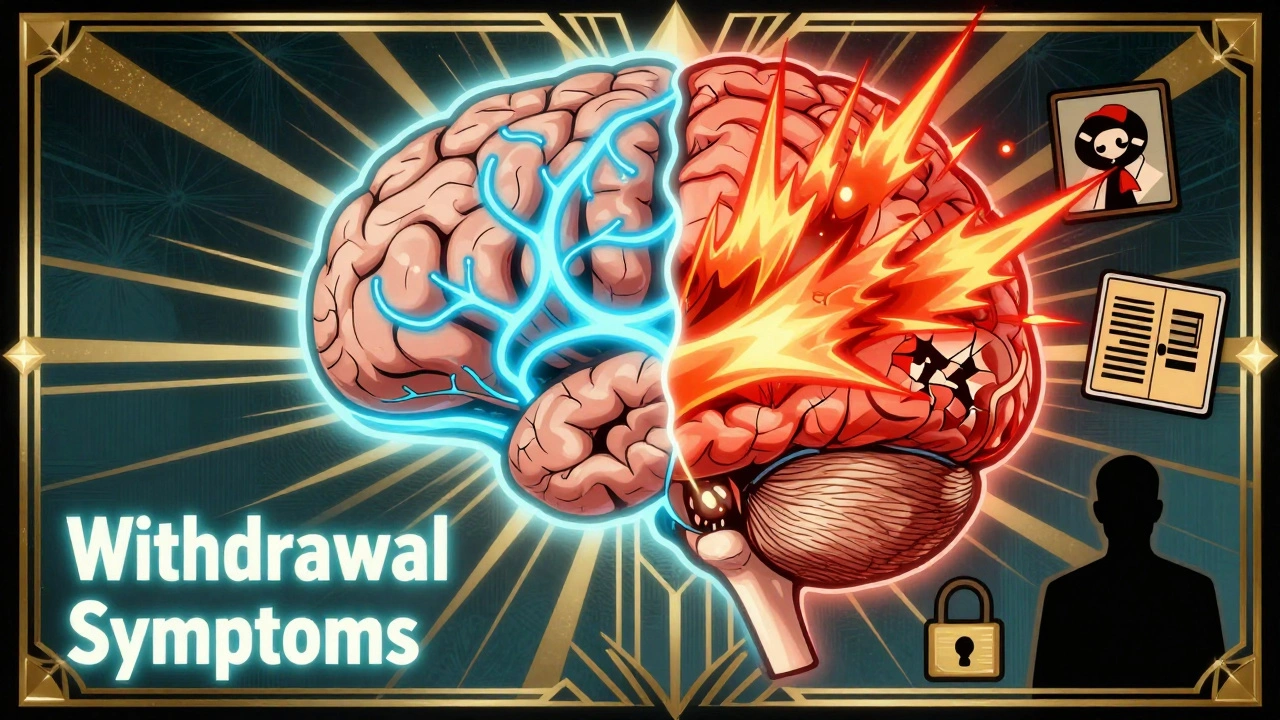
When you stop taking the drug suddenly, your nervous system goes into overdrive. That’s withdrawal. Symptoms include nausea (92% of cases), vomiting (85%), sweating (78%), anxiety (89%), diarrhea (68%), and yawning (76%). These aren’t signs of addiction. They’re signs your body missed its daily dose.
Studies show that nearly every patient who takes opioids daily for 30 days or more will develop physical dependence. That’s not rare. That’s expected. The CDC says dependence usually shows up after just 7-10 days at doses over 30 morphine milligram equivalents (MME) per day.
And here’s the key: you can have full-blown physical dependence and still not be addicted. You can take your pills exactly as prescribed, never use them for fun, never lie to get refills, never miss work because you’re high - and still get sick if you stop cold turkey.
What Is Addiction? (Opioid Use Disorder)
Addiction - now called Opioid Use Disorder (OUD) - is not about your body. It’s about your brain’s wiring.
OUD is a brain disease. It changes how the reward system works. The dopamine pathway gets rewired. The part of your brain that makes decisions (the prefrontal cortex) weakens. The part that drives impulses (the amygdala) gets louder. You start chasing the drug not because you need it for pain, but because your brain says you must have it.
The DSM-5, the official diagnostic manual used by doctors, lists 11 signs of OUD. You need at least two to be diagnosed. The most telling ones:
- Craving the drug (83% of severe cases)
- Using more than you meant to
- Failed attempts to cut down
- Continuing use despite harm - like losing your job, relationship, or health
- Spending huge amounts of time getting, using, or recovering from the drug
These aren’t side effects. They’re behaviors. And they’re not caused by physical dependence. They’re caused by brain changes.
Only about 8% of people who take opioids long-term for pain develop OUD. That’s according to a 2017 study in Pain Medicine. But because so many people develop physical dependence, doctors and patients often mistake one for the other.
The Big Mistake: Treating Dependence Like Addiction
In 2016, the CDC released guidelines to reduce opioid overprescribing. That was needed. But some doctors took it too far.
They saw a patient on 60 MME/day for back pain. The patient had withdrawal symptoms when they tried to stop. The doctor assumed: “Addiction.” So they cut the dose in half overnight. The patient went into severe withdrawal. They couldn’t sleep. Couldn’t eat. Couldn’t work. And because they were in pain and scared, they turned to street drugs. Some died.
This isn’t hypothetical. A 2021 report in the New England Journal of Medicine found that when doctors abruptly stopped opioids for chronic pain patients, overdose deaths from illicit drugs like fentanyl rose. Why? Because patients were left without pain control - and without support.
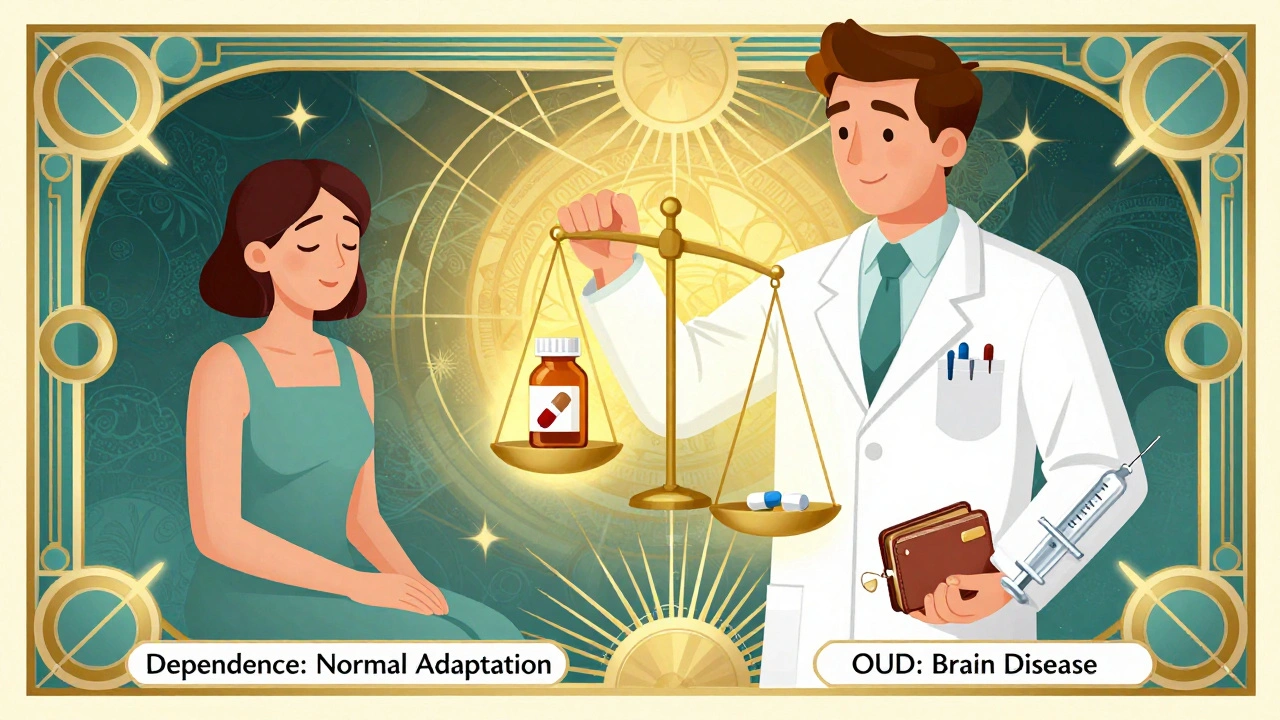
Dr. Nora Volkow, head of the National Institute on Drug Abuse, says it clearly: “Physical dependence is a normal physiological adaptation. Addiction reflects pathologic changes in brain circuits that govern motivation and behavior.”
The American Medical Association passed a resolution in 2021 telling doctors: “Do not confuse dependence with addiction. Don’t stop necessary medication because of fear.”
Yet, a 2020 study in the Journal of Pain Research found that 68% of chronic pain patients believed withdrawal meant they were addicted. That’s why so many quit their meds - even when they still needed them.
How Do You Tell the Difference?
Here’s a simple way to tell them apart:
| Aspect | Physical Dependence | Opioid Use Disorder (Addiction) |
|---|---|---|
| Definition | Body adapts to drug presence | Brain circuits change, driving compulsive use |
| Primary Symptoms | Nausea, sweating, diarrhea, anxiety during withdrawal | Craving, loss of control, continued use despite harm |
| Brain Areas Affected | Locus ceruleus, hypothalamus (autonomic control) | Nucleus accumbens, prefrontal cortex, amygdala (reward, decision-making) |
| Time to Develop | 7-10 days of daily use | Weeks to months of misuse; varies by individual |
| Can It Be Managed? | Yes - slow taper under medical care | Yes - Medication-Assisted Treatment (MAT) + therapy |
| Is It Harmful? | No - unless stopped suddenly | Yes - causes job loss, family breakdown, overdose |
One patient I know - let’s call her Linda - took oxycodone for a year after spinal surgery. She never took more than prescribed. Never used it to get high. When she tapered down over 12 weeks, she had bad withdrawal for 10 days. She cried, shook, couldn’t sleep. But she didn’t call dealers. She didn’t steal. She didn’t lie to her doctor. She just wanted to feel normal again. That’s dependence.
Another patient - let’s call him Marcus - started with a prescription after a car accident. Within six months, he was doctor-shopping, forging scripts, lying to his wife, skipping work. He spent his savings on pills. He stole from his sister. He didn’t take them for pain anymore. He took them because he couldn’t stop. That’s addiction.
What Happens If You’re Dependent?
If you’ve been on opioids for more than a few weeks and your doctor says it’s time to stop, don’t quit cold turkey.
The CDC recommends a slow taper: reduce your dose by 5-10% every 2-4 weeks. For people on over 100 MME/day, go even slower - 5% per month. Use a tool called the Clinical Opiate Withdrawal Scale (COWS). If your score hits 12 or higher, you’re in moderate withdrawal and need help.
Medications like clonidine or the newer lofexidine (FDA-approved in 2023) can ease withdrawal symptoms. But you don’t need MAT unless you have OUD.
And if you’re on opioids for chronic pain and doing fine - no cravings, no lying, no stealing - there’s no reason to stop just because you’re dependent. The CDC says: “Physical dependence is not a reason to discontinue opioid therapy when benefits outweigh risks.”
What If You Have Opioid Use Disorder?
If you have OUD, the goal isn’t just to stop using. It’s to rewire your brain.
Medication-Assisted Treatment (MAT) is the gold standard. Three FDA-approved drugs:
- Buprenorphine - reduces cravings and blocks other opioids. Lowers death risk by 70-80%.
- Methadone - long-acting opioid that stabilizes brain chemistry. Lowers death risk by 50%.
- Naltrexone - blocks opioids entirely. Best for people who are already detoxed.
These aren’t “replacing one drug with another.” They’re fixing broken brain circuits. Studies show people on MAT are 3x more likely to stay in treatment and 5x more likely to survive.
But MAT alone isn’t enough. You need counseling - cognitive behavioral therapy, contingency management, peer support. You need to learn why you used, how to cope without it, how to rebuild your life.
Why This Matters Now
In 2021, over 80,000 people in the U.S. died from opioid overdoses. That’s more than car crashes or gun violence.
Part of the reason? Misunderstanding. Fear of addiction made doctors cut prescriptions. Patients stopped their meds. Pain got worse. Some turned to heroin. Some turned to fentanyl-laced pills. They died.
Meanwhile, people with real OUD were left without treatment because their doctors didn’t know how to diagnose it. Or they thought “dependence” meant they were bad patients.
But the science is clear. You can be dependent without being addicted. You can be addicted without being dependent (think cocaine or meth). And you can be both - but they’re not the same thing.
Doctors are starting to catch up. In 2023, new brain imaging techniques could distinguish dependence from OUD with 89% accuracy by measuring prefrontal cortex activity during craving tasks. That’s huge. In five years, we might have a blood test or brain scan to tell them apart.
Until then, we need better education - for patients, for families, for doctors.
Frequently Asked Questions
Can you be physically dependent on opioids without being addicted?
Yes. In fact, most people who take opioids daily for more than a week become physically dependent. That’s a normal body response. Addiction means compulsive use despite harm - like lying, stealing, or losing your job. Many patients on long-term pain meds are dependent but not addicted.
Does withdrawal mean I’m addicted?
No. Withdrawal is a sign of physical dependence, not addiction. If you take your medication as prescribed and stop suddenly, you’ll likely feel sick. That doesn’t mean you’re addicted. Addiction involves cravings, loss of control, and harmful behavior - not just physical symptoms.
Is it safe to stop opioids cold turkey?
No. Stopping suddenly can cause severe withdrawal - vomiting, diarrhea, seizures, extreme anxiety. It’s dangerous and painful. Always taper slowly under medical supervision. The CDC recommends reducing your dose by 5-10% every 2-4 weeks.
What’s the difference between tolerance and addiction?
Tolerance means you need more of the drug to get the same effect - often because your body adapted. Addiction means you keep using despite negative consequences - like losing relationships, jobs, or health. You can have tolerance without addiction. But addiction almost always includes tolerance.
Can someone with OUD recover?
Yes. Medication-Assisted Treatment (MAT) with buprenorphine or methadone, combined with counseling, helps 70-80% of people stay in recovery. Recovery isn’t about willpower. It’s about fixing brain chemistry and rebuilding life skills. Thousands of people live full, healthy lives after OUD.
Why do doctors sometimes misdiagnose dependence as addiction?
Because the terms were used interchangeably for decades. Many doctors weren’t trained to tell the difference. Fear of the opioid crisis led to overcaution. Patients were stigmatized. Some were cut off abruptly. Now, guidelines from the CDC, AMA, and NIH stress the distinction to prevent harm and ensure proper care.
What Comes Next?
If you’re on opioids for pain and worried about dependence: talk to your doctor. Ask about tapering. Ask about COWS scores. Ask if you need MAT - even if you think you’re not addicted.
If you’re worried you might have OUD: don’t wait. Call a clinic that offers MAT. You don’t need to hit rock bottom to get help. Buprenorphine can be prescribed in a doctor’s office. You can start tomorrow.
If you’re a family member: learn the difference. Don’t shame someone for withdrawal. Don’t assume they’re “just addicted.” Ask: Are they lying? Stealing? Losing control? Or are they just sick from stopping their meds?
Physical dependence isn’t a moral failure. Addiction isn’t a choice. Both are medical conditions. And both can be treated - if we understand them right.
James Kerr
December 3, 2025 AT 16:22Wow, this is such a clear breakdown. I’ve seen so many people panic when their doctor tapers them off, thinking they’re ‘addicted’-but it’s just their body saying ‘hey, where’s my medicine?’ Thanks for explaining the science without the stigma. 🙌
Cindy Lopez
December 5, 2025 AT 02:22Physical dependence is a physiological adaptation. Addiction is a neurobehavioral disorder. The distinction is not merely semantic-it’s life-or-death. Mislabeling dependence as addiction leads to iatrogenic harm, increased illicit drug use, and preventable mortality. This post is clinically accurate and urgently needed.
Archie singh
December 6, 2025 AT 04:08Of course the AMA and CDC say this-because they’re all in bed with Big Pharma. They don’t want you to know opioids are designed to keep you hooked. Dependence? Addiction? Same thing. They just rebranded it to sell more pills. Wake up.
Gene Linetsky
December 8, 2025 AT 03:14So you’re telling me if I take oxycodone for back pain and get sick when I stop, I’m not addicted? Then why do 90% of people who start on these meds end up on heroin? Coincidence? I don’t think so. The system’s rigged.
bobby chandra
December 8, 2025 AT 22:37This isn’t just medical info-it’s liberation. For years, people like me were told we were ‘drug seekers’ just because our bodies adapted to pain relief. We weren’t junkies. We were survivors. And now we’ve got the science to prove it. Thank you for speaking truth to fear.
vinoth kumar
December 9, 2025 AT 09:34I’m from India and we don’t talk about this enough. In my village, people think if you take painkillers for more than a week, you’re a ‘junkie’. This post should be translated and shared everywhere. Physical dependence ≠ addiction. Period.
Ignacio Pacheco
December 10, 2025 AT 04:42So let me get this straight-you’re saying someone can be physically dependent on opioids but not addicted… and that’s somehow different from being addicted to caffeine? Because I wake up screaming for my coffee and if I miss it, I turn into a snarling beast. Is that dependence? Or is my brain just weak?
Jim Schultz
December 11, 2025 AT 17:49Let’s be real: 8%? That number is fabricated. The real number is closer to 40% if you track long-term use, relapse, and black-market substitution. You’re sanitizing the crisis with academic jargon. People die because of this confusion-and you’re giving doctors permission to keep prescribing?
Kidar Saleh
December 12, 2025 AT 02:03As a British GP who’s seen this play out in rural Wales, I can confirm: the confusion between dependence and addiction has led to a silent epidemic of untreated pain. Patients are left in agony, terrified to ask for help. This post is a lifeline. Thank you for the clarity, the courage, and the compassion.
Chloe Madison
December 13, 2025 AT 02:39Thank you for this. I’m a nurse who works in chronic pain management, and I’ve watched patients cry because they were told they were ‘addicts’ for needing their meds. This isn’t just education-it’s dignity. I’m printing this out and handing it to every patient who walks in scared.
Vincent Soldja
December 13, 2025 AT 12:35Dependence is not addiction. The distinction is well established in medical literature. The CDC guidelines are clear. The AMA supports this. The science is settled. End of discussion.
shalini vaishnav
December 14, 2025 AT 09:46Why are Americans so obsessed with medicalizing everything? In India, we don’t need fancy brain scans or DSM-5 labels to know that drugs are dangerous. If your body reacts when you stop, you were using too much. Stop making excuses. Weakness is weakness, no matter how many studies you cite.