Questions to Ask Your Pharmacist About Potential Drug Interactions
 Dec, 24 2025
Every year, over a million people in the U.S. end up in the emergency room because of unexpected reactions between their medications. Many of these cases aren’t accidents-they’re preventable. The biggest reason? People don’t ask the right questions when they pick up their prescriptions. Your pharmacist isn’t just the person who hands you your pills. They’re your last line of defense against dangerous drug interactions. And you need to treat them like one.
What exactly is a drug interaction?
A drug interaction happens when something changes how a medication works in your body. It could be another pill, a food, a supplement, or even a drink. These changes can make your medicine too strong, too weak, or cause side effects you didn’t expect. Some interactions are mild-like a stomach upset. Others can be life-threatening. For example, taking warfarin (a blood thinner) with too much vitamin K from leafy greens can make it less effective, raising your risk of a clot. Or mixing grapefruit juice with certain statins can cause muscle damage. The FDA says over 112,000 serious adverse events linked to drug interactions were reported in 2022 alone. Most involved heart meds, diabetes drugs, or anticoagulants.What should you ask your pharmacist before leaving the counter?
You don’t need to be a doctor to spot red flags. Start with these five essential questions every time you get a new prescription-or even refill an old one.- Can this medicine interact with anything else I’m taking? This includes everything: prescription drugs, over-the-counter painkillers, cold meds, sleep aids, vitamins, herbal supplements, and even CBD. Many people forget about the supplements. St. John’s wort, for instance, can make birth control, antidepressants, and even some cancer drugs stop working. A 2022 survey found that 77% of American adults take at least one supplement. Most have no idea how risky that can be.
- Should I avoid any foods, drinks, or alcohol? Grapefruit juice is the most famous culprit-it blocks enzymes that break down over 85 medications, including some blood pressure pills and cholesterol drugs. But it’s not the only one. Aged cheeses, cured meats, and red wine can spike blood pressure if you’re on an MAO inhibitor like phenelzine. Alcohol can make sedatives, painkillers, and even antibiotics dangerously strong. Ask specifically: “Is there anything I can’t eat or drink while on this?”
- Will this affect my existing health conditions? A common mistake is assuming a new drug is safe just because your doctor prescribed it. But if you have high blood pressure, an over-the-counter decongestant can send your numbers soaring. If you have kidney disease, some antibiotics or NSAIDs can worsen it. The American Heart Association says patients with hypertension should always ask: “Is this safe with my heart condition?”
- When and how should I take this? Timing matters. Some meds need to be taken on an empty stomach. Others work better with food. Taking them at the wrong time can change how much gets absorbed-or cause interactions. For example, taking thyroid medicine with calcium or iron supplements can block absorption. The label says “take on an empty stomach”? Ask what that actually means. “Two hours before or after meals?” “Can I have coffee?”
- What signs should I watch for if something’s wrong? You need to know what’s normal and what’s not. Dizziness, unusual bruising, rapid heartbeat, muscle pain, or sudden confusion could signal a problem. The FDA says patients should be told exactly what symptoms mean “stop this medicine and call your pharmacist or doctor.” Don’t wait for a crisis. Ask for a list of warning signs.
Why your medication list matters more than you think
Pharmacists don’t magically know what you’re taking. They rely on what you tell them. And most people don’t give complete info. A 2021 study showed that patients forget or misreport about 40% of their medications-including supplements and OTCs. That’s why bringing a written list is non-negotiable. Write down:- The name of each medicine
- The dose (e.g., 10 mg, 500 mg)
- How often you take it (e.g., once daily, every 8 hours)
- Why you take it (e.g., “for blood pressure,” “for arthritis”)
What about supplements and herbal products?
They’re not harmless. “Natural” doesn’t mean safe. Many herbal products interfere with how your body processes drugs. St. John’s wort speeds up the breakdown of antidepressants, birth control, and even some heart meds. Garlic and ginkgo can thin your blood, which is dangerous if you’re on warfarin or before surgery. Kava can damage your liver when mixed with alcohol or acetaminophen. Rita Shane, PharmD, says: “Some of these products can cause side effects such as bleeding, interfere with absorption of other drugs, or have effects on how the drugs are eliminated from your system.”What if you’re on five or more medications?
You’re not alone. Nearly half of adults over 65 take five or more daily medications. That’s called polypharmacy-and it’s where most serious interactions happen. The more pills you take, the higher the risk. The American Society of Health-System Pharmacists says pharmacists should review all your meds every time you visit. But they can’t do it if you don’t bring the list. If you’re on multiple drugs, ask for a medication therapy management (MTM) session. These are free for many Medicare patients and can reduce interaction-related ER visits by over 23%.What’s new in drug interaction screening?
Pharmacies now use electronic systems that flag interactions in real time. CVS and Walgreens have had them since 2021. But here’s the catch: they only work if your full medication history is in the system. If you fill a prescription at a different pharmacy, or if you take supplements not tracked in their database, the system misses them. A 2022 JAMA study found these tools still miss about 18% of dangerous interactions. That’s why your input matters more than ever.
How often should you talk to your pharmacist?
Don’t wait until something goes wrong. Make it a habit. Ask for a quick review every time you get a new prescription. Even if you’re just refilling, say: “Is this still safe with everything else I’m on?” If you’re on multiple meds, schedule a full review every three to six months. The most common cause of a new interaction? The last drug added. That’s usually the one you didn’t think about.What if you’re unsure about a label?
Medication labels have sections like “Warnings,” “Drug Interactions,” and “Other Information.” But they’re written for doctors, not patients. If you see something confusing-like “avoid strong CYP3A4 inducers”-don’t guess. Ask. Ask what that means in plain language. Ask if your other meds fall into that category. The FDA says patients should always ask: “Is there more information available about this drug?” There is. Your pharmacist is the one who can give it to you.What’s the bottom line?
Drug interactions aren’t rare. They’re common-and often avoidable. The system isn’t perfect. Electronic alerts miss things. Doctors don’t always know about your supplements. But your pharmacist? They’re trained to catch what others miss. You just have to speak up. Bring your list. Ask the five questions. Don’t assume anything is safe. And never, ever skip a refill check-in. Your life might depend on it.Can I just rely on my doctor to catch drug interactions?
No. Doctors focus on treating your condition, not reviewing every pill you’ve ever taken. Pharmacists are the only healthcare professionals trained specifically to check for interactions across all your meds-including supplements and OTCs. Your doctor may not know you take turmeric or melatonin. Your pharmacist will.
Are over-the-counter drugs safe to mix with prescriptions?
Not always. Many people think OTC means harmless. But ibuprofen can increase bleeding risk if you’re on blood thinners. Antacids can block absorption of antibiotics. Decongestants can raise blood pressure. Always ask your pharmacist before taking any OTC medicine-even if you’ve taken it before.
Does grapefruit juice really interact with so many drugs?
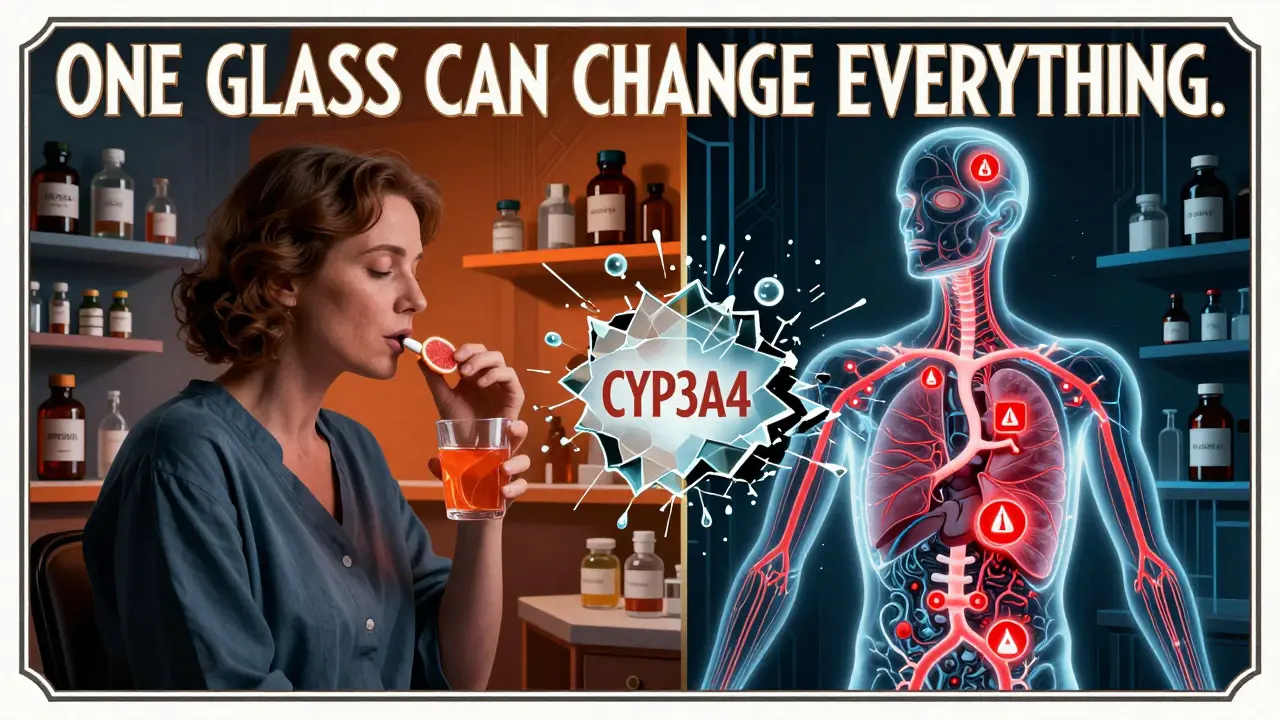
Yes. Grapefruit juice blocks an enzyme in your gut called CYP3A4 that breaks down about 85 medications. This can cause dangerous buildup in your blood. It affects statins, blood pressure meds, anti-anxiety drugs, and even some cancer treatments. One glass can affect you for up to 72 hours. If you’re on any prescription, ask if grapefruit is safe-even if you only drink it once a week.
What if I can’t remember all my medications?
Take a photo of your pill bottles or use a free app like MyMedSchedule or Medisafe. Write down names, doses, and how often you take them. Even if you’re unsure about a supplement, write it down. Your pharmacist can look it up. Better to include something you’re not sure about than leave something out.
Can I trust herbal supplements labeled as “drug-free”?
No. The FDA doesn’t regulate supplements the same way as prescription drugs. A product labeled “drug-free” might still contain active compounds that interact with your meds. St. John’s wort, for example, is sold as a “natural mood booster,” but it’s known to interfere with over 50 medications. Always disclose every supplement-even if the label says it’s “safe.”
Mussin Machhour
December 26, 2025 AT 09:39Man, I used to skip asking my pharmacist stuff till my buddy ended up in the ER over mixing ibuprofen with his blood thinner. Now I bring a list like it’s a grocery run. Seriously, just ask the five questions. It takes two minutes and might save your life.
Linda B.
December 27, 2025 AT 04:19Of course they want you to ask questions. Meanwhile the FDA and Big Pharma are quietly lobbying to make pharmacists stop talking to patients so they can sell more pills. They don’t want you to know grapefruit juice blocks enzymes. They want you to keep buying statins.
Christopher King
December 28, 2025 AT 11:53Let me guess-next they’ll tell us to drink water and exercise. This whole thing is a distraction. The real danger? The government’s secret database that tracks every pill you take and links it to your social security number. Your pharmacist? Just a pawn. The real interaction is between your data and the algorithm that decides if you’re ‘high risk’ for being alive too long. I’ve seen the documents.
Justin James
December 28, 2025 AT 20:28People don’t realize how deep this goes. It’s not just grapefruit juice or St. John’s wort-it’s the entire pharmacokinetic cascade. When you ingest something, your liver doesn’t just metabolize it like a toaster oven-it’s a complex symphony of CYP450 isoforms, phase II conjugation, renal excretion pathways, plasma protein binding dynamics, and gut microbiome modulation. And most pharmacists? They’re just reading off a screen that was programmed by a software engineer who failed organic chemistry. You think they know what CYP3A4 really does? They just see a red flag and say ‘avoid grapefruit.’ But what about pomelos? What about Seville oranges? What about the fact that your morning coffee has flavonoids that inhibit OATP1B1? Nobody talks about that. Nobody. And you wonder why people die.
Sophie Stallkind
December 30, 2025 AT 03:59Thank you for this comprehensive and vital overview. I have long advocated for patients to engage proactively with their pharmacists, particularly in cases of polypharmacy. The data supporting pharmacist-led medication therapy management is unequivocal, and I urge all healthcare institutions to prioritize these services as standard practice. Your emphasis on documentation and clarity is both timely and necessary.
Katherine Blumhardt
December 30, 2025 AT 22:51i just took a new med and forgot to tell my pharmacist i take melatonin and turmeric bc i thought they were ‘natural’ so like… no big deal right? then i started bleeding from my gums and thought i had scurvy 😭 turns out it was the combo with warfarin. now i write everything on a sticky note and tape it to my pill bottle. also i cried in the pharmacy aisle. again.
sagar patel
December 31, 2025 AT 19:27Pharmacists are trained to catch interactions. But in India, most pharmacies are run by people who passed a 6-month course and still think aspirin is for headaches only. No one asks questions here. People just take what’s handed to them. This article is for the West. Here, we pray.
Bailey Adkison
January 1, 2026 AT 13:01You say ask questions but never mention that doctors prescribe these drugs without knowing what patients are taking. Why are we blaming the patient when the system is broken? My doctor didn’t even know I was on a supplement. He wrote the script. The pharmacist had to tell me. So who’s really negligent here?
Gary Hartung
January 3, 2026 AT 06:58Oh, the noble pharmacist-our last line of defense against the corporate pharmaceutical machine. How quaint. But let’s be honest: most chain pharmacies are corporate machines themselves. The pharmacist is under pressure to fill 60 scripts an hour. They’re not going to sit with you for 20 minutes to review your 12 supplements. They’re going to scan your card, say ‘no interactions found,’ and hand you the bottle with a smile that doesn’t reach their eyes. This is performative safety. The real solution? Stop taking so many damn pills.
Oluwatosin Ayodele
January 4, 2026 AT 04:10Let me clarify something. You say ‘ask your pharmacist’ as if they have the time or authority. In Nigeria, the pharmacy is often a kiosk run by someone who studied medicine for two years and now sells antibiotics without a prescription. You want to ask about interactions? They’ll ask you how much you can pay for the ‘special medicine.’ This article is written for people who live in countries with functioning healthcare. It’s not universal. It’s a luxury.
Jason Jasper
January 5, 2026 AT 16:01I’ve been on five meds for years and never thought to ask. But after reading this, I made an appointment with my pharmacist. She spent 30 minutes going through everything-even the fish oil and vitamin D. Turns out my blood pressure med and the magnesium were competing for absorption. We changed the timing. No more dizziness. Just… asking. That’s all it took.
Carlos Narvaez
January 6, 2026 AT 06:35Pharmacists aren’t miracle workers. They’re employees. The system is broken. You’re asking the wrong person to fix it.
Harbans Singh
January 7, 2026 AT 00:57I’m from India and I’ve seen this play out-people take antibiotics with milk, or herbal teas with heart meds. I started making simple handouts in Hindi for my neighbors: ‘Don’t mix turmeric with blood thinners.’ ‘Grapefruit = danger.’ One woman cried and said she’d been taking both for years. We need more of this. Not just in the U.S. Everywhere.
Zabihullah Saleh
January 8, 2026 AT 11:34It’s funny how we treat medicine like it’s a magic wand. We swallow pills like they’re candy and then act shocked when our body rebels. But here’s the real truth-we’ve outsourced our health to systems that profit from our ignorance. The pharmacist isn’t your last line of defense. You are. The moment you stop assuming and start asking, you reclaim agency. Not because the system is good. But because you refused to be passive.
Rick Kimberly
January 8, 2026 AT 23:29The notion that pharmacists are the primary safeguard against drug interactions is misleading. While they play a critical role, the responsibility for medication safety must be shared across the entire healthcare continuum. The prescribing physician, the patient, the electronic health record system, and the pharmacy’s clinical protocols must all function in alignment. To place the burden solely on the pharmacist is to ignore systemic failures in care coordination and communication infrastructure. A holistic approach is required-not a single-point dependency.