Restless Legs vs Akathisia: How to Spot Medication Side Effects and Find Relief
 Jun, 10 2026
Akathisia vs. Restless Legs Syndrome Checker
Step 1: Medication History
Akathisia is often triggered by specific medications.
Step 2: Symptom Characteristics
Select the descriptions that best match your experience.
Assessment Result
Imagine sitting in a quiet room, but your body feels like it’s vibrating with an urge to move. You can’t sit still. You pace. You shift your weight from foot to foot. You feel like you’re going to jump out of your skin. If you are taking certain psychiatric medications, this isn’t just anxiety or bad luck. It might be akathisia, a distressing movement disorder that is often mistaken for worsening mental health symptoms.
This confusion is dangerous. When doctors mistake akathisia for agitation or anxiety, they often increase the dose of the very medication causing the problem. This creates a vicious cycle of suffering. Understanding the difference between akathisia and Restless Legs Syndrome (RLS) is critical for anyone on antipsychotics, anti-nausea drugs, or other psychotropic agents. Knowing what to look for and how to treat it can save you from unnecessary pain and potential safety risks.
What Is Akathisia? The "Cannot Sit" Disorder
Akathisia comes from Greek words meaning "not to sit." It was first formally described by Hungarian psychiatrist L. Vox in 1959. Unlike simple fidgeting, akathisia is a severe extrapyramidal side effect-a term for movement disorders caused by drugs affecting dopamine receptors in the brain.
The experience is both physical and psychological. Patients describe an inner sense of restlessness that feels involuntary. It’s not that you want to move; it’s that you *must* move to relieve a deep, aching discomfort. Jack Henry Abbott famously described it as feeling like you have to walk, pace, and then immediately need to sit, only to feel the opposite urge again. There is no relief.
| Type | Onset Timeline | Duration/Context |
|---|---|---|
| Acute Akathisia | Days to weeks after starting meds | Lasts less than 6 months |
| Chronic Akathisia | After acute phase | Persists beyond 6 months |
| Tardive Akathisia | Months or years later | Long-term medication use |
| Withdrawal Akathisia | Within 6 weeks of stopping/reducing dose | Rebound effect |
The most common trigger is antipsychotic medication. First-generation drugs like haloperidol carry a high risk due to their strong affinity for D2 dopamine receptors. However, second-generation antipsychotics (like risperidone or quetiapine) and even non-psychiatric drugs like metoclopramide (used for nausea) can cause it. According to data from the National Institute of Mental Health, 20-40% of patients on first-generation antipsychotics develop akathisia, compared to 5-15% on newer agents.
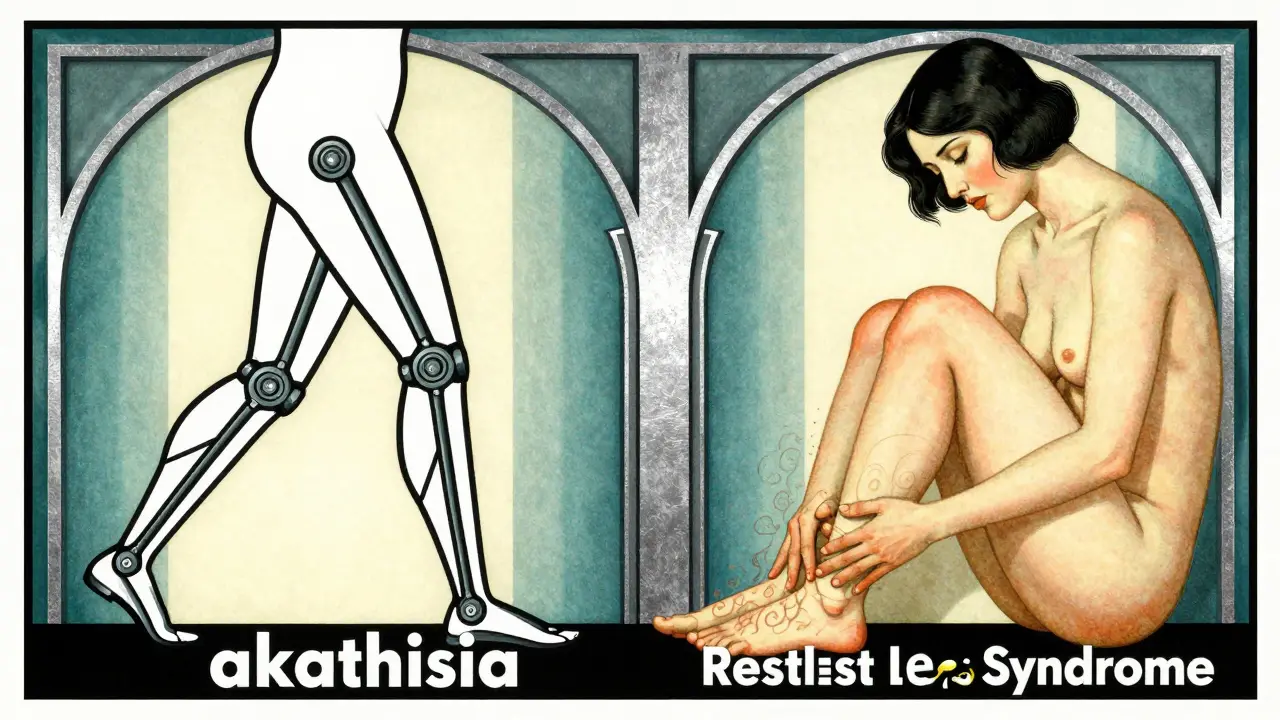
Akathisia vs. Restless Legs Syndrome: Spotting the Difference
This is where things get tricky. Both conditions involve leg restlessness. But treating them incorrectly can make things worse. For example, dopaminergic drugs used to treat RLS can actually worsen akathisia.
Here is how to tell them apart:
- Timing: Akathisia usually starts within 4 weeks of beginning or increasing a medication dose. RLS often has a genetic link or is associated with iron deficiency and may have been present before medication started.
- Sensation: In RLS, the urge to move is often accompanied by creepy-crawly sensations in the legs, typically at night or during inactivity. Movement provides immediate relief. In akathisia, the restlessness is generalized, affects the whole body, and movement doesn't always bring relief-it just changes the type of agitation.
- Movement Type: Akathisia involves repetitive, rhythmic movements like rocking back and forth, pacing in place, or constantly crossing and uncrossing legs while seated. RLS movements are more about stretching or walking to stop the sensory itch.
Dr. Jonathan M. Meyer, a clinical professor of psychiatry, notes that akathisia is tragically underrecognized. A 2020 review in the Journal of Clinical Psychiatry found misdiagnosis rates as high as 50%. Many patients are told they are "just anxious," leading to higher doses of sedatives or antipsychotics, which fuels the fire.
The Danger of Misdiagnosis
Why does this distinction matter so much? Because akathisia is linked to serious safety risks. The American Psychiatric Association warns that undiagnosed akathisia is associated with suicidal ideation, aggression, and violence. The distress can be so overwhelming that some patients prefer untreated psychosis to the sensation of akathisia.
Consider a case study published in the Royal Australian College of General Practitioners (RACGP) journal. A patient developed acute suicidal thoughts directly linked to haloperidol-induced akathisia. Her doctor initially saw her agitation as worsening schizophrenia. Once the akathisia was recognized, the medication was adjusted, and she reported being "back to myself" within three days.
If you feel like you are losing control, pacing incessantly, or experiencing intense inner turmoil after starting a new med, do not assume it is part of your underlying condition. Ask your doctor specifically about akathisia.
How Doctors Diagnose Akathisia
Diagnosis relies on recognizing both subjective feelings and objective signs. Clinicians often use the Barnes Akathisia Rating Scale (BARS). This tool evaluates inner restlessness and observable motor activity on a scale.
To self-assess, ask yourself these questions during your next appointment:
- Do I feel an inner sense of restlessness that makes me need to move?
- Am I rocking, pacing, or shifting my weight repeatedly when I try to sit?
- Did these symptoms start shortly after changing my medication?
Your doctor should also rule out other extrapyramidal side effects like parkinsonism (tremors, rigidity) or tardive dyskinesia (involuntary facial or limb movements). Differentiating these ensures you get the right treatment.

Treatment Options: Finding Relief
The goal is to reduce the distress without compromising your mental health stability. Treatment strategies fall into two main categories: adjusting the offending drug and adding symptomatic relief.
1. Adjusting the Causative Medication
The first step is often lowering the dose of the antipsychotic or switching to a different agent. Newer medications like lumateperone (Caplyta) have shown lower rates of akathisia (3.6%) compared to older drugs like risperidone (14.3%) in clinical trials. If possible, tapering off the drug slowly over several days can help resolve symptoms.
2. Add-On Medications
If you cannot stop the primary medication, doctors may prescribe additional drugs to manage the restlessness. Common options include:
- Beta-blockers: Propranolol is often the first line of defense. Typical doses range from 10 to 60 mg daily. It helps calm the physical agitation.
- Benzodiazepines: Clonazepam (0.5-2 mg daily) can provide relief by reducing anxiety and muscle tension.
- Antihistamines: Cyproheptadine (4 mg daily) is another option sometimes used.
- Vitamin E: Some studies suggest high-dose Vitamin E may help, though evidence is mixed.
Dr. Stephen M. Stahl, a prominent psychopharmacologist, suggests that maintaining antipsychotic efficacy while managing akathisia with add-on treatments like propranolol is often preferable for severe psychiatric conditions where stopping the drug isn't safe.
What You Can Do Right Now
If you suspect you have akathisia, don’t wait for your next scheduled appointment if symptoms are severe. Contact your healthcare provider immediately. Keep a log of your movements and feelings. Note when the restlessness is worst-is it when sitting? At night? Does moving help?
Be honest about how bad it is. Use strong words if needed. Say, "I feel like I’m jumping out of my skin," or "I am pacing constantly and it’s driving me crazy." These descriptions help clinicians connect the dots faster than saying "I’m anxious."
Remember, akathisia is a known, treatable side effect. It is not a sign that your mental illness is getting worse. With proper recognition and adjustment, you can regain comfort and stability.
Can akathisia go away on its own?
Acute akathisia may resolve if the causative medication is reduced or stopped, often within days to weeks. However, chronic or tardive akathisia can persist for months or years if the medication continues. It rarely goes away completely without intervention if the triggering drug remains in your system.
Which medications are most likely to cause akathisia?
First-generation antipsychotics like haloperidol and trifluoperazine carry the highest risk. Second-generation antipsychotics such as risperidone, paliperidone, and aripiprazole also commonly cause it. Anti-nausea medications like metoclopramide and prochlorperazine are significant non-psychiatric triggers.
Is akathisia the same as anxiety?
No, though they look similar. Anxiety is a mental state of worry or fear. Akathisia is a physical movement disorder with a distinct sensation of inner restlessness and an inability to stay still. Treating akathisia as anxiety by increasing sedatives or antipsychotics will usually make it worse.
How long does it take for akathisia to appear after starting medication?
Acute akathisia typically emerges within days to 4 weeks of starting a new medication or increasing the dosage. Withdrawal akathisia can occur within 6 weeks of reducing or stopping the drug. Tardive akathisia appears after months or years of use.
Are there any home remedies for akathisia?
There are no proven home cures for akathisia. While gentle exercise, warm baths, or massage might provide temporary distraction, they do not treat the underlying neurological cause. Medical intervention, such as adjusting medication or using beta-blockers, is necessary for effective relief.