Rhabdomyolysis from Medication Interactions: What You Need to Know About Muscle Breakdown Emergencies
 Dec, 18 2025
Rhabdomyolysis Medication Interaction Checker
Check Your Medication Risks
This tool identifies dangerous medication combinations that may cause rhabdomyolysis (muscle breakdown) based on medical evidence. Always consult with your doctor before making changes to your medication regimen.
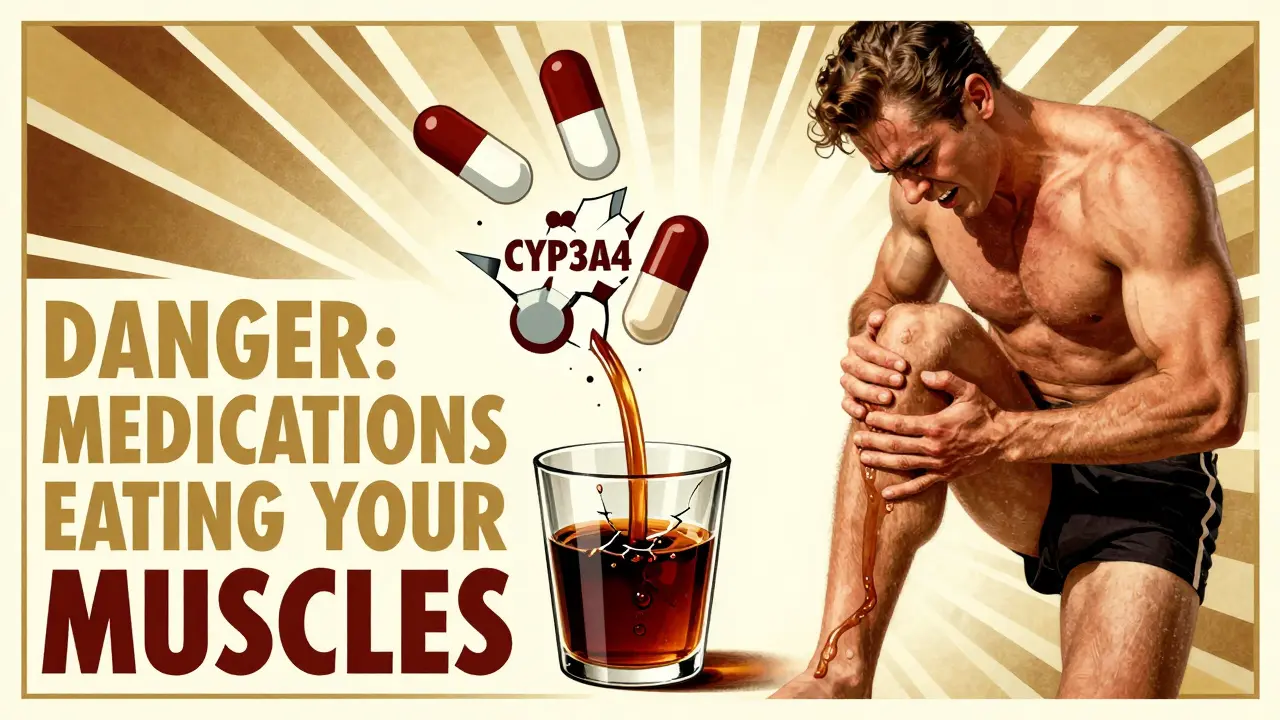
Imagine taking your daily statin for cholesterol, then adding an antibiotic for a sinus infection-only to wake up with dark urine, unbearable muscle pain, and no idea why. This isn’t rare. Every year in the U.S. alone, over 27,000 people are hospitalized because their medications started eating away at their muscles. It’s called rhabdomyolysis, and it’s one of the most dangerous drug interactions you’ve probably never heard of.
What Exactly Is Rhabdomyolysis?
Rhabdomyolysis happens when skeletal muscle cells break down rapidly, spilling their contents-like creatine kinase, potassium, and myoglobin-into your bloodstream. Myoglobin is especially dangerous. It clogs your kidneys, leading to acute kidney injury. In severe cases, you’ll need dialysis. About half of all patients with drug-induced rhabdomyolysis develop kidney failure. And 5% to 15% of those cases end in death.
The classic signs-muscle pain, weakness, and dark, cola-colored urine-only show up in about half of cases. Many people just feel tired, nauseous, or have abdominal pain. By the time they go to the ER, their creatine kinase (CK) levels are already over 10,000 U/L. Normal is under 200. When it hits 50,000 or higher, you’re in serious trouble.
Which Medications Cause It?
Statins are the biggest culprit. They’re prescribed to over 100 million people worldwide. But they’re not alone. About 60% of all drug-induced rhabdomyolysis cases come from statins, especially simvastatin and atorvastatin. The problem isn’t just the statin itself-it’s what you take with it.
Take simvastatin and gemfibrozil together? Your risk jumps 15 to 20 times. Add erythromycin or clarithromycin? Risk spikes 18.7-fold. Why? These drugs block the same liver enzyme-CYP3A4-that breaks down statins. When that enzyme is shut down, statins build up in your blood like a traffic jam. Your muscles can’t handle the overload.
Other dangerous combos:
- Colchicine (for gout) + clarithromycin or azole antifungals like itraconazole: 14.2 times higher risk
- Erlotinib (lung cancer drug) + simvastatin: CK levels over 20,000 U/L within 72 hours
- Zidovudine (HIV treatment): 12.3% of users show CK levels over 10x normal
- Leflunomide (for rheumatoid arthritis): Rare, but CK can hit 50,000 U/L and needs plasma exchange
- Propofol (in ICU sedation): Causes mitochondrial failure-68% mortality if rhabdomyolysis develops
It’s not just about two drugs. The real danger is polypharmacy. People over 65, especially those on five or more medications, are 17.3 times more likely to develop this. And women? They’re 1.7 times more at risk than men.
Who’s Most at Risk?
You don’t have to be old or sick to get rhabdomyolysis-but certain factors make it much more likely:
- Age over 65: 3.2 times higher risk
- Female gender: 1.7 times higher incidence
- Chronic kidney disease (eGFR under 60): 4.5 times higher risk
- Dehydration, heat exposure, or recent intense exercise: Makes muscle damage worse
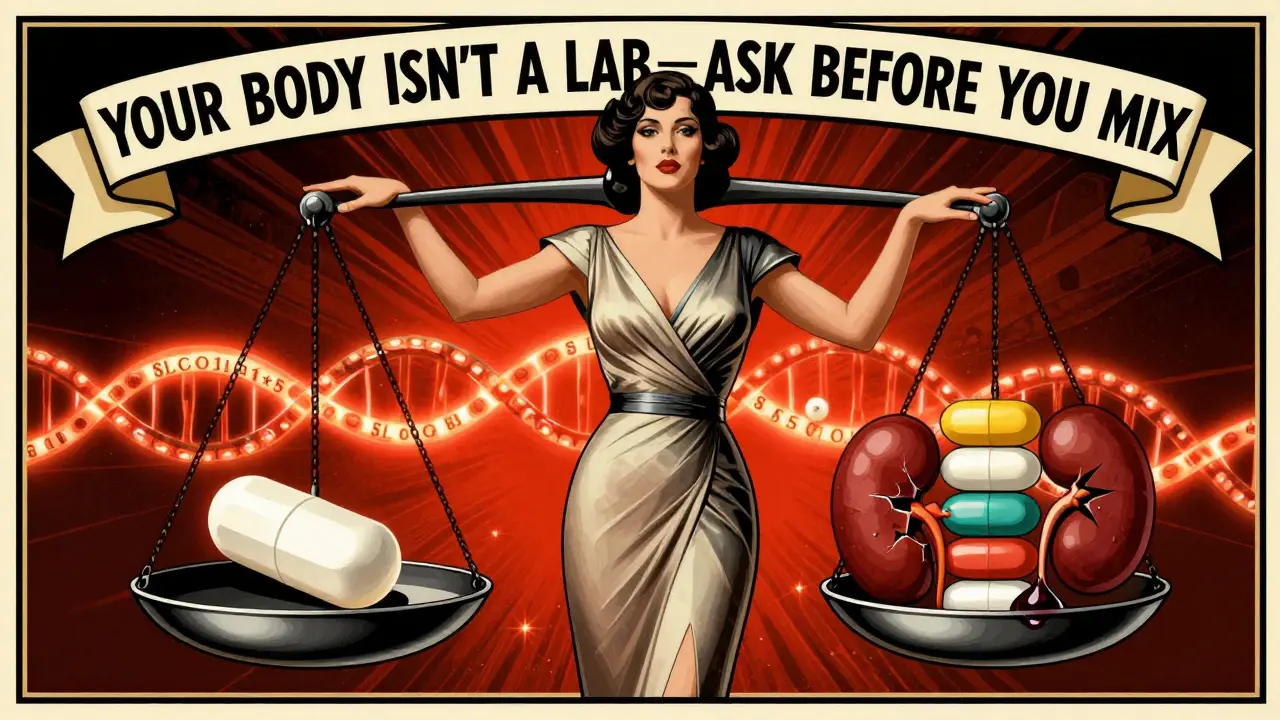
- Genetics: The SLCO1B1*5 gene variant increases simvastatin toxicity by 4.5-fold
One patient in a Mayo Clinic forum described it perfectly: “I was on colchicine for gout. My doctor added clarithromycin for a cold. Two days later, my urine turned dark. I thought it was dehydration. By the time I got to the hospital, my CK was 28,500. I spent three days in the ICU.”
Doctors miss this. A Reddit thread with 147 cases of statin-induced rhabdomyolysis found 92% of patients said their provider didn’t recognize early muscle pain as a red flag.
How Is It Diagnosed?
There’s no single test. Diagnosis relies on three things:
- Symptoms: Muscle pain, weakness, dark urine-but remember, half the time, there are no classic signs.
- Lab work: CK levels above 1,000 U/L (5x normal) are the diagnostic threshold. Severe cases are often above 5,000 U/L. Some hit 100,000.
- History: What drugs did you start or change in the last 30 days? Over half of cases happen within that window.
Doctors also check for electrolyte imbalances. High potassium (hyperkalemia) can stop your heart. Low calcium (hypocalcemia) causes tingling and cramps. And in 5% of severe cases, pressure builds in your muscles-compartment syndrome-requiring emergency surgery.
What Happens in the Hospital?
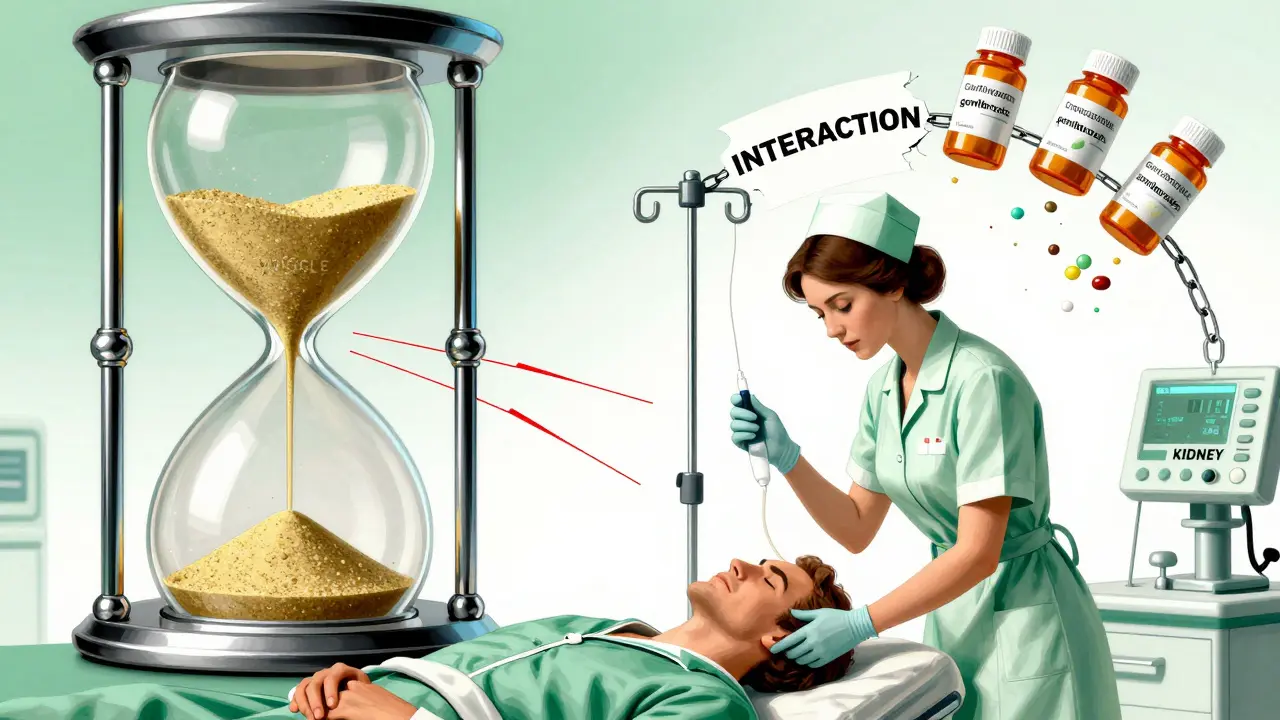
Time is muscle. And time is kidney.
Step one: Stop the drug. Immediately. No waiting. No “let’s monitor.”
Step two: Aggressive IV fluids. The Cleveland Clinic protocol is 3 liters of saline in the first 6 hours, then 1.5 liters per hour. Goal? Urine output of 200-300 mL per hour. This flushes out myoglobin before it clogs your kidneys.
Step three: Alkalinize the urine. Sodium bicarbonate is added to keep urine pH above 6.5. Myoglobin dissolves better in alkaline urine. This simple trick cuts kidney damage by nearly half.
Step four: Monitor like crazy. Electrolytes every 4-6 hours. CK levels every 12-24 hours. Watch for rising potassium, dropping calcium, and signs of compartment syndrome.
In extreme cases-CK over 50,000 U/L, kidney failure, or severe acidosis-doctors may use dialysis or even plasma exchange (especially for leflunomide, which lingers in your body for weeks).
Recovery and Long-Term Effects
Recovery isn’t quick. If your kidneys weren’t damaged, you might feel better in 3 to 4 weeks. But if you needed dialysis? Recovery takes 6 to 8 weeks, sometimes longer.
And it’s not over when you leave the hospital. A 10-year Mayo Clinic study found 43.7% of survivors still had muscle weakness at six months. Some never fully regain their strength.
Worse, many go back on statins after recovery-without proper testing or dose adjustment. One patient wrote: “They told me my kidney recovered, so I restarted Lipitor. Two months later, I was back in the ER with CK at 18,000.”
How to Prevent It
You can’t avoid all medications. But you can avoid this tragedy.
- Always tell your doctor and pharmacist every drug you take-including supplements, OTC painkillers, and herbal remedies.
- If you’re on a statin and your doctor prescribes a new antibiotic, antifungal, or antiviral, ask: “Could this interact with my statin?”
- Know your high-risk combos: simvastatin + clarithromycin, colchicine + azoles, gemfibrozil + any statin.
- If you’re over 65, have kidney issues, or take five or more meds, ask about genetic testing for SLCO1B1*5.
- Watch for early warning signs: unexplained muscle soreness, dark urine, extreme fatigue. Don’t dismiss it as “just aging” or “flu symptoms.”
- Stay hydrated, especially if you’re on a statin and exercising or in hot weather.
The FDA and EMA now require statin labels to warn about CYP3A4 interactions. But warnings don’t stop mistakes. Only awareness does.
What’s Next?
Researchers are working on solutions. The NIH is funding a real-time drug interaction alert system that will flag dangerous combos before they’re prescribed. Clinical trials are testing drugs that protect mitochondria from statin damage. And in the future, genetic screening before starting statins may become standard.
But right now, the best protection is knowledge. If you’re taking statins-or any other chronic medication-don’t assume your doctor knows every possible interaction. Ask. Push. Document. Your muscles-and your kidneys-are counting on it.
Isabel Rábago
December 18, 2025 AT 19:38This is the kind of post that makes me want to scream at every doctor who prescribes statins like they’re candy. I had a friend die from this. They gave her clarithromycin for a sinus infection while she was on simvastatin. She thought her muscle pain was just ‘getting older.’ By the time they admitted her, her CK was over 80,000. No one warned her. No one even asked what else she was taking. This isn’t rare. It’s negligent.
And don’t get me started on how pharmacies don’t flag these interactions. I’ve seen the same script go through three different pharmacies-no alerts, no red flags. We need mandatory interaction checks built into every e-prescribing system. Not optional. Mandatory.
Also, why is it still on patients to know this? If you’re going to prescribe a drug with a 15x risk multiplier when mixed with common antibiotics, the system should stop you before you hit ‘submit.’
Vicki Belcher
December 20, 2025 AT 06:03Thank you for sharing this 💙 I’m so glad someone’s talking about this-it’s terrifying how many people don’t know this can happen. My mom was on a statin and got prescribed an antifungal for a yeast infection. She got super tired and her urine looked like iced tea. She thought it was just the flu. Thank goodness her pharmacist caught it before she went to the ER. 🙏
PLEASE, if you’re on statins and get a new script-ask your pharmacist. Just say: ‘Is this safe with my cholesterol med?’ It takes 10 seconds. Could save your kidneys. Or your life. 💪
Lynsey Tyson
December 20, 2025 AT 09:05I really appreciate how thorough this is. I’ve been on simvastatin for 8 years and just last year got prescribed azithromycin for bronchitis. I didn’t think twice about it. Now I’m going back to my doctor to ask about genetic testing for SLCO1B1*5. I didn’t even know that was a thing.
Also, I’ve had weird muscle soreness for months and just assumed it was from hiking. Maybe I should’ve pushed harder. This post is a wake-up call-not in a scary way, but in a ‘hey, let’s be smart about this’ way. Thank you.
And hydration? I’m drinking way more water now. No excuses.
Edington Renwick
December 20, 2025 AT 20:49Wow. So let me get this straight-people are dying because doctors are too lazy to check drug interactions? And we’re supposed to be the ones doing the research? This isn’t healthcare. It’s a casino. Statins are the house’s favorite game. You play, you lose. The system doesn’t care until you’re on dialysis.
And don’t get me started on the FDA. They ‘require warnings’ like that’s some kind of moral victory. Warnings don’t stop people from dying. Accountability does. Someone should lose their license for this.
Kitt Eliz
December 22, 2025 AT 09:58As a clinical pharmacist, I see this daily. Let me break it down: CYP3A4 inhibition + statin = toxic buildup. Period. Simvastatin is the worst offender-its bioavailability skyrockets when CYP3A4 is blocked. Clarithromycin? It’s a CYP3A4 inhibitor with a half-life longer than your ex’s resentment. Gemfibrozil? It’s not just inhibiting-it’s shutting down the entire pathway.
Pro tip: Use pravastatin or rosuvastatin instead. They’re not metabolized by CYP3A4. Less risk. Same efficacy.
And yes-genetic screening for SLCO1B1*5 is underutilized. It’s cheap, it’s fast, and it’s life-saving. Insurance won’t cover it? Push back. Your muscles are worth more than a $120 test.
Also: Propofol-induced rhabdo? That’s a silent killer in ICUs. Nurses need to be trained to spot it. Not just CK-look for unexplained hyperkalemia + myoglobinuria. It’s not ‘fluid overload.’ It’s rhabdo. Call nephrology. NOW.
Knowledge is power. But action is survival. 🚨
anthony funes gomez
December 23, 2025 AT 12:02Statins inhibit HMG-CoA reductase-yes. But the downstream effect on mitochondrial coenzyme Q10 synthesis is rarely discussed. That’s the real mechanism behind myopathy. The CYP3A4 interaction is a pharmacokinetic amplifier, but the pharmacodynamic root is energy depletion in myocytes. The kidneys suffer because myoglobin isn’t just a toxin-it’s an oxidative stressor. And alkalinization? It’s not just solubility-it’s preventing tubular cast formation.
And yet-we treat this like a checklist item. We don’t interrogate the biology. We don’t question why we’re prescribing a drug that induces mitochondrial dysfunction in 5% of users. We just dose and forget.
What we need isn’t more warnings. We need a paradigm shift: from reactive pharmacology to predictive, systems-based therapeutics. Genetic screening. Real-time pharmacokinetic modeling. AI-driven interaction alerts. This isn’t 1995 anymore.
And if your doctor says ‘it’s rare’-ask them what ‘rare’ means when it’s your kidney failing. Rare doesn’t mean impossible. It means ‘I didn’t think it would happen to you.’
Mark Able
December 23, 2025 AT 13:04So I’m on atorvastatin and just got a script for fluconazole. Should I panic? I’ve been feeling kinda tired. Is this it? Am I about to turn into a human volcano? I’m scared now. I didn’t even know fluconazole was on the list. I thought it was just antibiotics. What about ibuprofen? Does that make it worse? I need answers. Like, now. Can someone DM me? I’m not joking. I’m 58 and I don’t want to end up on dialysis because I took a pill for a yeast infection.
Dorine Anthony
December 24, 2025 AT 20:19My dad had this. He didn’t even know what rhabdomyolysis was until he was in the ICU. He’s fine now, but he still gets muscle cramps sometimes. He doesn’t take statins anymore. He’s on ezetimibe instead. He says he’d rather be a little less ‘protected’ than almost die.
Just… talk to your pharmacist. Even if you think it’s dumb. Even if they’re busy. Even if you feel like a bother. It’s not a bother. It’s saving your life.