Severe Hypertensive Crisis from Drug Interactions: What You Need to Know
 Jan, 25 2026
Hypertensive Crisis Drug Interaction Checker
Check Your Medications for Dangerous Interactions
Enter the medications you're currently taking to see if they could interact and cause a severe blood pressure spike. This tool is designed for informational purposes only and should not replace medical advice.
Add Your Medications
Your Selected Medications
Add at least 2 medications to check for dangerous interactions
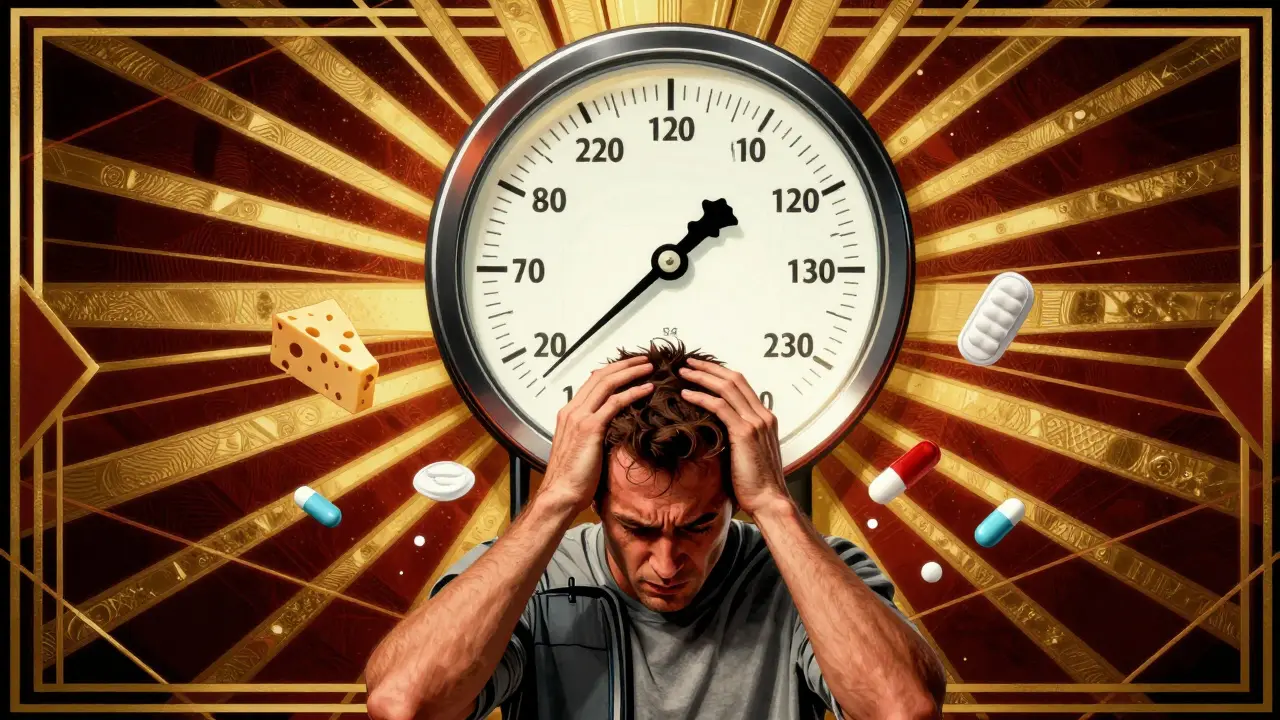
When your blood pressure spikes to 220/130 in minutes, you don’t just feel dizzy-you feel like your head might explode. That’s what happens in a severe hypertensive crisis caused by drug interactions. It’s not a rare outlier. It’s a preventable medical emergency that shows up in ERs every day, often because no one asked about the over-the-counter cold medicine, the herbal supplement, or the cheese sandwich with dinner.
What Exactly Is a Hypertensive Crisis?
A hypertensive crisis isn’t just "high blood pressure." It’s when your systolic pressure hits 180 mmHg or higher, or your diastolic climbs past 120 mmHg-and your body starts shutting down. The difference between a bad day and a life-threatening event is whether your organs are already damaged. If your kidneys, brain, heart, or eyes are showing signs of injury-like blurred vision, chest pain, confusion, or reduced urine output-you’re in a hypertensive emergency. If your pressure is sky-high but your organs are still okay, it’s a hypertensive urgency. Either way, you need help fast.Most people think high blood pressure is slow and silent. But drug-induced crises? They hit like a lightning bolt. And they’re not always from prescription drugs. Sometimes it’s a combination of your antidepressant and a decongestant. Or your MAOI and a slice of aged cheddar. Or licorice candy you thought was harmless.
Top Drug Culprits That Trigger Sudden Blood Pressure Spikes
Some medications are known to cause trouble when mixed. But not everyone knows which ones. Here are the biggest offenders:
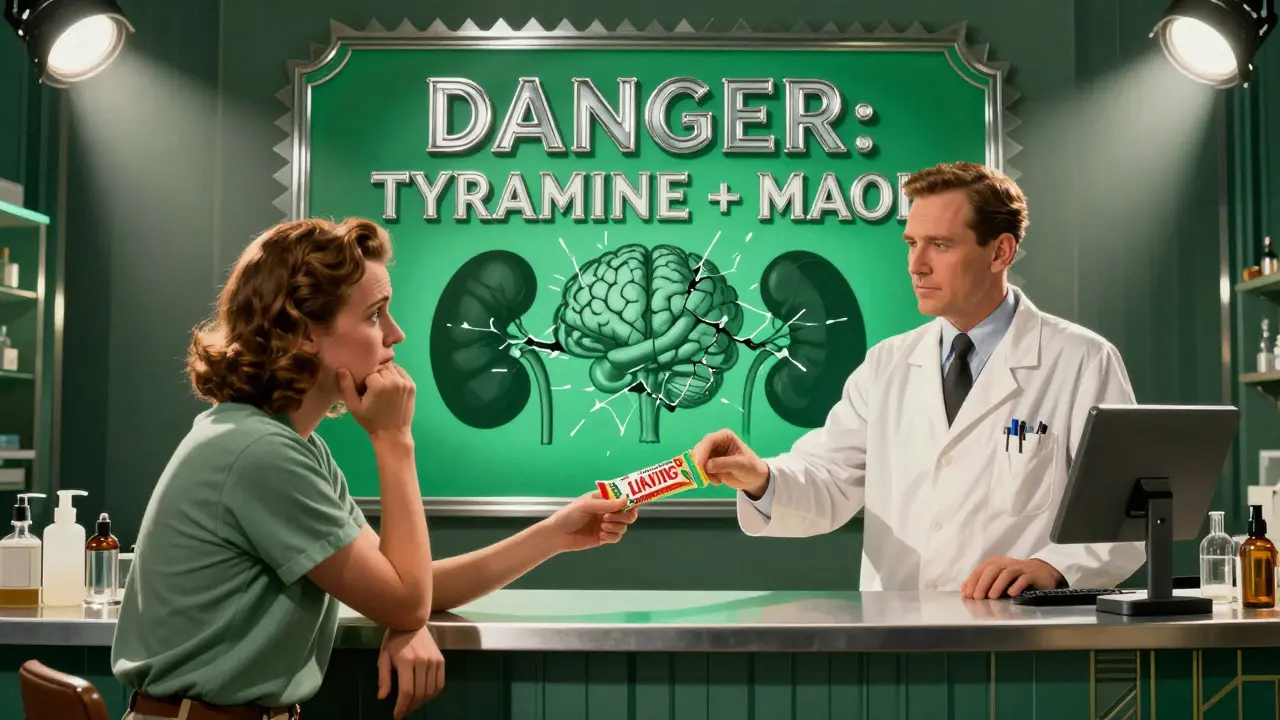
- MAOIs (Monoamine Oxidase Inhibitors) like phenelzine, tranylcypromine, and selegiline. These are used for depression and Parkinson’s. But if you eat tyramine-rich foods-aged cheese, cured meats, tap beer, soy sauce-you trigger a massive norepinephrine dump. Systolic pressure can jump 50-100 mmHg in under an hour. In extreme cases, it hits 250 mmHg. The death rate without treatment? Up to 30%.
- Venlafaxine (Effexor) at doses above 300 mg/day. This SNRI antidepressant can raise diastolic pressure above 90 mmHg. Many patients report headaches or palpitations, but doctors often dismiss it as "anxiety." A 2021 study found 42% of users had their concerns ignored-even though the data shows clear dose-dependent spikes.
- Cocaine + Propranolol. Cocaine raises blood pressure by blocking norepinephrine reuptake. Propranolol blocks beta receptors but leaves alpha receptors wide open. Result? Unopposed vasoconstriction. Cases show systolic pressure soaring past 220 mmHg within 30 minutes. This combo is deadly.
- Cyclosporine. Used after organ transplants, this drug affects kidney function and sodium balance. Up to half of transplant patients develop hypertension. Many are misdiagnosed as having organ rejection-so doctors give them more immunosuppressants, making the problem worse.
- Mineralocorticoid activators. Licorice candy, carbenoxolone, and even some herbal supplements can mimic aldosterone. They cause sodium retention, low potassium, and fluid overload. Blood volume can rise 10-15%. Systolic pressure climbs steadily over weeks. It’s often mistaken for primary hypertension.
- Decongestants like pseudoephedrine and phenylephrine. Found in cold meds, allergy pills, and even some weight-loss products. These are OTC-but they’re potent vasoconstrictors. When combined with antidepressants or blood pressure meds, they can trigger a crisis in minutes.
Why Doctors Miss These Interactions
Here’s the uncomfortable truth: doctors aren’t always looking for this. A 2022 study found that only 35% of ER physicians routinely check for drug interactions in patients with severe hypertension. Why? Because the system isn’t built for it.
Patients don’t mention their supplements. They don’t think licorice candy counts as a "medication." They don’t realize their antidepressant and a cold pill could be a ticking bomb. Meanwhile, FDA labels for 78% of high-risk drugs still don’t clearly warn about hypertensive crisis potential-especially for off-label uses.
One patient, "u/MigraineWarrior" on Reddit, described waking up with 220/130 after eating cheddar with selegiline. Three days in the ICU. Still terrified of cheese. That’s not an anomaly. That’s a pattern. A 2021 survey found 68% of patients had symptoms like headaches or vision changes before their crisis-but only 22% had their meds reviewed.
How to Spot a Drug-Induced Crisis Before It’s Too Late
You don’t need to be a doctor to recognize the red flags. Here’s what to watch for:
- Sudden, severe headache-especially if it’s unlike any you’ve had before
- Blurred vision, seeing spots, or temporary blindness
- Chest pain or pressure, even if it’s mild
- Shortness of breath without exertion
- Nausea, vomiting, or confusion
- Decreased urine output
- Unexplained anxiety or racing heart
If you’re on any of the high-risk drugs listed above, and you start feeling this way-especially after starting a new medication or eating something unusual-get your blood pressure checked immediately. Don’t wait. Don’t assume it’s stress. Don’t take another pill hoping it’ll help.
What Happens in the ER? Treatment and Rescue Protocols
Time is tissue. The goal is to bring blood pressure down safely-not too fast, not too slow. Too rapid a drop can cause stroke or heart attack. Too slow, and organs keep getting damaged.
For MAOI-tyramine crises, the gold standard is IV phentolamine. It works in minutes. Studies show 92% success rate within 20 minutes. Labetalol is also effective, especially if phentolamine isn’t available.
For cyclosporine-induced spikes, calcium channel blockers like amlodipine or nifedipine work best. For mineralocorticoid overload, stopping the trigger (like licorice) and using potassium-sparing diuretics like spironolactone can reverse the problem over days.
For venlafaxine overdose or toxicity, the first step is stopping the drug. Then, use labetalol or clonidine. Avoid beta-blockers alone if there’s any chance of unopposed alpha stimulation.
And here’s the kicker: if you’re on an MAOI, you need to wait 2-5 weeks before starting another antidepressant. The European Society of Hypertension recommends 4-5 weeks for irreversible MAOIs. Skipping this can kill you.
Prevention: The Only Real Solution
The best treatment is no crisis at all. Prevention isn’t hard-it just requires awareness.
- Always tell your doctor and pharmacist everything you take: prescriptions, OTC meds, supplements, herbal teas, even candy. Licorice is not harmless.
- If you’re on an MAOI, use an app like "MAOI Diet Helper." A 2021 Mayo Clinic study showed it improved dietary adherence by 78%.
- Ask your doctor: "Could this med interact with anything else I’m taking?" Don’t assume they know.
- If you’re on venlafaxine and your dose is above 225 mg/day, get your blood pressure checked every three months. That’s now a guideline from the American College of Cardiology (2024).
- Never combine decongestants with antidepressants, especially SSRIs or SNRIs.
- Know your meds. If you’re taking cyclosporine, get your potassium and blood pressure checked monthly.
And if you’re a caregiver for an elderly person on multiple medications? Pay attention. The European Society of Cardiology reports that 18% of hypertensive emergencies in people over 65 are from polypharmacy interactions. One pill too many-and it’s a crisis.
The Future: Technology Is Helping
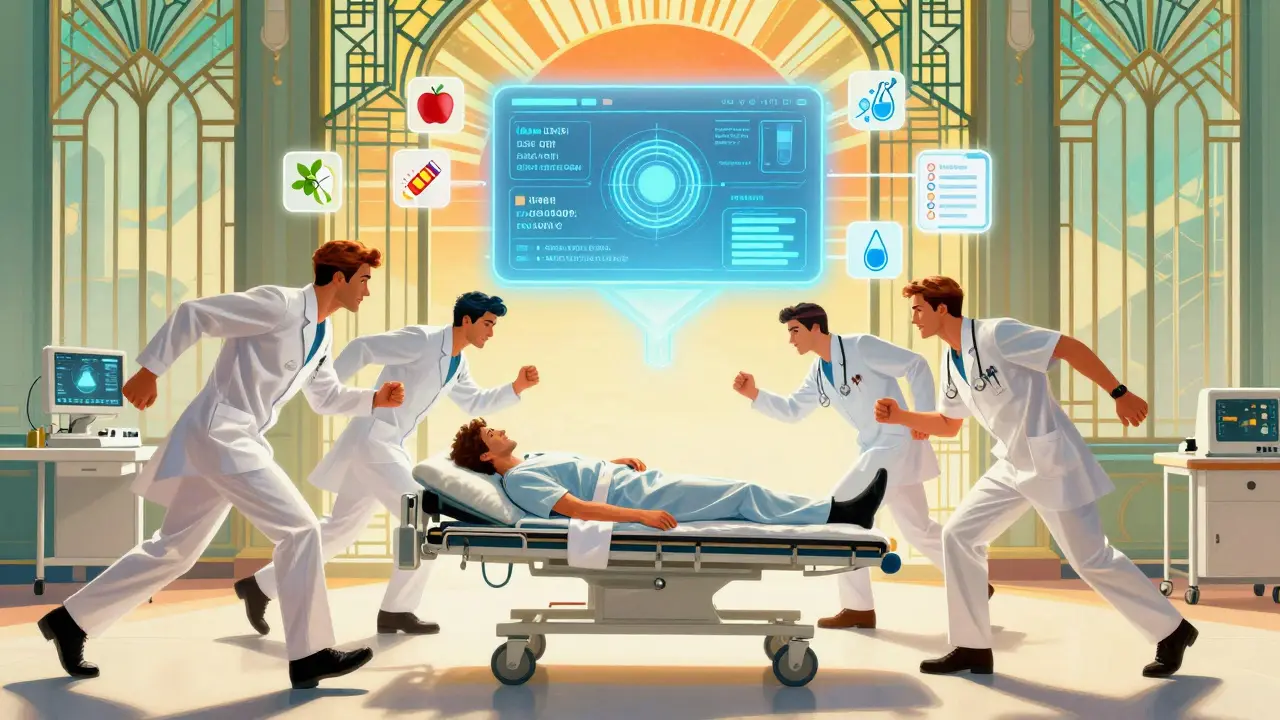
There’s good news. In January 2023, the FDA approved the first AI-powered decision-support tool designed to flag drug interactions that cause hypertensive crises. In trials, it cut MAOI-related emergencies by 40%. It’s now being rolled out in major hospital systems.
Researchers are also testing genetic screening for CYP2D6 enzyme variants. People with certain variants metabolize some antidepressants slower-making them 3.2 times more likely to have a severe reaction. That kind of precision medicine could save lives.
But technology won’t fix what people don’t know. And right now, only 12% of OTC decongestant labels warn about hypertension risk. That’s not enough.
The bottom line? A severe hypertensive crisis from drug interactions isn’t a fluke. It’s a system failure. And it’s preventable.
Can over-the-counter cold medicine cause a hypertensive crisis?
Yes. Decongestants like pseudoephedrine and phenylephrine can sharply raise blood pressure, especially when taken with antidepressants (like SSRIs or SNRIs), MAOIs, or blood pressure medications. Even a single dose can trigger a crisis in vulnerable individuals. Always check labels and ask your pharmacist before taking any OTC cold or allergy medicine if you’re on other meds.
Is licorice candy really dangerous for blood pressure?
Absolutely. Licorice contains glycyrrhizin, which blocks the enzyme that breaks down cortisol. This turns cortisol into a mineralocorticoid, causing sodium retention, potassium loss, and fluid buildup. Eating just 100g of licorice candy daily for two weeks can cause hypertension, low potassium, and even heart rhythm problems. Many patients don’t connect their blood pressure spike to candy-until they stop eating it and their pressure normalizes.
How long should I wait between stopping an MAOI and starting another antidepressant?
For reversible MAOIs like moclobemide, wait at least 24 hours. For irreversible ones like phenelzine or tranylcypromine, wait 4-5 weeks. This is critical. Starting an SSRI or SNRI too soon can cause serotonin syndrome or a hypertensive crisis. Many doctors still underestimate this risk. Always confirm the washout period with your prescriber.
Can venlafaxine cause high blood pressure even at normal doses?
Yes, but the risk increases significantly above 225 mg/day. At doses under 150 mg, blood pressure changes are usually mild. Above 300 mg, diastolic pressure often exceeds 90 mmHg. Even patients who’ve been on venlafaxine for years can develop hypertension suddenly. If you’re on this drug and notice headaches, nosebleeds, or dizziness, get your pressure checked. Don’t wait for symptoms to worsen.
What should I do if I think I’m having a hypertensive crisis?
Call 911 or go to the nearest ER immediately. Do not try to manage it at home. High blood pressure at this level can cause stroke, heart attack, kidney failure, or brain bleeding within hours. While waiting for help, sit quietly, avoid caffeine or salt, and do not take any additional medications unless instructed by a medical professional. Bring a list of all your current medications with you.
Final Takeaway: Knowledge Saves Lives
Severe hypertensive crisis from drug interactions isn’t something that happens to "other people." It happens to people who took a cold pill with their antidepressant. Who ate cheese with their MAOI. Who didn’t know licorice candy was a problem. Who trusted their doctor to know everything-but no one asked the right questions.
You don’t need to be a medical expert to prevent this. You just need to know your meds. Ask questions. Speak up. Keep a list. Use apps. Tell your pharmacist everything. And if your blood pressure suddenly spikes-don’t ignore it. Act fast. Because in this case, seconds matter more than symptoms.
Rakesh Kakkad
January 26, 2026 AT 07:21The article is meticulously researched and clinically precise, yet it fails to address the systemic neglect of pharmacovigilance in primary care settings. In India, where polypharmacy is rampant and OTC medications are sold without prescription, this crisis is not merely medical-it is structural. Patients are not informed, pharmacists are not trained, and physicians are overburdened. The solution requires policy intervention, not just patient awareness.
Suresh Kumar Govindan
January 26, 2026 AT 23:06Let’s be honest: the FDA’s approval of an AI tool to flag drug interactions is just PR. The same corporations that profit from selling decongestants and antidepressants lobbied against clear warning labels for decades. This isn’t negligence-it’s calculated. Licorice candy? A $2 snack that kills. They don’t want you to know. They want you to keep buying.
Karen Droege
January 28, 2026 AT 19:09I’m a clinical pharmacist in Toronto and I’ve seen this too many times. A 72-year-old woman on selegiline eats a slice of blue cheese with her afternoon tea-next thing you know, she’s in the ER with a BP of 230/140. No one asked her about her "little herbal teas" or her "chocolate-covered licorice." I keep a laminated cheat sheet in my bag: "What’s on your shelf?" That’s my first question. Not your symptoms. Not your history. Your damn pantry. If you’re on an MAOI, I don’t care if it’s 1985-NO AGED CHEESE. NO SOY SAUCE. NO BACON. I say it like I mean it because I’ve seen people die from a snack.
And yes, venlafaxine above 225 mg? That’s not a dose-it’s a gamble. I had a patient who said, "My doctor said it was fine." I checked his BP logs-he’d been at 150/95 for six months. He thought it was "just stress." He didn’t know his kidneys were already whispering goodbye.
Use the MAOI Diet Helper app. Print the list. Tape it to your fridge. Tell your family. If you’re taking anything that says "stimulant," "decongestant," or "appetite suppressant," stop. Call your pharmacist. Now. This isn’t fearmongering-it’s survival.
And if you’re a doctor: stop assuming patients know what’s dangerous. Ask. Twice. Write it down. And if they say "I don’t take anything else," ask again. Because they’ll say "I just eat licorice" three minutes later.
Knowledge isn’t power here. It’s oxygen.
Skye Kooyman
January 30, 2026 AT 14:29My dad had a 220/130 spike after mixing Effexor with Sudafed. He didn’t even know it was a problem. Now he carries a card in his wallet that says "NO DECONGESTANTS" and lists every med he’s on. Best thing he ever did.
Peter Sharplin
February 1, 2026 AT 08:37As someone who’s worked in ERs for 18 years, I can tell you this: the most common phrase we hear from patients in hypertensive crisis is, "I didn’t think it would do this." That’s not ignorance-it’s a failure of communication. The article nails it. But here’s the real problem: patients don’t know what to ask. Doctors don’t know what to listen for. And the system rewards speed over safety.
I’ve had patients come in with BP over 200/120 after taking a single dose of pseudoephedrine because the label said "for colds and allergies" and they didn’t connect it to their antidepressant. We treat the crisis, but we don’t fix the system.
The AI tool is a start. But what we need is mandatory pharmacist counseling for high-risk meds. Not optional. Not a suggestion. Required. Like the flu shot for healthcare workers. Because right now, we’re playing Russian roulette with people’s lives.
And if you’re on an MAOI? Don’t just avoid cheese. Avoid everything that looks like it might be fermented, aged, or preserved. That includes soy sauce, sauerkraut, tap beer, and even some types of yogurt. If you’re unsure-ask. Don’t guess. I’ve seen people die from a single bite.
And yes, venlafaxine above 300 mg? That’s a red flag. Not a suggestion. A warning siren. Get your BP checked every 3 months. Period.
This isn’t just about meds. It’s about trust. Trust your body. Trust your pharmacist. Trust your instincts. If something feels wrong-it probably is.
Kipper Pickens
February 3, 2026 AT 05:00From a pharmacokinetic standpoint, the MAOI-tyramine interaction is a classic case of monoamine displacement mediated by presynaptic vesicular depletion and subsequent extracellular norepinephrine surge. The pharmacodynamic cascade involves alpha-1 adrenergic receptor overstimulation leading to unopposed peripheral vasoconstriction, with resultant afterload elevation and myocardial oxygen demand mismatch. The clinical manifestation-hypertensive crisis-is essentially a catecholamine storm.
Similarly, the venlafaxine-induced hypertensive response at supratherapeutic doses is attributable to dual serotonin-norepinephrine reuptake inhibition with disproportionate noradrenergic activity, particularly when CYP2D6 metabolism is impaired. The concomitant use of alpha-1 agonists like phenylephrine exacerbates this via synergistic vasoconstriction, creating a pharmacological perfect storm.
Moreover, the mineralocorticoid effect of glycyrrhizin in licorice involves inhibition of 11β-HSD2, leading to cortisol-mediated activation of the mineralocorticoid receptor in the distal nephron. This results in sodium retention, volume expansion, and secondary hypertension-a mechanism often misattributed to essential hypertension.
While the AI decision-support tools are promising, their clinical utility remains contingent upon structured EHR integration and clinician compliance. Without standardized pharmacogenomic screening for CYP2D6 variants, we’re merely mitigating symptoms rather than preventing etiology.
Prevention requires a paradigm shift: from reactive emergency response to proactive, personalized pharmacotherapy risk stratification. The future lies in polypharmacy risk scoring algorithms embedded in prescribing workflows-not patient education alone.
Faisal Mohamed
February 3, 2026 AT 15:55Isn’t it ironic? We live in an age of hyperconnectivity, yet we’re more disconnected from our own biology than ever. We swipe for pills like we swipe for dates-no context, no consequence. We think of medicine as a commodity, not a conversation. The MAOI diet? The licorice? The decongestant? These aren’t just interactions-they’re metaphors. We’ve outsourced our responsibility to algorithms, to labels, to doctors who don’t have time to listen.
And now we’re surprised when our bodies rebel?
The real crisis isn’t the BP spike. It’s the quiet surrender of agency. We stopped asking "why?" and started asking "where’s the nearest ER?"
Maybe the answer isn’t more apps. Maybe it’s more silence. More listening. More asking your body what it needs before you drown it in chemicals.
Just a thought.
eric fert
February 5, 2026 AT 06:52Look, I’ve read this whole thing. And I’m supposed to believe that a slice of cheese can kill you? That’s ridiculous. This feels like fear porn dressed up as medical advice. MAOIs are ancient. They’ve been around since the 60s. If they were that dangerous, why are they still prescribed? Why hasn’t the FDA banned them? Because they work. And if you’re too lazy to read the label, that’s your problem, not mine.
And don’t get me started on the "licorice candy" panic. You’re telling me that the same candy I’ve eaten since I was 5 is suddenly a death sentence? I’ve had 100g a week for 20 years. My BP is 110/70. Coincidence? Maybe. Or maybe this whole thing is being blown out of proportion by anxious clinicians trying to cover their asses.
And the AI tool? That’s just another way for Big Pharma to sell more software. They want you scared. They want you thinking every cold pill is a bomb. Meanwhile, the real killers? Obesity. Smoking. Stress. But no-let’s blame cheese.
I’ve seen people die from heart attacks after eating a burger. Should we ban burgers too? No. We educate. We don’t panic. This article reads like a medical thriller written by someone who’s never met a real patient.
People have been mixing meds and snacks for centuries. Most of them lived. Maybe the system isn’t broken. Maybe you’re just overreacting.