Spinal Stenosis and Neurogenic Claudication: Symptoms and Treatment
 Apr, 16 2026
Imagine walking down a grocery aisle and suddenly feeling like your legs have turned into lead. You can't take another step without a wave of heaviness, tingling, or aching hitting your buttocks and thighs. But the moment you lean forward on your shopping cart, the pain vanishes. This isn't a circulation problem; it's a classic sign of spinal stenosis is a narrowing of the spaces within your spine, which can put pressure on the nerves that travel through the spine. When this narrowing happens in the lower back, it often leads to a specific set of symptoms known as neurogenic claudication.
Key Takeaways
- Neurogenic claudication causes leg pain and weakness that improves when bending forward.
- It is often confused with vascular claudication, but the two require very different treatments.
- Conservative care like physical therapy is the first line of defense.
- Surgery is typically reserved for cases where nerve compression causes persistent weakness.
What exactly is Neurogenic Claudication?
If you've heard the term neurogenic claudication, don't let the medical jargon throw you. Simply put, it's a clinical syndrome where your legs feel tired, numb, or painful during activity. This happens because the spinal canal in your lower back has narrowed-usually due to age-related wear and tear-and is squeezing the nerve roots. This compression restricts blood flow and disrupts nerve signals, leading to that "heavy leg" feeling.
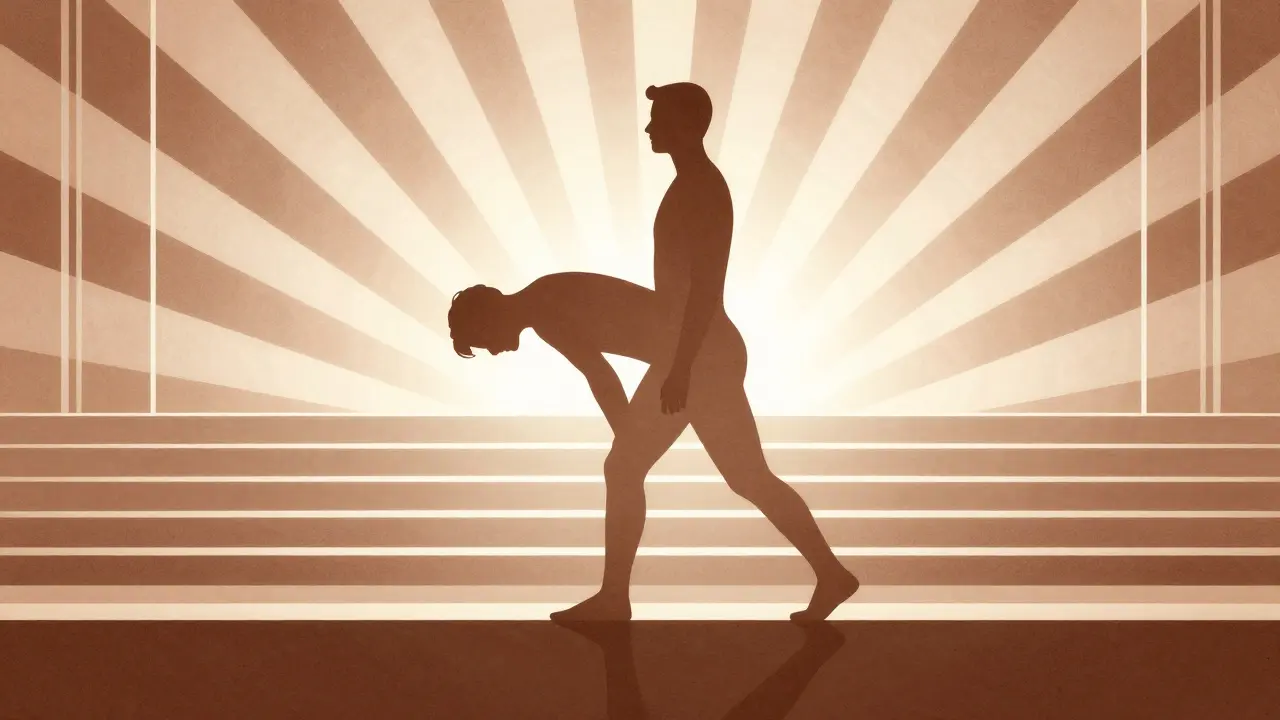
One of the most interesting parts of this condition is how it reacts to position. Unlike a typical muscle cramp, this pain is positional. When you stand straight, the spinal canal is at its narrowest. When you bend forward, you actually open up that space, giving the nerves a bit of breathing room. This is why many people unconsciously adopt a stooped posture or feel a sudden sense of relief when they sit down to rest.
The "Shopping Cart Sign" and Other Red Flags
Doctors often look for specific "clues" to diagnose this condition. The most famous is the "shopping cart sign." If you find that you can walk much further while leaning on a grocery cart or a walker than you can while walking upright, you're demonstrating a key characteristic of lumbar spinal stenosis. This happens because leaning forward (flexion) increases the diameter of the spinal canal.
Aside from the shopping cart habit, here are a few other signs to watch for:
- The Simian Stance: A natural tendency to walk with a stooped or flexed posture to avoid pain.
- Bilateral Pain: Heaviness or tingling that affects both legs, though it can sometimes be just one side.
- Slow Onset: These symptoms don't usually appear overnight; they creep up over months or years as the spine degenerates.
- Rapid Relief: The pain disappears quickly once you sit or bend forward, rather than requiring long periods of total rest.
Clinicians also use the five repetitive sit-to-stand test (5R-STS). If it takes you significantly longer than 10 seconds to complete five repetitions of sitting and standing, it's a strong indicator of functional impairment caused by the stenosis.
Neurogenic vs. Vascular: Why the Difference Matters
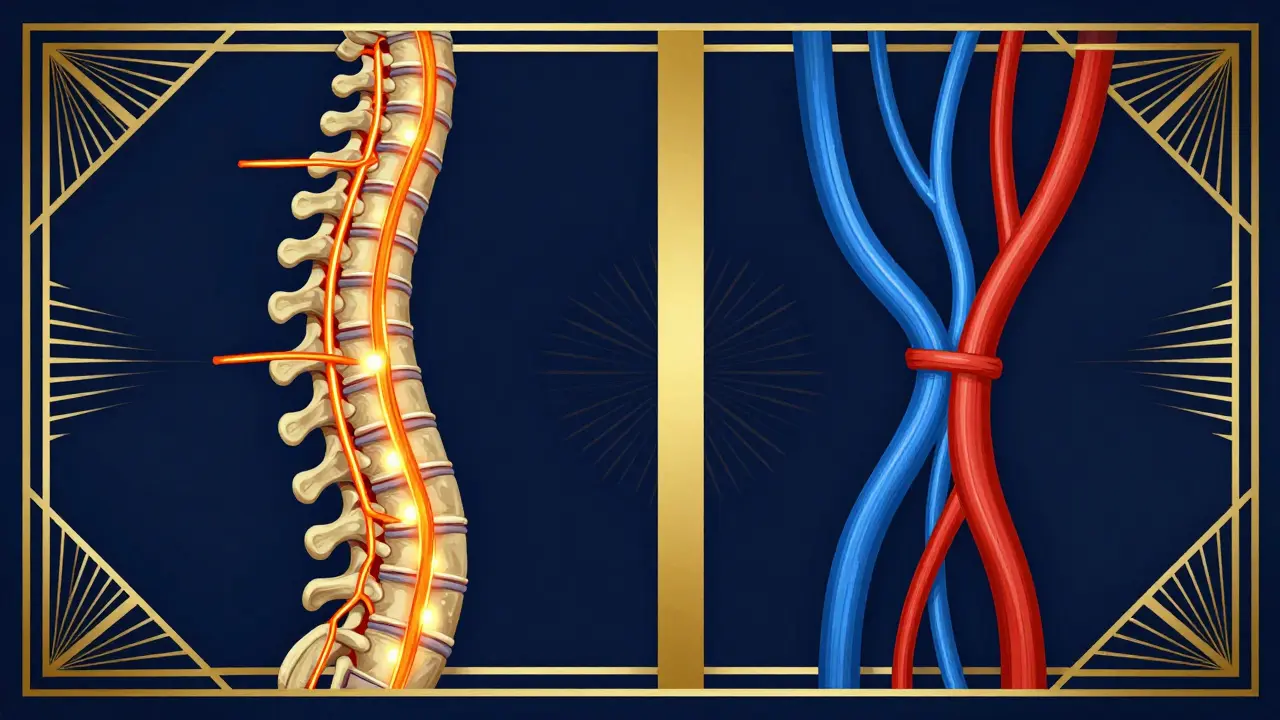
This is where things get critical. Neurogenic claudication looks a lot like vascular claudication, which is pain caused by poor blood circulation (usually due to clogged arteries). If a doctor misdiagnoses you, you could end up with a treatment plan that doesn't work or, worse, could be harmful.
| Feature | Neurogenic (Nerve-based) | Vascular (Blood-flow based) |
|---|---|---|
| Pain Trigger | Walking or standing | Walking or exercise |
| Relief Position | Bending forward or sitting | Stopping movement (any position) |
| Foot Pulses | Present and strong | Weak or absent |
| Posture | Stooped/Flexed | Usually normal |
A simple way to tell them apart is by checking your pulses. In neurogenic cases, your foot pulses remain symmetric and strong because the issue is in the spine, not the arteries. If the pain goes away simply by stopping-without needing to bend over-it's more likely to be vascular.
How Doctors Confirm the Diagnosis
Getting a diagnosis usually starts with a conversation. A doctor will ask if you feel relief when using a bicycle or a cart and if you have numbness in your buttocks. While an MRI is the gold standard for seeing the actual narrowing of the canal, it can be tricky. Interestingly, some people have "narrow" spines on an MRI but feel zero pain, while others have mild narrowing but severe symptoms. This means the doctor has to rely more on your actual symptoms than just a picture of your spine.
During a physical exam, they might check for wasting in the muscles of the foot (specifically the extensor digitorum brevis). If those muscles are shrinking, it's a reliable bedside marker that the lumbar canal is severely constricted.
Treatment Pathways: From Therapy to Surgery
Most people don't start with surgery. The goal is to manage symptoms and maintain mobility through a stepwise approach.
Conservative Management
For many, the first 3 to 6 months are spent on a conservative plan. This typically involves:
- Flexion-Based Physical Therapy: Exercises that encourage bending forward to open the spinal canal.
- Pain Medication: Using anti-inflammatories to reduce swelling around the nerve roots.
- Postural Training: Learning how to move and stand in ways that minimize nerve compression.
Interventional Steps
If physical therapy isn't enough, doctors might suggest epidural steroid injections. These are shots designed to reduce inflammation directly in the spinal canal. While they don't "cure" the narrowing, they can provide temporary relief for 50-70% of patients, giving them a window to engage more effectively in exercise.
Surgical Options
When the legs start feeling consistently weak, or when the pain makes life miserable despite therapy, nerve decompression surgery is considered. The most common procedure is a laminectomy, where the surgeon removes the back part of the vertebra (the lamina) to create more space for the nerves. There are also newer, minimally invasive options like interspinous process decompression devices that can act as "spacers" to keep the canal open.
Studies show that about 70-80% of well-selected patients see significant improvement after surgery, though the goal is always to try the least invasive method first.
Living with Stenosis: Practical Tips
Living with this condition is all about adaptation. Understanding that your pain is positional allows you to take control. If you're going for a walk, don't be afraid to use a walker or a cart-not because you "can't walk," but because it mechanically opens your spine and lets you go further.
Consistency in physical therapy is the biggest hurdle for most. It usually takes 6 to 8 weeks of dedicated flexion exercises before you notice a real difference. Be patient with the process; the nerves take time to settle down once the pressure is reduced.
Can spinal stenosis be cured without surgery?
While the physical narrowing of the bone (stenosis) cannot be "undone" without surgery, the symptoms can often be managed effectively. Through physical therapy, weight management, and core strengthening, many people can reduce their pain and increase their walking distance without ever needing an operation.
Why does leaning forward help the pain?
Leaning forward, known as spinal flexion, physically opens the spinal canal and the neural foramina (the exits for the nerves). This reduces the mechanical pressure on the spinal cord and nerve roots, allowing blood flow to return and nerve signals to travel more freely.
Is an MRI always necessary for diagnosis?
An MRI is very helpful for confirming the degree of narrowing, but it isn't the only way to diagnose the condition. Because many people have abnormal MRIs without any symptoms, doctors rely heavily on a clinical exam and your specific symptom patterns (like the shopping cart sign) to make a final call.
What are the risks of ignoring neurogenic claudication?
If left untreated and if the stenosis progresses, you may experience permanent nerve damage, leading to muscle wasting in the legs or a loss of balance. In severe cases, it can lead to cauda equina syndrome, which is a medical emergency involving the loss of bladder or bowel control.
How long does recovery take after a laminectomy?
Recovery varies, but most patients start feeling relief from leg pain almost immediately. Full recovery typically involves several months of guided physical therapy to regain strength and flexibility. About 65% of patients report "good to excellent" outcomes at the one-year mark.
Next Steps and Troubleshooting
If you suspect you have spinal stenosis, your first move should be a primary care visit to rule out vascular issues. If your pulses are strong but your legs feel heavy, ask for a referral to a physiatrist or an orthopedic spine specialist.
For those in early stages: Start a daily walking routine and experiment with different postures. Notice if leaning slightly forward helps you walk longer. Start a gentle stretching program focused on the lower back and hips.
For those failing conservative care: If you've done 3 months of physical therapy with no improvement, it's time to discuss interventional options like steroid injections or a surgical consultation. Keep a log of your "walking distance" (how many feet you can go before the pain starts) to give your doctor concrete data on your progress.
william wang
April 20, 2026 AT 04:04That shopping cart sign is such a classic clinical indicator. I've seen so many people just assume they're getting old or have bad circulation when really it's just the mechanical narrowing of the canal. It's always worth checking those pedal pulses first to make sure you aren't dealing with PAD before jumping into spinal PT.
ira fitriani
April 21, 2026 AT 13:25Omg this is so helpful!! ✨ I had a relative who felt exactly like this and they just thought they were tired! It's crazy how much a little posture change makes a difference 😱 stay strong everyone!! 💪💖
Rock Stone
April 23, 2026 AT 04:21Just keep moving, folks. Even if it's just a little bit every day, it adds up. Just take it slow and listen to your body.
Bonnie Piersall
April 24, 2026 AT 01:50The distinction between neurogenic and vascular is absolutely paramount because the treatment trajectories are poles apart. It is quite a conundrum when patients present with vague lower extremity heaviness, but the pulse check is a remarkably elegant diagnostic tool in a clinical setting. One must be diligent in pursuing flexion-based therapies before considering the surgical route, as the risks of a laminectomy, while generally low, still necessitate a careful cost-benefit analysis. Many patients find that core stability exercises provide a surprising amount of relief by stabilizing the lumbar segments. It is truly fascinating how the human body adapts by intuitively finding the 'shopping cart' position to relieve neural compression. Patience is the key here, as nerves heal at a glacial pace compared to muscle tissue. Consistency in PT is where the battle is won or lost. I've seen patients who gave up after two weeks only to find a breakthrough in week seven. The 5R-STS test is a great way to quantify the struggle. It's a simple yet effective marker of functional decline. We should encourage more clinicians to use these bedside tests before rushing to an expensive MRI. Ultimately, the goal is quality of life and maintaining autonomy in movement. Keep grinding and stay consistent with the stretches!
Michael Lewis
April 24, 2026 AT 06:52Get after it! Don't let a diagnosis make you feel like you're broken. Use the tools, do the PT, and push through the discomfort to get your mobility back!
Anna BB
April 26, 2026 AT 02:31It's so interesting how our bodies find a way to cope... just by leaning forward... it makes you think about how we adapt to pain without even knowing it!!
Heer Malhotra
April 27, 2026 AT 14:44The healthcare standards in the West often overemphasize surgical intervention over holistic and conservative management. This guide provides a necessary perspective on the importance of physical therapy.
Dana Chichirita Nicoleta
April 29, 2026 AT 00:03I simply cannot express how profoundly moving it is to see such a comprehensive breakdown of a condition that leaves so many people feeling utterly stranded in their own bodies, and while the path to recovery is undoubtedly arduous and requires a monumental amount of fortitude, the prospect of regaining the ability to walk through a park without debilitating pain is a beacon of hope that we must all cling to with everything we have!