Tendinopathy Treatment: How Eccentric Training and Injections Really Work
 Jan, 15 2026
When your tendon hurts-not just a quick twinge, but a deep, persistent ache that lingers after exercise, makes climbing stairs a chore, or stops you from running altogether-you’re not just dealing with inflammation. You’re dealing with tendinopathy. It’s not a sprain. It’s not a tear. It’s a broken-down tendon that’s lost its ability to handle load. And the good news? Most cases respond well to the right kind of movement-and not always the ones you’d expect.
What Exactly Is Tendinopathy?
Tendinopathy isn’t just "tendonitis"-that old term implied swelling, but modern imaging shows it’s mostly degeneration. The collagen fibers in the tendon fray, thicken, and lose their organized structure. It happens slowly. Runners get it in their Achilles. Jumpers get it in their patellar tendon. Even office workers get it in their wrists from typing too long. It’s not about being unfit-it’s about overload. Too much stress, too fast, without enough recovery.
Studies show about 30% of all sports medicine visits involve tendinopathy. And the most common sites? The Achilles and the patellar tendon. If you’ve ever felt pain just above your heel after a long run, or under your kneecap after squatting, you’ve likely felt it too.
Eccentric Training: The Gold Standard That’s Not as Simple as It Sounds
In 1998, Dr. Hakan Alfredson published a simple protocol: stand on a step, lift up on both feet, then lower down slowly on just one. That’s the foundation of eccentric training-and it changed everything. Eccentric means the muscle is lengthening under load. Think of lowering a dumbbell slowly, or the downward phase of a squat. That’s where the magic happens for tendons.
For Achilles tendinopathy, the classic protocol is 3 sets of 15 repetitions, twice a day. You do heel drops with your knee straight (to target the calf muscle) and then again with your knee bent (to target the deeper soleus). You lower over 3 to 5 seconds. No bouncing. No rushing. Just slow, controlled, painful descent.
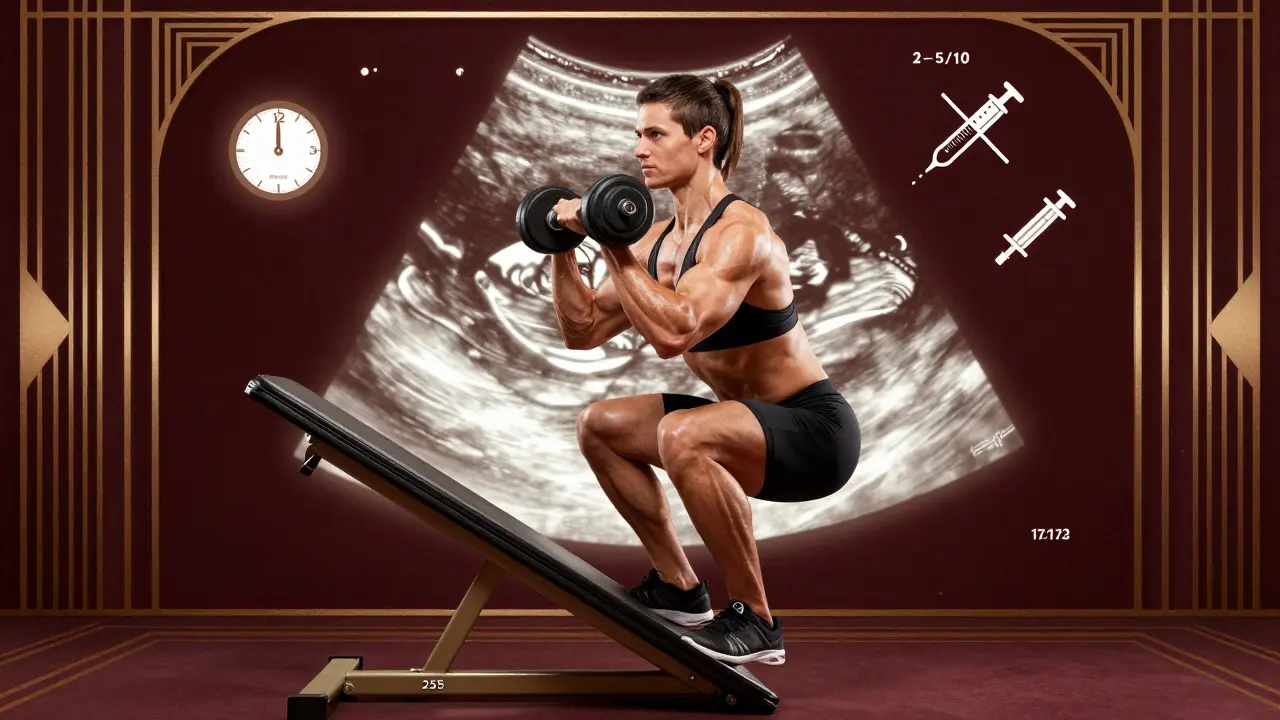
For patellar tendinopathy, it’s single-leg decline squats on a 25-degree board. You lower slowly, keeping your knee aligned over your toes. You do 3 sets of 15, daily. Sounds simple? Try it for a week. Most people say the first two weeks feel unbearable. That’s normal.
But here’s what the research says: after 12 weeks, people who stick with it see 40-65% improvement in pain and function. VISA scores-used to measure tendon health-jump from around 40 to over 80. That’s not just feeling better. That’s tendon structure actually improving. Ultrasound scans show thicker, more organized collagen fibers after 8-12 weeks.
And here’s the catch: you need to do it with pain. Not agony, but enough to feel it. The old advice was "no pain, no gain." The new advice? "Pain between 2 and 5 out of 10 during exercise is okay. Pain above 7 or lasting more than 24 hours? Stop and adjust." Only 38% of people doing this on their own get this right. That’s why working with a physical therapist for the first two sessions cuts failure rates in half.
Heavy Slow Resistance: The Quiet Contender
What if you can’t handle the sharp pain of eccentric heel drops? What if your knee gives out during decline squats? Enter heavy slow resistance (HSR) training. Instead of doing 15 reps with bodyweight, you use a weight-70% of your one-rep max. You do 3 sets of 15 reps, three times a week. You lift slowly (3 seconds up), lower slowly (3 seconds down).
A 2015 study comparing HSR to eccentric training for Achilles tendinopathy found both groups improved by the same amount after 12 weeks. But here’s the kicker: 87% of people stuck with HSR. Only 72% stuck with eccentric training. Why? Less initial pain. More control. More confidence.
HSR isn’t just for Achilles. It’s now used for rotator cuff, elbow, and even hamstring tendinopathy. And it’s easier to scale. You can add weight. You can adjust reps. You can do it in a gym. That’s why NCAA Division I teams now use HSR in 92% of their rehab programs.
Isometrics: The Quick Pain Fix
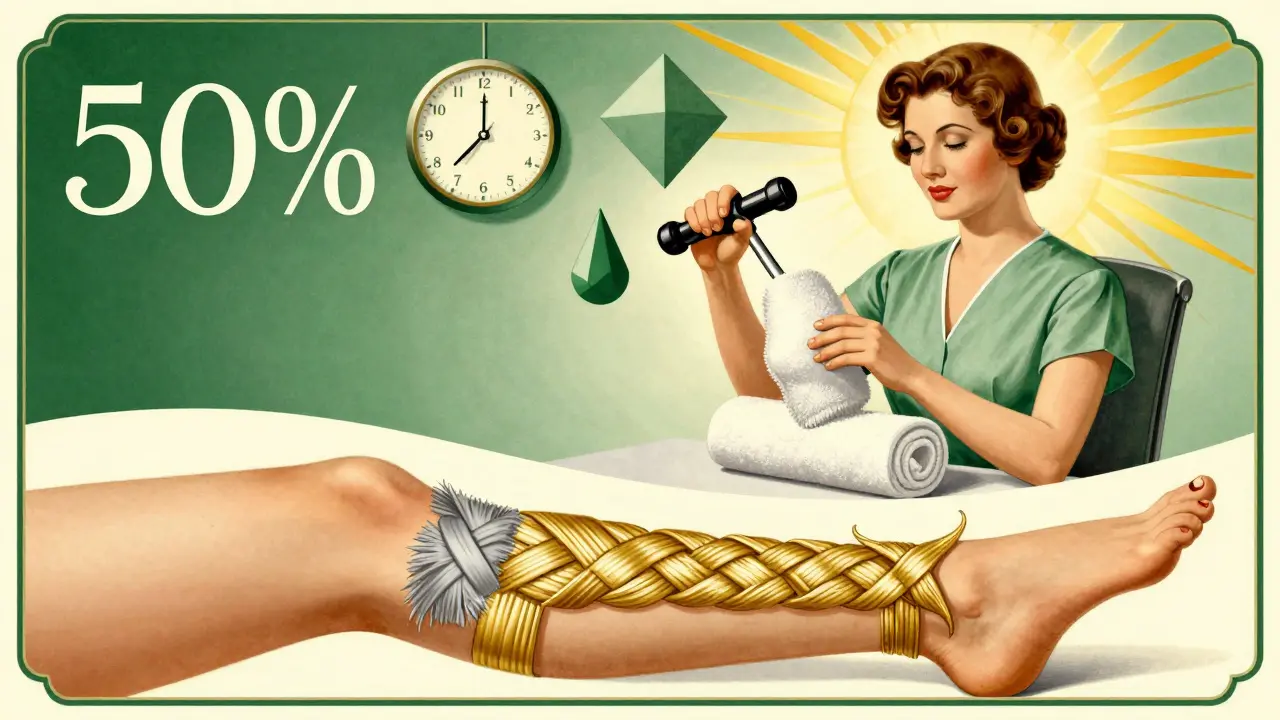
Want to reduce pain right now-before your workout, before a game, before you even start your eccentric routine? Try isometrics. That’s when you push against something that doesn’t move. For Achilles, stand on a step, lift up, then hold the top position for 45 seconds. For patellar, sit with your leg straight, press your knee down into a rolled towel, and hold.
Research shows isometric contractions can reduce pain by 50% within 45 minutes. That’s faster than any injection. It doesn’t fix the tendon, but it gives you a window to move without fear. Many athletes use it as a pre-game warm-up. It’s not a cure, but it’s a powerful tool to get you back in motion.
Injections: Quick Fix or Long-Term Trap?
Corticosteroid injections sound tempting. You get a needle, you feel relief in days, and you think you’re fixed. But here’s what the data says: at 4 weeks, steroid shots reduce pain by 30-50%. Sounds great, right? But at 6 months, 65% of people need another treatment. In the exercise-only group? Only 35% do.
Why? Steroids shut down inflammation, but they also weaken the tendon. They don’t rebuild. They mask. And repeated shots increase rupture risk. The BMJ study in 2013 was clear: exercise beats steroids in the long run.
What about PRP-platelet-rich plasma? It’s expensive. It’s trendy. It sounds like science fiction. But a 2020 review found PRP only beats placebo by 15-20% at 6 months. Not enough to justify the cost or the discomfort. Most guidelines don’t recommend it as a first-line treatment.
Shockwave therapy? It helps some people, especially for calcific tendinopathy. But it’s not magic. It’s just another tool. And it doesn’t replace movement.
Why Do Some People Still Fail?
Even with perfect technique, 30% of people don’t respond to eccentric training. Why?
Dr. Jill Cook, a leading tendon researcher, says it’s because we treat tendinopathy like it’s one condition. It’s not. It’s a spectrum. Early stage? Your tendon is reactive-you need rest and isometrics. Mid-stage? It’s degenerative-you need load, like eccentric or HSR. Late stage? It’s structural failure-you might need surgery.
Another reason: people skip the basics. They do the exercises, but they don’t change their activity. They keep running 10Ks every weekend. They keep jumping without building capacity. Tendons need time to adapt. You can’t load a weak tendon and expect it to hold up.
And then there’s pain fear. Many people stop because it hurts. But pain during exercise doesn’t mean damage. It means adaptation. The key is staying within the "acceptable pain" zone. That’s why apps like Tendon Rehab-built with real-time feedback-boost adherence to 85%.
What Works Best? A Practical Guide
Here’s what the evidence says to do, step by step:
- Start with isometrics for immediate pain relief (hold 45 seconds, 3-5 times a day).
- Begin eccentric training or HSR within a week. Choose based on pain tolerance: use eccentric if you can handle the discomfort; use HSR if you need less pain.
- Do the exercises daily for Achilles, every other day for patellar (let the tendon recover).
- Use a pain scale: aim for 2-5/10 during exercise. If it’s 6 or higher, reduce load.
- Track progress: measure your VISA score every 4 weeks. If it doesn’t improve after 8 weeks, see a specialist.
- Don’t rush. Structural changes take 12 weeks. Most people quit before then.
- Combine with load management: reduce high-impact activities until your tendon adapts.
If you’re a runner: cut back on hills and speed work. If you’re a volleyball player: reduce jumping volume. If you’re a desk worker: take breaks to stretch your wrists. Tendons respond to consistency, not intensity.
Where Do We Go From Here?
The future of tendinopathy treatment isn’t about one magic exercise. It’s about precision. Researchers are now testing biomarkers-blood tests, ultrasound patterns, even genetic markers-to predict who will respond to eccentric training and who needs something else.
Early trials of peptides that activate tendon cells are starting in 2024. But for now, the best tool is still movement. Not injections. Not machines. Not creams. Just controlled, progressive, consistent loading.
And the best part? You don’t need a gym. You don’t need expensive gear. You just need patience. And the willingness to move-even when it hurts.
Can tendinopathy heal without surgery?
Yes, in over 80% of cases. Most people recover fully with conservative treatment-eccentric training, isometrics, and load management. Surgery is only considered after 6-12 months of failed conservative care and persistent, disabling pain.
How long does eccentric training take to work?
You’ll notice pain reduction in 4-6 weeks, but structural changes in the tendon take 8-12 weeks. Most people see the best results at the 12-week mark. Stopping early is the most common reason for failure.
Is it normal for tendinopathy pain to get worse before it gets better?
Yes, especially in the first 2-3 weeks. This is called an "initial flare-up" and is common with eccentric training. It doesn’t mean you’re damaging the tendon-it means you’re challenging it. Keep going if pain stays below 5/10 and fades within 24 hours. If it spikes above 7/10 or lasts longer, reduce the load.
Can I keep exercising while doing eccentric training?
Yes, but modify it. Avoid high-impact or repetitive loading on the affected tendon. Swap running for cycling or swimming. Replace jumping with step-ups. The goal is to maintain fitness without overloading the tendon. Use isometrics before activity to reduce pain.
Do I need an ultrasound to diagnose tendinopathy?
No. Diagnosis is usually clinical-based on location of pain, what makes it worse, and how it responds to movement. Ultrasound is helpful to confirm the diagnosis, rule out tears, or track progress, but it’s not required to start treatment.
What’s the difference between eccentric and concentric training?
Eccentric means the muscle lengthens under tension (like lowering a weight). Concentric means it shortens (like lifting a weight). For tendons, eccentric loading creates the right kind of mechanical stress to stimulate repair. Concentric training alone doesn’t produce the same healing response in degenerated tendons.
Can I do eccentric training at home?
Absolutely. You don’t need equipment. For Achilles: use a step or stair. For patellar: use a decline board (a wedge or stacked books work). Just focus on slow, controlled movements. Videos from the International Tendinopathy Symposium or apps like Tendon Rehab can guide your form.
What if eccentric training doesn’t work for me?
You’re not alone-about 30% of people don’t respond. Try switching to heavy slow resistance training. If that doesn’t help, consider shockwave therapy or consult a specialist. Sometimes the issue isn’t the exercise-it’s the load on your body. You may need to address strength imbalances, footwear, or training volume.
Rob Deneke
January 15, 2026 AT 17:06evelyn wellding
January 16, 2026 AT 21:47Chelsea Harton
January 17, 2026 AT 08:29Corey Chrisinger
January 17, 2026 AT 21:40Bianca Leonhardt
January 19, 2026 AT 01:45Travis Craw
January 20, 2026 AT 01:06Christina Bilotti
January 20, 2026 AT 18:26brooke wright
January 22, 2026 AT 03:26vivek kumar
January 22, 2026 AT 22:02Nick Cole
January 24, 2026 AT 04:55Riya Katyal
January 24, 2026 AT 17:17Henry Ip
January 25, 2026 AT 07:10