Theophylline Clearance: How Common Medications Reduce Its Metabolism and Increase Toxicity Risk
 Dec, 23 2025
Theophylline Interaction Checker
Check how common medications affect your theophylline clearance. Enter your current dose and select medications you're taking to see potential interaction risks.
Most people don’t realize that a simple, old-school asthma medication like theophylline can turn dangerous with just one new prescription. It’s not the drug itself that’s risky-it’s what happens when other medications slow down how your body clears it. Theophylline has a narrow therapeutic window: between 10 and 20 mcg/mL in your blood, it works. Go just a little above that, and you could end up in the emergency room with vomiting, rapid heartbeat, or even seizures. And the most common reason for that? Drug interactions that reduce its clearance.
Why Theophylline Is So Sensitive to Other Drugs
Theophylline is broken down almost entirely in the liver-about 90% of it-by an enzyme called CYP1A2. This enzyme is like a factory worker: if you give it extra tasks or block its tools, it slows down. That’s exactly what happens when you take certain medications alongside theophylline. The result? Theophylline builds up in your blood faster than your body can get rid of it. Even a small drop in clearance-say, 15%-can push someone from a safe level of 15 mcg/mL to a toxic 22 mcg/mL in just a few days.What makes this even trickier is that theophylline doesn’t clear linearly. At therapeutic doses, its metabolism becomes saturated. That means doubling the dose doesn’t just double the blood level-it can triple it. So if you start a new medication that inhibits CYP1A2, your body suddenly can’t keep up. And because theophylline has a half-life of about 8 hours in healthy adults, it takes several days for levels to stabilize after a change. That delay is why many patients don’t realize they’re in danger until symptoms hit.
Medications That Slow Theophylline Clearance
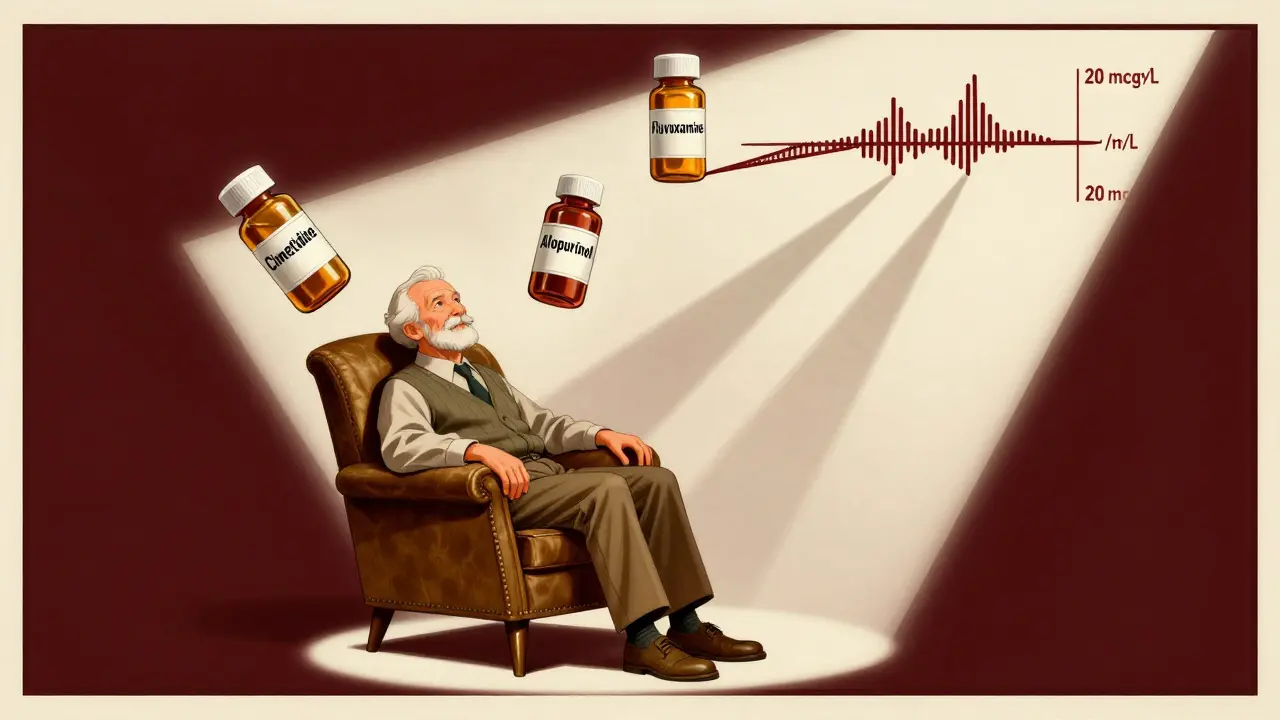
Not all drugs affect theophylline the same way. Some are minor offenders. Others are major red flags. Here are the biggest culprits based on clinical evidence:- Fluvoxamine (an SSRI antidepressant): Reduces clearance by 40-50%. This is one of the most dangerous combinations. The European Respiratory Society explicitly warns against using these two together. In one study, patients on both had a 12.7-fold higher chance of severe toxicity.
- Cimetidine (a stomach acid reducer): Slows clearance by 25-30%. It’s one of the most common causes of preventable theophylline toxicity, especially in older patients who take it for heartburn. Emergency department data shows cimetidine is involved in nearly 29% of theophylline-related hospitalizations.
- Allopurinol (used for gout): Reduces clearance by about 20%. Even though it’s not a direct CYP1A2 inhibitor, it interferes with theophylline’s metabolic pathway. Many doctors don’t realize this interaction unless they’ve seen a case firsthand.
- Erythromycin and clarithromycin (antibiotics): Reduce clearance by 15-25%. These are often prescribed for respiratory infections-exactly when someone on theophylline might need them most. That’s a dangerous overlap.
- Furosemide (a diuretic): Evidence is mixed. Some studies show a 10-15% drop in clearance; others show no effect. Still, if a patient is on furosemide and theophylline, monitoring levels is wise.
On the flip side, some drugs increase theophylline clearance-like smoking, phenytoin, and rifampicin. That’s why quitting smoking can be just as risky as starting a new medication. When a patient stops smoking, their CYP1A2 activity drops by 30-50% within two weeks. If their theophylline dose hasn’t been adjusted, toxicity can follow quickly.
Who’s at Highest Risk?
It’s not just about the drugs-it’s about who’s taking them. A 2021 study of over 1,200 patients found that nearly 28% of people over 65 on theophylline were also taking at least one medication that reduced its clearance. Only 37% of those cases had their dose adjusted. Why? Because many clinicians still don’t think of theophylline as a high-risk drug. It’s old. It’s cheap. It’s not flashy like newer inhalers.But here’s the truth: theophylline is still used in 12.4% of COPD cases in Africa and 7.8% in Asia. In low-resource settings, it’s often the only affordable bronchodilator. And in the U.S., it’s still prescribed for refractory nocturnal asthma or when patients can’t tolerate newer drugs. The problem? Many of these patients are on multiple medications-statins, antibiotics, antacids, antidepressants-and no one’s checking for interactions.
Older adults are especially vulnerable. Their livers don’t metabolize drugs as well. Their kidneys are slower. They’re more likely to have heart failure, which reduces theophylline clearance even further. A 2023 survey of 412 pulmonologists found that 78.6% had seen a serious interaction in the past year. And 62% blamed poor electronic health record alerts. If your system doesn’t flag cimetidine + theophylline, you might never know.
What Should You Do?
If you’re on theophylline, here’s what you need to do right now:- Know your current blood level. If you haven’t had a serum level checked in the last 3 months, ask for one. The therapeutic range is 10-20 mcg/mL. Anything above 20 is risky.
- Review every new medication. Before taking anything new-over-the-counter or prescription-ask your pharmacist or doctor: “Will this affect theophylline?” Don’t assume it’s safe just because it’s common.
- Never start or stop smoking without telling your doctor. Smoking increases clearance. Quitting drops it. That change alone can cause toxicity if your dose isn’t adjusted.
- Get your levels checked 48-72 hours after starting or stopping any interacting drug. Don’t wait for symptoms. By then, it might be too late.
Doctors should reduce theophylline doses by 25-50% when adding a strong CYP1A2 inhibitor like fluvoxamine or cimetidine. For allopurinol, a 20% reduction is usually enough. And if you’re on fluvoxamine? The safest move is to switch to a different antidepressant. There are plenty of SSRIs that don’t interfere with CYP1A2-like sertraline or escitalopram.

Why This Still Matters in 2025
You might think theophylline is outdated. After all, its use in the U.S. has dropped by 62% since 2000. But here’s the catch: the remaining users are the ones most at risk. They’re older. They’re sicker. They’re on more drugs. And they’re more likely to be in places where newer medications aren’t available.In 2022, the FDA reported 1,842 theophylline-related adverse events, with over 41% tied to drug interactions that reduced clearance. That’s a 5.3% increase from the year before-even as overall use declined. That means the risk per patient is going up.
And it’s not just about emergencies. Chronic low-level toxicity causes fatigue, insomnia, tremors, and heart palpitations. Many patients think they’re just getting older. But it could be their medication mix.
There’s also new research exploring very low-dose theophylline (100-200 mg daily) for its anti-inflammatory effects in COPD. But those trials specifically exclude patients on CYP1A2 inhibitors. Why? Because the risk isn’t worth it.
Bottom Line
Theophylline isn’t going away. Not yet. And until it does, we need to treat it like the high-risk drug it is. A single new prescription can turn a stable patient into a medical emergency. It’s not about fear-it’s about awareness. If you’re taking theophylline, make sure every provider who writes you a prescription knows about it. Keep your blood levels checked. And never assume a drug is too common to matter.Because in the world of pharmacokinetics, the smallest change can have the biggest consequences.
Spencer Garcia
December 24, 2025 AT 19:22I’ve seen this too many times in the ER. Patient on theophylline for years, gets a script for cimetidine for heartburn, ends up in cardiac arrest. No one thought to check interactions. It’s not rocket science-just basic pharmacokinetics. Always ask: what’s this doing to my liver enzymes?
Abby Polhill
December 25, 2025 AT 12:59CYP1A2 inhibition is the silent killer here. Fluvoxamine is basically a sledgehammer to the enzyme’s face. And don’t even get me started on how allopurinol sneaks in through the backdoor via xanthine oxidase interference. Most clinicians still think ‘it’s just gout meds’-nope. It’s a metabolic landmine.
Bret Freeman
December 26, 2025 AT 07:24Let me tell you something. This is why Big Pharma doesn’t want you to know about theophylline. It’s cheap. It’s effective. And it doesn’t need a $2000 patent. So they push these fancy inhalers that cost a fortune while letting people die from preventable interactions. They don’t care. Your life is a spreadsheet. And now they’re trying to bury this in the archives because it’s inconvenient.
Quit smoking? You better tell your doctor. Start an SSRI? You better get a level checked. This isn’t medicine-it’s a minefield with no warning signs.
Austin LeBlanc
December 26, 2025 AT 18:47Anyone else notice how the author says ‘don’t assume it’s safe just because it’s common’? That’s the entire problem with American medicine. People treat meds like candy. ‘Oh, I took cimetidine for 10 years, no problem.’ Yeah, until your theophylline level spikes and you’re convulsing in the ER. You think your grandma’s heartburn is more important than her life? Wake up.
niharika hardikar
December 27, 2025 AT 19:26It is imperative to underscore that theophylline pharmacokinetics remain critically underappreciated in low-resource settings where therapeutic drug monitoring is either unavailable or inconsistently implemented. The confluence of polypharmacy, limited clinician awareness, and absence of electronic decision support systems renders this a public health imperative rather than a mere clinical curiosity.
Blow Job
December 29, 2025 AT 05:17My uncle was on theophylline for COPD. He quit smoking cold turkey after 30 years. Two weeks later, he was shaking, nauseous, heart racing. No one told him. He thought he was just ‘getting old.’ Got admitted. Level was 28. He’s fine now, but it scared the hell out of us. Just… ask. Always ask.
Christine Détraz
December 31, 2025 AT 00:00I work in pharmacy and I’ve had patients come in with this exact scenario. They’re on theophylline, start fluvoxamine for anxiety, and say ‘it’s just an antidepressant, right?’ Nope. I’ve had to call doctors at 9 PM to get doses adjusted. It’s not dramatic-it’s just poorly communicated. We need better alerts, better education, better systems.
John Pearce CP
January 1, 2026 AT 06:48It is a matter of national concern that the United States continues to permit the use of this archaic agent without mandatory CYP1A2 interaction screening protocols. The FDA’s own data confirms escalating toxicity rates despite declining utilization. This is not negligence-it is institutional failure. We must enforce mandatory pharmacist-led medication reconciliation for all theophylline prescriptions.
EMMANUEL EMEKAOGBOR
January 2, 2026 AT 02:25In Nigeria, theophylline is still the backbone of asthma management in primary care. We don’t have access to salmeterol or tiotropium. So we use theophylline. But we also give antibiotics like erythromycin for coughs. No one checks levels. No one has the equipment. We rely on clinical judgment. This post is a wake-up call-not just for the West, but for the Global South where this drug is still life-saving.
Jillian Angus
January 2, 2026 AT 17:29My mom takes theophylline and furosemide. I’ve been asking her to get levels checked every time she gets a new med. She thinks it’s overkill. But after reading this I’m printing it out and handing it to her doctor. Just in case.
Gray Dedoiko
January 2, 2026 AT 17:42My dad’s on theophylline for asthma. He’s 72. Takes statins, a beta-blocker, and omeprazole. Never thought about interactions. I’m calling his doctor tomorrow. This is scary how easy it is to mess this up.
Joe Jeter
January 3, 2026 AT 07:18So you’re telling me we’re still using a 70-year-old drug because it’s cheap? That’s not progress, that’s poverty medicine. If you can’t afford the new inhalers, you shouldn’t be on theophylline. You should be on a sliding scale program or something. This isn’t a public health win-it’s a systemic failure dressed up as pragmatism.
Sidra Khan
January 5, 2026 AT 05:17Okay but like… why is this even a thing in 2025? 🤡 We have AI that can predict drug interactions in milliseconds. Why are we still relying on doctors remembering a 1980s pharmacology textbook? Someone get the FDA a laptop.
Lu Jelonek
January 7, 2026 AT 00:07One study I reviewed showed that 40% of patients on theophylline who started fluvoxamine had levels rise above 25 mcg/mL within 5 days. The median time to symptom onset was 72 hours. That’s why we need mandatory baseline and follow-up levels-not just when something goes wrong. Prevention > reaction.
Ademola Madehin
January 7, 2026 AT 03:10My cousin died from this. 68 years old. Took cimetidine for acid reflux. Theophylline dose never changed. He was fine one day. Next day, he was in the hospital, seizing. They told us it was ‘unpredictable.’ That’s bullshit. It was preventable. And now I’m screaming into the void hoping someone listens.