When to Use OTC vs. Prescription Medications for Common Conditions
 Dec, 1 2025
Every year, millions of people reach for an OTC painkiller, antihistamine, or heartburn pill without thinking twice. But how do you know when that bottle on the shelf is enough - and when you really need a prescription? The line isn’t always clear, and mixing up the two can lead to wasted money, ineffective treatment, or even harm.
What Exactly Is an OTC Medication?
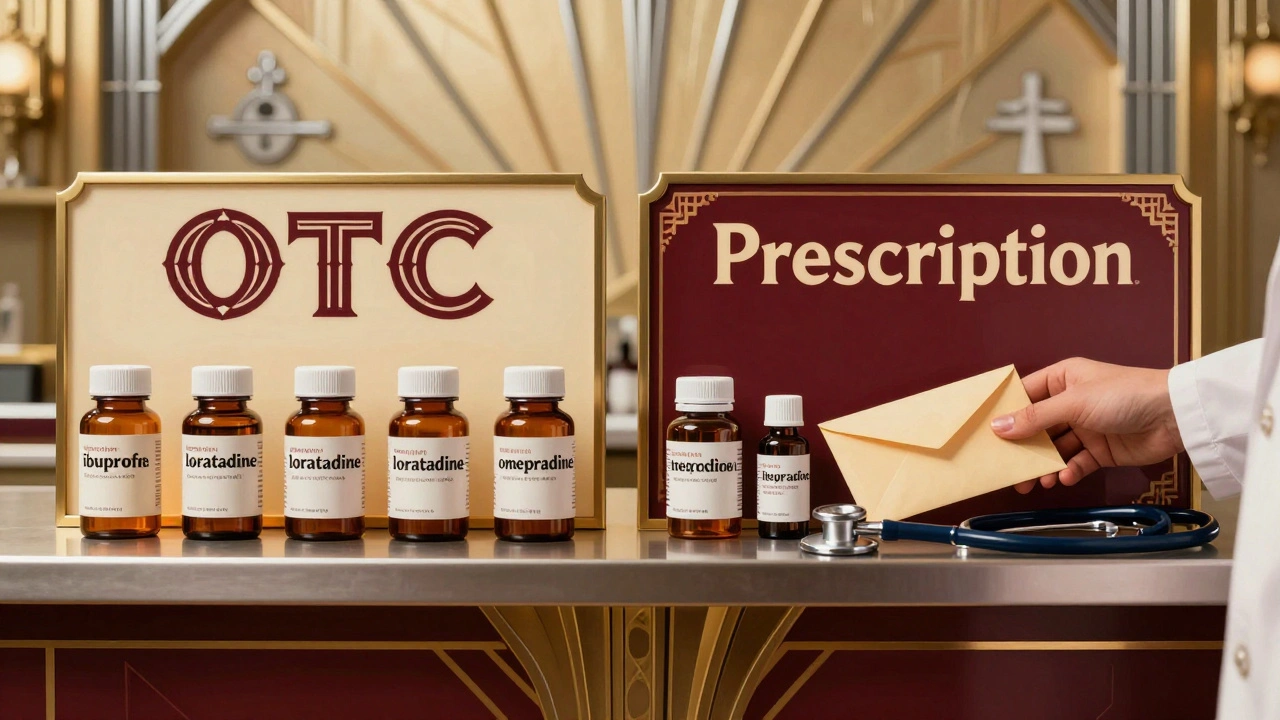
OTC, or over-the-counter, medications are drugs you can buy without a doctor’s note. You’ll find them on shelves in pharmacies, grocery stores, gas stations, and even convenience stores. Common examples include ibuprofen for headaches, loratadine for allergies, and omeprazole for occasional heartburn. These aren’t weak or low-quality - they’re approved by the FDA to be safe and effective when used exactly as directed.
The key difference? OTC drugs follow a set of rules called the OTC Monograph system. Think of it like a recipe book: if a product matches the approved formula, dosage, and labeling, it can be sold without individual review. That’s why you’ll see the same active ingredient - like 200mg ibuprofen - in brand-name Advil and store-brand generics. The difference is usually just the price.
When Do You Need a Prescription?
Prescription medications are meant for conditions that need a professional diagnosis, ongoing monitoring, or stronger treatment. These include high blood pressure, diabetes, thyroid disorders, chronic pain, and severe infections. A doctor doesn’t just write a script - they assess your full health picture, check for interactions with other meds you’re taking, and adjust doses over time.
Take acid reflux, for example. If you get heartburn once a week after spicy food, OTC omeprazole might be fine. But if you’re having it daily, waking up at night with a burning throat, or struggling to swallow, that’s not just indigestion. It could be GERD - and untreated, it raises your risk of esophageal damage. A prescription-strength proton pump inhibitor, combined with a doctor’s guidance, is the right move.
Same Active Ingredient, Different Strengths
Many OTC drugs are lower-dose versions of prescription drugs. The active ingredient is the same, but the amount, how fast it releases, or what else is in it changes.
Take hydrocortisone cream. OTC is 1%. That’s fine for a small itchy rash. But if you have eczema covering your arms or legs, your doctor might prescribe 2.5%. The higher dose works faster and deeper. Using the OTC version for a serious case might mean weeks of discomfort while waiting for it to work - if it works at all.
Same goes for ranitidine (now mostly replaced by famotidine). OTC was 75mg. Prescription was 150mg or 300mg. Taking the OTC version for persistent symptoms? You’re underdosing. And with some medications, like antidepressants or blood thinners, the difference between OTC and prescription isn’t just strength - it’s the entire formulation. Switching without knowing can be dangerous.
When OTC Is Perfect - And When It’s Not
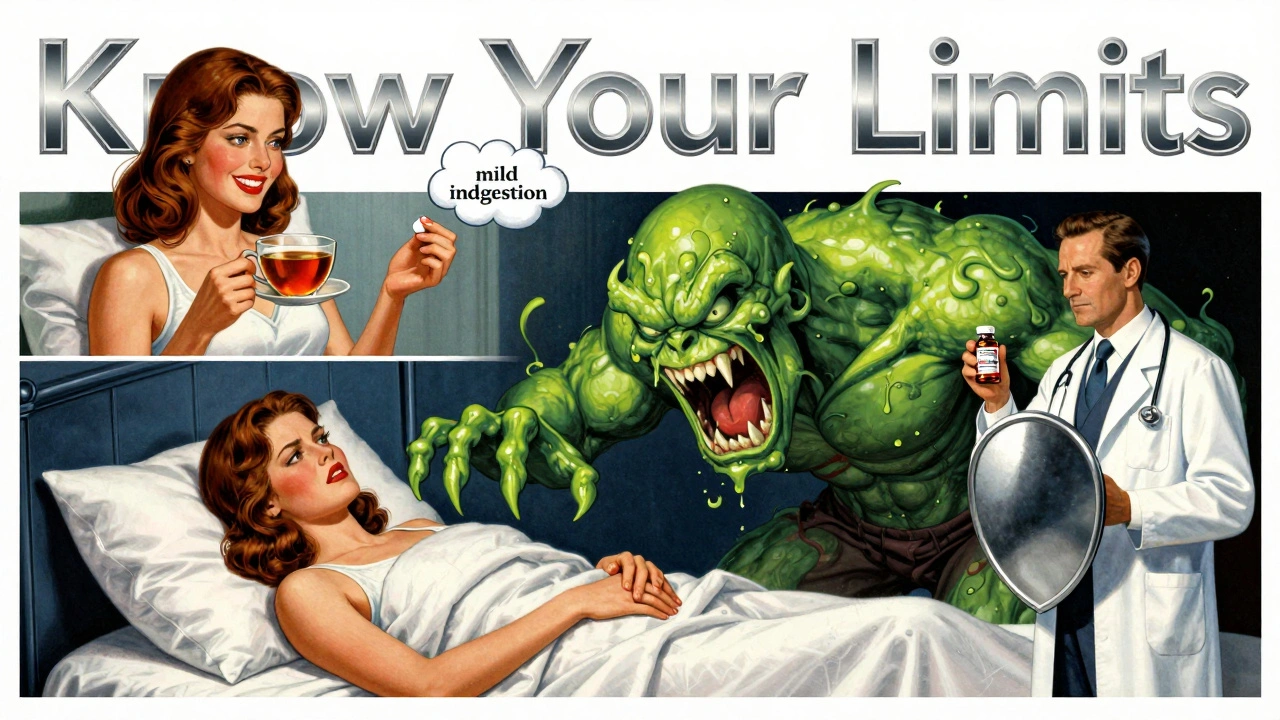
Here’s a simple rule: OTC medications work best for mild, short-term, clearly identifiable symptoms.
- Headaches: If you get one or two a month from stress or lack of sleep, ibuprofen or acetaminophen is fine. If you’re having headaches 15+ days a month, or they come with vision changes, nausea, or weakness - see a doctor. You might need preventive treatment.
- Allergies: A stuffy nose in spring? Cetirizine or loratadine will help. But if you’re wheezing, having trouble breathing, or your symptoms last more than two weeks, you could have asthma or a sinus infection. OTC won’t fix that.
- Heartburn: One episode after a big meal? OTC antacids or H2 blockers are fine. If you’re relying on them three or more times a week, it’s not just diet. You could have GERD, a hiatal hernia, or even a sign of something more serious.
- Minor cuts and rashes: Antibiotic ointment and hydrocortisone cream are safe for small areas. But if the skin is oozing, hot to the touch, or spreading - that’s infection. You need a prescription antibiotic.
There’s a pattern: if symptoms last longer than 7-10 days, get worse, or start interfering with sleep, work, or daily life - stop guessing. Call your doctor.
Cost Isn’t Always What You Think
Many assume OTC is cheaper. Sometimes it is - but not always.
A 100-tablet bottle of generic ibuprofen 200mg costs about $4. Brand-name Advil? Around $15. But if you’re on Medicare Part D or have insurance that covers prescription pain meds, your co-pay might be $5 for a 30-day supply of a stronger, extended-release version. Suddenly, the prescription isn’t more expensive - and it might work better.
Same with esomeprazole (Nexium). OTC is 20mg, once daily. Prescription can be 40mg, twice daily for severe GERD. If you’re taking two OTC pills a day because the single one isn’t working, you’re spending more - and risking side effects from too much acid suppression.
Pharmacists see this every day. About 89% of community pharmacists say they regularly help patients decide whether an OTC or prescription option makes more sense - not just for cost, but for safety and effectiveness.
The Big Shift: More Drugs Going OTC
In recent years, the FDA has approved more prescription drugs to become available without a prescription. This isn’t random - it’s based on years of safety data.
Examples:
- Fexofenadine (Allegra) - once prescription, now OTC for allergies.
- Esomeprazole (Nexium) - switched to OTC in 2014 after proving safe for long-term, self-managed use.
- Adapalene (Differin) - acne treatment now available OTC as a gel.
And in April 2023, the FDA approved the first OTC epinephrine auto-injector - the same device used for life-threatening allergic reactions. Previously, you needed a prescription. Now, you can buy it off the shelf. That’s a huge step forward for public safety.
More are coming. Experts predict 20-25 additional medications - especially for allergies, heartburn, and birth control - will become OTC by 2030. But don’t assume everything that’s OTC is right for you. Just because it’s available doesn’t mean it’s the best choice for your condition.
What You Should Never Do
- Don’t self-diagnose chronic conditions. If you’ve had the same symptom for months - fatigue, joint pain, dizziness - don’t treat it with OTC meds. It could be thyroid disease, anemia, or something else.
- Don’t double up. Many cold and flu products contain acetaminophen. Taking one OTC cold pill plus a separate pain reliever can lead to accidental overdose - the leading cause of acute liver failure in the U.S.
- Don’t use OTC for kids without checking. Children’s dosing is weight-based, not age-based. A child’s “one tablet” isn’t the same as an adult’s.
- Don’t ignore warning labels. OTC meds still carry risks. Ibuprofen can raise blood pressure. Antihistamines cause drowsiness. Some interact with alcohol or other prescriptions.
When in Doubt, Talk to Someone
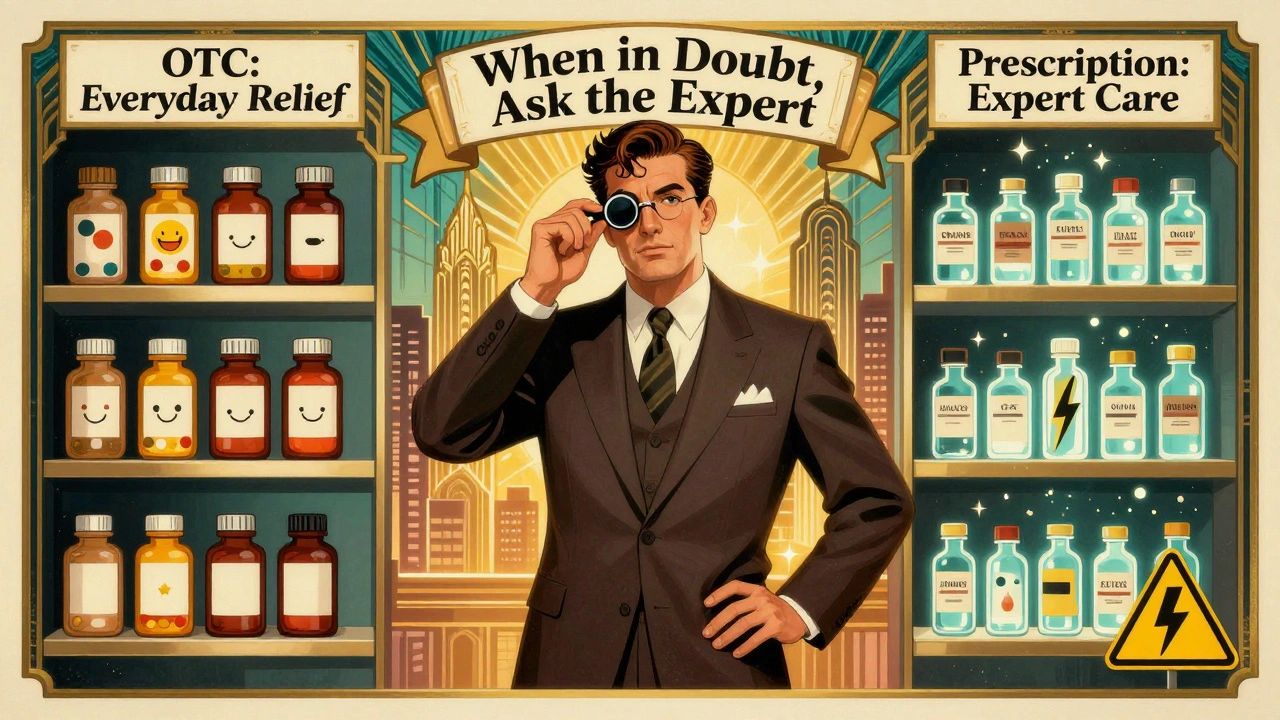
You don’t need to see a doctor for every sniffle. But you should talk to a pharmacist - they’re trained to help you pick the right OTC product, avoid dangerous combos, and know when to refer you to a doctor.
And if you’ve tried OTC meds for more than 7-10 days with no improvement, or your symptoms are getting worse - that’s your signal to seek care. Delaying can turn a simple issue into a complex one.
Medications aren’t just about what’s on the label. They’re about your body, your history, and your life. OTC drugs are powerful tools for everyday problems. But they’re not substitutes for medical care when you need it.
Can I switch from a prescription to an OTC version of the same drug?
Sometimes, but not always. For example, you can switch from prescription omeprazole to OTC omeprazole if you have occasional heartburn. But if you were on a higher dose or a special formulation for GERD, the OTC version may not be strong enough. Always check with your doctor or pharmacist before switching - even if the active ingredient is the same.
Are OTC medications safer than prescription ones?
Both are safe when used as directed. The difference isn’t safety - it’s risk level and who’s managing the treatment. Prescription drugs are for conditions that need oversight. OTC drugs are for short-term, low-risk symptoms. But misuse - like taking too much, using too long, or combining with other meds - can make any drug dangerous.
Why do some OTC drugs take longer to work than prescription ones?
Because they’re designed for safety, not speed. OTC versions often have lower doses or slower-release formulas so they don’t cause side effects if used incorrectly. For example, OTC esomeprazole takes 1-2 days to build up in your system. A prescription version might be stronger or faster-acting. That’s why people get frustrated - they expect instant relief from an OTC pill, but it’s meant to be used over time.
Is it okay to use OTC meds for migraines?
For mild to moderate migraines that happen less than 10 days a month, yes. OTC options like ibuprofen, naproxen, or acetaminophen with caffeine (Excedrin) can help. But if your migraines are severe, come with nausea or light sensitivity, or happen more than 10 days a month, you need prescription options like triptans. OTC meds often don’t work fast enough or strong enough for those cases.
Can I give my child my OTC painkiller?
No. Children’s dosing is based on weight, not age. A tablet that’s safe for you could be dangerous for a child. Always use products labeled for children and follow the dosing chart on the bottle. If you’re unsure, ask a pharmacist.
Eddy Kimani
December 2, 2025 AT 21:35Let’s be real - the OTC monograph system is a regulatory marvel, but it’s also a double-edged sword. The FDA’s framework allows for scalable safety, but it doesn’t account for pharmacogenomic variability. Two people taking the same 200mg ibuprofen may have wildly different CYP2C9 metabolism rates, leading to subtherapeutic or toxic plasma concentrations. We’re treating symptoms like they’re binary, when biology is a spectrum.
And don’t get me started on the ‘same active ingredient’ fallacy. Bioavailability, excipients, and release kinetics aren’t trivial. OTC famotidine is immediate-release; prescription versions often use enteric coatings or sustained-release matrices. The clinical outcome isn’t just about mg - it’s about kinetics.
Also, the shift toward OTC epinephrine auto-injectors? Brilliant. But without proper public education on anaphylaxis triggers and epinephrine’s narrow therapeutic window, we’re just distributing liability in plastic casings.
Pharmacists are the unsung heroes here. They’re the only clinicians trained to triage OTC vs Rx at the point of sale. We need more of them in retail, not fewer.
And yes - 7-10 days is a reasonable heuristic, but it’s not evidence-based. For migraines, if you’re hitting 8+ days/month, you’re already in chronic territory. Waiting for symptoms to ‘get worse’ is a dangerous delay tactic.
Bottom line: OTC isn’t ‘weaker’ - it’s ‘risk-optimized for the general population.’ But population averages don’t care about your genotype, your comorbidities, or your polypharmacy cocktail.
We need better labeling. Not just ‘for occasional use’ - but ‘if you’ve taken this 3x/week for 14 days and still have symptoms, you’re not managing - you’re masking.’
Carolyn Woodard
December 2, 2025 AT 22:19It’s fascinating how we’ve normalized self-diagnosis as a form of autonomy, when in reality, it’s often just avoidance.
We reach for OTC meds because we’re afraid of what a doctor might find. Or because we don’t want to face that our lifestyle - the caffeine, the sleep deprivation, the stress-eating - is the real culprit.
The OTC aisle is a mirror. It reflects our desire to fix things quickly, quietly, without having to change anything fundamental.
But medicine isn’t a vending machine. It’s a conversation - with your body, with your history, with someone who’s seen this before.
And yet… I get it. The system is broken. Co-pays are high. Wait times are long. So we patch ourselves with ibuprofen and antacids like we’re duct-taping a leaking pipe.
Maybe the real problem isn’t that people misuse OTC drugs - it’s that we’ve made healthcare feel like a luxury.
And that’s not a pharmacological issue.
It’s a moral one.
Allan maniero
December 4, 2025 AT 00:47Look, I’ve worked in a pharmacy for 17 years, and I’ve seen it all. People come in with a 12-pack of OTC omeprazole, say they’ve been taking two a day for six months, and then ask, ‘Why does my stomach still burn?’
I don’t judge. I just hand them a referral form and say, ‘You’ve been treating the symptom, not the cause.’
Same with the guy who’s been popping Excedrin every other day for migraines - turns out he’s got sleep apnea. Or the woman who’s been using hydrocortisone on her legs for ‘eczema’ - it’s actually psoriasis, and she needs a steroid cream that actually penetrates the skin.
OTC is great for a sprained ankle or a cold. But if you’re using it like a daily vitamin, you’re not being smart - you’re being desperate.
And don’t even get me started on people mixing NyQuil with Advil because ‘they both help.’
Listen - if you’re reading this and you’ve been taking something for more than two weeks without seeing a professional? Stop. Just stop. Go talk to someone. Even if it’s just a pharmacist. They’re not there to sell you stuff - they’re there to keep you alive.
Zoe Bray
December 4, 2025 AT 04:33It is imperative to recognize that the regulatory paradigm governing over-the-counter pharmaceuticals is predicated upon a risk-benefit calculus that prioritizes population-level safety over individualized therapeutic optimization.
Consequently, the pharmacokinetic and pharmacodynamic profiles of OTC formulations are deliberately constrained to mitigate potential for misuse, overdose, and adverse drug reactions in unsupervised settings.
That is to say: the lower potency, slower onset, and restricted dosing frequency are not indicative of inferior efficacy - they are intentional design features to preserve public health.
Moreover, the transition of certain prescription agents (e.g., esomeprazole, fexofenadine) into OTC status is not a dilution of medical authority - it is an evolution of patient empowerment, contingent upon robust labeling, accessible counseling, and pharmacovigilance infrastructure.
That said, the conflation of accessibility with appropriateness remains a pervasive and perilous cognitive bias.
Self-medication is not self-care.
It is, at best, a temporary palliative strategy - and at worst, a gateway to iatrogenic harm.
Pharmacists must be empowered as frontline clinical decision-makers - not merely dispensers of commodity medications.
Until then, we remain in a state of therapeutic ambiguity.
Girish Padia
December 4, 2025 AT 04:44People are dumb. They think if it’s on the shelf, it’s harmless. You take ibuprofen like candy, then wonder why your kidneys are messed up. You take antacids for years, then get osteoporosis. You think ‘natural’ means safe - nope. Just because it’s not prescription doesn’t mean it’s not poison.
And now they’re letting epinephrine pens be bought like candy? Great. Now the kids will play with them and die because mom didn’t know how to use it.
Stop pretending OTC is ‘empowerment.’ It’s laziness with a label.
Saket Modi
December 5, 2025 AT 21:24Ugh. Another ‘meds are complicated’ essay. Can we just say: if you feel bad for more than a week, go to the doctor? That’s it. No jargon. No monographs. Just… go.
Also, why does everyone act like pharmacists are wizards? They’re just the people who hand you the bottle. They don’t know your blood pressure or your meds. Just sayin’.
Also also: I take 2 Advil for my headache. I don’t need a lecture. 😒
Chris Wallace
December 6, 2025 AT 06:06I’ve been on a low-dose SSRI for anxiety for five years. My doctor switched me from prescription sertraline to OTC 5-HTP because ‘it’s natural.’ It didn’t work. I went back. He didn’t blink.
That’s the thing nobody talks about - doctors sometimes push OTC because they’re overworked, or because insurance won’t cover the Rx. Not because it’s better.
And then you get stuck in this loop: you’re told ‘try OTC first,’ but when OTC fails, you’re told ‘oh, we should’ve prescribed that earlier.’
It’s bureaucratic whiplash.
Also, I’ve had migraines since I was 16. I’ve tried every OTC combo. None worked. Triptans? Lifesaver. But I had to beg for them. Like I was asking for heroin.
Why does ‘first-line’ always mean ‘cheapest,’ not ‘most effective’?
william tao
December 6, 2025 AT 23:49Let me just say this - the FDA is asleep at the wheel.
OTC epinephrine? Brilliant? No. It’s a liability waiting to happen. People will buy it, never open the box, then panic when their kid swallows a peanut. They’ll freeze. They’ll misfire. They’ll call 911 and say ‘I used the pen… I think.’
And then the lawsuit comes. And the FDA gets blamed for letting ‘laypeople’ handle life-saving devices.
Also - ‘OTC is cheaper’? Ha. My insurance covers my 40mg Nexium for $5. OTC costs $28. So no - it’s not cheaper. It’s just marketed better.
And the fact that people think ‘same active ingredient’ = same effect? That’s not ignorance. That’s corporate propaganda.
Wake up. You’re being played.
Sandi Allen
December 7, 2025 AT 20:15THEY’RE HIDING SOMETHING! OTC drugs are NOT safe! I’ve read the studies - the FDA’s ‘monograph system’ is a backdoor for Big Pharma to push drugs without proper trials! They’re testing on unsuspecting Americans in Walmart! The same companies that gave us Vioxx are now selling OTC ibuprofen that causes silent heart damage! I’ve got 17 pages of documents from the NIH archive - they admit the 200mg dose is too high for long-term use! And they WON’T CHANGE THE LABEL BECAUSE THEY’RE AFRAID OF LOSING PROFITS!!
Also - did you know that hydrocortisone 1% can cause adrenal suppression? I’ve got a cousin who got hospitalized! They don’t tell you that on the bottle! WHY?!
THEY’RE LYING TO YOU. EVERY. SINGLE. DAY.
CALL YOUR CONGRESSMAN. SHARE THIS. THEY’RE COMING FOR YOUR MEDS NEXT.
John Webber
December 9, 2025 AT 00:41ok so i think otc stuff is fine for like a headache or a little heartburn but if its been going on for more than a week you prob should see a doc. i did that with my back pain and turned out i had a pinched nerve. took me 3 months to figure it out because i kept taking ibuprofen. dumb. also dont mix tylenol with cold meds. i did that once and my liver was mad. like, really mad. so yeah. just sayin’.
ps: i think the epinephrine pens are cool but like… can we have instructions on the box? like, how to use it? i dont wanna be the one who kills someone by accident.
Shubham Pandey
December 10, 2025 AT 17:12OTC works for minor stuff. If it doesn’t, see a doctor. Simple.
Stop overcomplicating.
Elizabeth Farrell
December 10, 2025 AT 23:31I want to say thank you for writing this - not just because it’s accurate, but because it’s kind.
So many people feel ashamed when they realize they’ve been masking symptoms instead of treating causes. They think, ‘I should’ve known better.’ But you didn’t - because the system doesn’t make it easy to know.
Pharmacists are your secret weapon. Go talk to one. Ask: ‘Is this right for me?’ They won’t judge. They’ll help.
And if you’ve been taking something for more than two weeks? That’s not a failure. It’s a signal. Your body is asking for help. Don’t ignore it.
You’re not lazy. You’re just trying to survive.
And you deserve care - not just a bottle from the shelf.
Sheryl Lynn
December 11, 2025 AT 11:41Oh, how quaint - another treatise on the ‘democratization’ of pharmaceuticals. As if putting epinephrine on a shelf turns the layperson into a competent emergency responder. How poetic.
It’s the same logic that led to the rise of ‘wellness influencers’ prescribing turmeric for cancer. The OTC aisle is the new altar of performative self-care - a temple built on convenience, branded with the logo of corporate benevolence.
And yet, the very act of calling it ‘empowerment’ is the most patronizing form of disempowerment.
You don’t empower someone by handing them a tool they don’t know how to wield - you endanger them.
Let’s stop romanticizing ignorance as autonomy.
Real empowerment requires education, access, and - dare I say - a licensed professional.
Paul Santos
December 11, 2025 AT 11:56Look, I’m a Brit, so I’m used to the NHS telling me what I can and can’t have. But this OTC shift? Honestly, it’s kind of genius. Epinephrine pens on the shelf? Yes please. I’d rather have a guy at the corner shop have one than wait 45 minutes for an ambulance because his kid ate a peanut.
And yeah, the ‘same ingredient’ thing - I used to buy OTC omeprazole until I realized I was taking 2x the dose just to match my prescription. Total scam.
But here’s the thing - most people aren’t trying to game the system. They’re just tired. Overworked. Broke. They don’t have time to see a doctor.
So yeah - OTC is a band-aid.
But sometimes, a band-aid is all you’ve got.
And that’s okay. 😊
Chelsea Moore
December 12, 2025 AT 10:22I CAN’T BELIEVE THIS POST ISN’T MORE OUTRAGED.
THEY’RE LETTING PEOPLE BUY EPINEPHRINE PENS LIKE THEY’RE CHOCOLATE BARS?!
WHAT IF A KID TAKES IT WHEN THEY’RE NOT ALLERGIC?!
WHAT IF SOMEONE USES IT FOR A ‘STRESS ATTACK’?!
AND WHY ISN’T THE FDA DOING MORE TO STOP THIS?!
THEY’RE LETTING BIG PHARMA TURN EMERGENCIES INTO COMMODITIES!
MY COUSIN’S DOG GOT INTO A PILL BOTTLE LAST WEEK - IMAGINE IF IT WAS AN EPI PEN?!
WE NEED TO BAN THIS NOW.
SHARE THIS. TAG YOUR SENATOR. #SAVEAMERICAFROMOTC
Eddy Kimani
December 12, 2025 AT 12:54Re: @5399 - you’re not wrong to be alarmed. But panic doesn’t fix policy. Education does.
Epinephrine auto-injectors are designed with safety locks, clear instructions, and audible clicks. They’re nearly impossible to misuse accidentally.
And here’s the real stat: 80% of anaphylaxis deaths occur because epinephrine was delayed - not administered incorrectly.
So yes, let’s teach people how to use them. Let’s put posters in schools, gas stations, restaurants.
But banning access? That’s not protection. That’s fear masquerading as safety.
And @5392 - no, the FDA didn’t skip trials. Fexofenadine and esomeprazole underwent 12+ years of post-marketing surveillance before OTC approval. The data is public.
Let’s fight misinformation with facts - not hashtags.